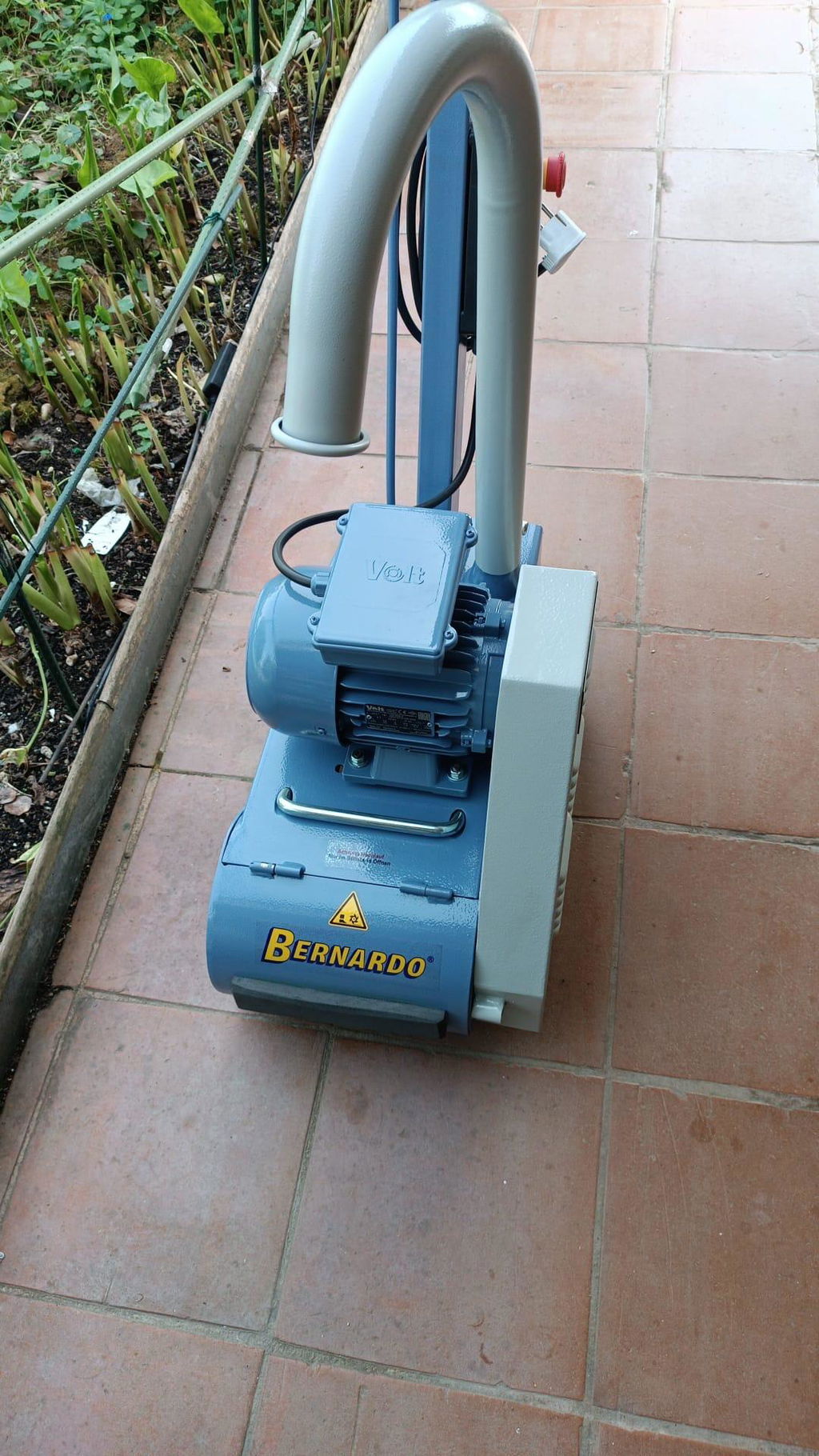

Best Wood Sanders 2026: Top 10 Ranking
|
|
Time to read 18 min

|
|
Time to read 18 min
A woodworking sander is a stationary workshop machine for finishing edges, surfaces, and profiles. There are five main types: belt, belt and disc, oscillating spindle, disc, and plate. Choosing the wrong one means wasting time, consuming abrasives, and getting mediocre results.
This ranking is based on 18 years of direct experience. Since 2007, Krollit has delivered over 10,000 machines to carpenters, artisans, and small businesses throughout Italy. We sell and ship these 10 sanders and receive real feedback from customers who use them every day. These are not reviews copied from a catalog.
I have selected 10 models from 3 European brands: Bernardo (Austria, founded in 1982), Record Power (United Kingdom, founded in 1899 in Sheffield), and Güde (Germany). Five types, ranging from €96 to €3,074. Here's the overview:
If you're in a hurry, here's the summary. If you want to understand the reasoning behind each choice, scroll down to the reviews below.
Best overall for edges and veneers: Bernardo KSM 3000 C (€3,074). The only one with an integrated veneering device and an oscillating belt with a dedicated motor.
Best for multi-material workshops: Bernardo HV 80 OSZI (€1,317). Works with wood, non-ferrous metals, glass, and plastic.
Best value for money belt sander: Bernardo HV 70 (€873). Also available in 230V, graphite included.
Best belt and disc combination: Bernardo BDSM 250 (€695). Cast iron base, complete equipment.
Quietest for contained noise: Record Power BDS250 (€560). Only 78 dB idle, well below the 87 dB limit of directive 2003/10/CE.
Best entry-level: Bernardo BDSM 150 N (€201). Cast iron structure at an unexpected price.
Best under €100: Güde GBTS 400 (€96). To explore stationary sanding without a big commitment.
Best for curved pieces: Bernardo OVS 80 (€544). The only oscillating spindle sander in the ranking.
Best disc sander: Record Power DS300 (€308). 305 mm cast iron disc, precise finishes.
Best for angles: Bernardo TS 300 Pro (€590). Inclination from -15° to +45°, the only one with negative.
The best professional belt sander is the Bernardo KSM 3000 C (€3,074.40). It is the only one on the market with an integrated veneering device and an oscillating belt measuring 3000 × 150 mm, driven by a dedicated separate motor of 0.25 kW, for a total main power of 3.0 kW.
If you work with veneers and need to switch from trimming excess to sanding solid wood without changing machines, this is the only one that does it really well. The veneering device with fine adjustment is standard, not an accessory to buy separately. This alone justifies the price difference.
The 20 mm oscillation with a separate motor is independent of the workload: the belt wears evenly even during heavy passes. The 960 × 350 mm work table adjusts in height up to 210 mm, and the sanding unit tilts from 90° to 45° for chamfered and radiused edges. The European standard EN 12750:2013, which sets safety requirements for belt sanders, is fully complied with.
Key specifications:
What I like: the transition from veneering to solid wood is quick. The dual dust extraction port Ø 80/100/120 mm keeps things clean even during heavy work. The 330 kg structure does not vibrate, period.
What to consider: it requires 400V three-phase power and space. With 1910 × 840 mm footprint, it's not a machine you move around. And €3,074 is only justified with continuous production.
Verdict: the mandatory choice for furniture manufacturers and joinery shops that work with veneers every day. If your work revolves around perfect edges, there's no compromise here.
The Bernardo HV 80 OSZI (€1,317.60) is the most versatile edge sander in the ranking: it works with solid wood, plastic, acrylic glass, and non-ferrous metals like aluminum and brass. Just mount abrasive fabric belts to switch from wood to metal on the same machine.
In my experience, this is the sander I've seen used in the most diverse situations. The cast iron table adjusts in height by 90 mm to utilize the full width of the 2510 × 150 mm belt. The miter gauge covers from -45° to +45° and oscillation is integrated: the belt wears evenly without you having to intervene.
Key specifications:
What I like: its versatility across materials makes it unique in this price range. The stand with a tool storage compartment is a practical detail that comes in handy in a workshop. The ratio between what it offers and its €1,317 price is fair.
What to consider: it requires 400V three-phase power. It doesn't have the veneering device of the KSM 3000 C (€3,074), so if your work is predominantly on veneers, that remains the better choice.
Verdict: if your workshop works with different materials and you need a serious belt sander without spending €3,000, the HV 80 OSZI is probably the right choice.
The Bernardo HV 70 (€873.52) is the best belt sander for value for money. It is the only one in the ranking available in both 230V single-phase and 400V three-phase versions, which makes it accessible even to those who don't have three-phase power in their workshop.
It's the sander I recommend most often to those making the leap from advanced hobbyist to semi-professional. The sanding unit works both horizontally and vertically, the tables tilt from 0° to 45°, and the graphite coating on the table improves gliding, reducing belt wear. With 86 kg and 1300 × 600 mm footprint, it fits even in small workshops.
Key specifications:
What I like: the 230V version opens doors to those without three-phase power. The graphite on the table is a detail usually found on more expensive machines. The equipment is complete: stand, miter gauge, auxiliary table, fence, and 60-grit belt included.
What to consider: it does not have belt oscillation (which you find on the HV 80 OSZI at €1,317), so the belt needs to be centered manually and wears less evenly. The speed of 13 m/s is adequate but lower than the 16-20 m/s of its larger siblings.
Verdict: at €873, it is the entry point into the world of proper belt sanders. For many carpenters, it's exactly what they need.
The best belt and disc combination sander is the Bernardo BDSM 250 (€695.75). With a cast iron base, 1220 × 150 mm belt, Ø 250 mm disc, and graphite coating, it is the most complete and solid 230V combination in the ranking.
Belt and disc combination sanders are the most popular woodworking machines in the sanders category, and I understand why: with one machine, you cover edges, flattening, and light shaping. The BDSM 250 offers the most in the 230V range.
The belt quickly switches from vertical to horizontal, with a table that tilts from 0° to 90°. The quick-release tensioner and spring system maintain constant tension, which those who frequently change belts appreciate. The grey cast iron base, which according to the ASM International Handbook has a vibration damping coefficient 6-10 times higher than steel, translates into more uniform finishes and longer-lasting belts.
Key specifications:
What I like: the complete equipment. Belt, disc, hook&loop backing pad, miter gauge, fence, graphite, and cast iron stand: you don't need to buy anything extra to start working.
What to consider: the belt speed of 8.5 m/s is adequate for finishing but not for heavy stock removal. If you primarily work on solid wood edges, a pure belt sander like the HV 70 (€873) works better for that type of task.
Verdict: the combination sander to have if you're looking for serious build quality at 230V. For the workshop that does a bit of everything – edges, flattening, light shaping – it's the right choice.
The quietest combination sander is the Record Power BDS250 (€560.56), with 78 dB(A) no-load and 84.2 dB(A) under load. For comparison, European directive 2003/10/CE sets the daily noise exposure limit in the workplace at 87 dB(A). The BDS250 remains below this even under load.
Record Power is a British brand with a solid reputation in woodworking for over 125 years. The BDS250 confirms why. If you work in a shared workshop, a basement, or simply care about your hearing, this difference is noticeable. Literally. Compare it to the 88 dB of the Güde GBTS 400: that's 10 dB less, which in terms of perception means about half the perceived volume.
Key specifications:
What I like: The quietness is real, not a marketing number. Record Power's build quality is what you'd expect from a brand specializing in woodworking since 1899. The 800 W motor handles load well.
What to consider: The basic equipment is more essential compared to the Bernardo BDSM 250 (€695). No graphite coating, no cast iron stand. It costs €135 less, but you might spend more on separate accessories.
Verdict: If noise is a factor, and it should be, the BDS250 is the choice. If you're interested in a complete package, the BDSM 250 offers more.
The best entry-level sander is the Bernardo BDSM 150 N (€201.30). At this price, it features a grey cast iron frame, a maintenance-free induction motor, a 915 × 100 mm belt, and a Ø 150 mm disc. It fits on any workbench with its 19 kg and 460 × 400 mm footprint.
I say this right away: don't expect what you find on the BDSM 150 N (€201) or the BDSM 250 (€695). But at this price, the 350 W motor drives a 915 × 100 mm belt and a Ø 150 mm disc with Velcro fastening for quick changes. The table tilts from 0° to 45°. With 12 kg, you can take it anywhere.
Key specifications:
What I like: Cast iron for €201. Period. The quick-release belt change is convenient even on a machine in this range. The package includes everything: 80-grit belt, 80-grit disc, hook&loop backing pad, miter gauge, and dust extraction nozzle.
What to consider: The 100 mm wide belt and 150 mm disc limit the size of workpieces. The 370 W power is not for aggressive stock removal. It's a finishing machine for small jobs.
Verdict: The right entry point into the world of stationary sanding. And if you later upgrade, it still remains useful as a secondary machine.
Yes, there is a good sander under €100. The Güde GBTS 400 (€96.00) is a functional belt and disc combination sander that works on wood, plastic, and light metal. It's not a professional machine, but for the hobbyist who wants to try stationary sanding without committing a large budget, it works.
I'll say it right away: don't expect what you find on the BDSM 150 N (€201) or the BDSM 250 (€695). But at this price, the 350 W motor moves a 915 × 100 mm belt and a Ø 150 mm disc with Velcro fastening for quick changes. The table tilts from 0° to 45°. At 12 kg, you can take it anywhere.
Key specifications:
What I like: The price. For less than €100, you get a functional combination sander. The Velcro on the disc is convenient for abrasive changes. The 12 kg makes it the most portable in this ranking.
What to consider: The belt speed (4.9 m/s) is less than half that of the BDSM 150 N (7.5 m/s). The 36 mm dust extraction port is limited. And 88 dB of noise exceeds the daily limit of directive 2003/10/CE: hearing protection is required for prolonged use.
Verdetto: The entry ticket to stationary sanding. If you get passionate about it, you'll upgrade to the BDSM 150 N or BDSM 250 within six months. But to see if it's for you, €96 is a risk worth taking.
To sand the inside of curves, profiles, and shapes, you need an oscillating spindle sander, and the Bernardo OVS 80 (€544.12) is the best available in 230V. The spindle oscillates vertically while rotating, preventing the burn marks typical of static sanding on curved pieces.
No belt or disc sander can do this job. If you produce furniture with curved lines, chairs, handrails, mouldings, or shaped components, this is the machine you're missing. The table tilts from 0° to 45°, and the 3 abrasive spindles included cover the most common sizes. The stand with accessory compartment keeps everything tidy.
Key specifications:
What I like: Solves a problem that the other 9 machines in the ranking cannot. At 230V, you can plug it in anywhere. The 3 spindles cover the most frequent tasks without additional purchases.
What to consider: It's a specialist machine. It doesn't replace a belt sander for straight edges or a combination sander for general use. Only buy it if you have a specific need to sand curves.
Verdict: Indispensable for those who work with shaped pieces. If you only make furniture with straight lines, you don't need it. But if you have curves in your work, after using it, you'll wonder how you ever managed before.
The best disc sander for wood is the Record Power DS300 (€308.82). The 305 mm (12") cast iron disc is its strong point: cast iron maintains balance better than aluminum and absorbs vibrations, ensuring uniform and precise finishes.
It is a pure disc sander, without a belt. The 435 × 165 mm table tilts up to 45° and the included miter gauge facilitates repetitive operations. The 750 W motor runs at a constant 1,420 rpm and the noise level remains below 85 dB, a good value for this type of machine.
Key specifications:
What I like: Cast iron disc at €308, it's rare. Rotational stability results in better finishes. Record Power is a guarantee in woodworking since 1899.
What to consider: It's only a disc, no belt. For long edges and large surfaces, you need another machine. The 57-63.5 mm dust extraction port might require an adapter for your dust extraction system.
Verdict: If you do a lot of flattening, chamfering, and precise angled work, the DS300 is the right specialist. As a standalone machine, it's limiting, but as a complement to a belt sander, it's perfect.
The Bernardo TS 300 Pro (€590.48) is the only plate sander in this ranking with negative table inclination: from -15° to +45°. That -15° may seem like a detail, but for specific bevels and angled work, it offers a possibility that others don't.
The grey cast iron table with T-slots accepts guides and accessories, the Ø 300 mm disc is balanced to reduce vibrations, and the integrated brake quickly stops the disc at the end of the operation. A safety plus that I always appreciate in the workshop. The 950 mm working height is ergonomic for prolonged work.
Key specifications:
What I like: The -15° inclination makes it unique. The cast iron with T-slots is solid and versatile. The disc brake provides tangible safety. Works on wood, metal, and plastic.
What to consider: It is currently on pre-order, please check availability. It remains a disc machine, not a combination with a belt.
Verdict: For those seeking precise angles and negative inclination, the TS 300 Pro is the choice. Integrated brake, cast iron with T-slot, and Ø 100 mm dust extraction complete a machine designed for the professional workshop.
A belt sander is made for long edges and surfaces: the continuous belt allows for uniform passes on large pieces. A disc sander excels at flattening, chamfering, and precise angles. If you need to do both, a combined belt and disc sander covers more tasks with a single machine.
If you're starting from scratch and don't yet know what you'll need, a combined sander is the safest choice. In this ranking, you'll find 4 models, from €96 to €695. If, however, you already know that your work is on edges, a pure belt sander (from €873 to €3,074) operates at another level. In the workflow, sanding comes after planing and, for panels, after calibration.
No, not always. In the ranking, 7 out of 10 models operate on single-phase 230V. Only the KSM 3000 C (€3,074), the HV 80 OSZI (€1,317), and a version of the HV 70 (€873) require 400V three-phase. The combined models, OVS 80, DS300, and TS 300 Pro, all work with a standard outlet.
Three-phase offers more efficient motors and higher torque. If you have the option to install it, it's an investment that pays off on all future machines you'll buy, not just sanders.
Gray cast iron dampens vibrations 6-10 times better than steel (source: ASM International Handbook). On a sander, this translates to more uniform finishes, longer-lasting belts, and less fatigue. In the ranking, 6 out of 10 models have cast iron components: BDSM 250, BDSM 150 N, BDS250, DS300, TS 300 Pro, and HV 80 OSZI. It's one of the reasons I recommend them over stamped sheet metal machines that cost similarly.
Yes, quite a lot. The oscillating belt moves laterally during rotation, distributing abrasive wear across its entire width. Result: the belt lasts longer and the finish is more uniform. The KSM 3000 C has a dedicated 0.25 kW motor for oscillation (the best), while the HV 80 OSZI integrates it into the system. The HV 70 doesn't have it, which is the main difference justifying the jump from €873 to €1,317.
It's more important than you think. Something many underestimate: hardwood dusts are classified as Group 1 carcinogens by IARC, and Legislative Decree 81/2008 (Consolidated Law on Health and Safety at Work) mandates dust extraction. It's not optional.
Connection diameters vary: Ø 36 mm on the GBTS 400, Ø 60 mm on BDSM models, Ø 100 mm on HV and TS 300 Pro, up to Ø 80/100/120 mm on the KSM 3000 C. Check compatibility with your dust extractor before purchase.
Belts, discs, and spare parts for all models are always available.
For roughing, start with 60-80 grit. For intermediate sanding, use 100-120 grit. For finishing before varnishing, go up to 150-180 grit. On a stationary sander, avoid grits above 220: they are more suitable for final manual sanding. The jump between grits should never exceed 50% (e.g., from 80 to 120, not from 80 to 180).
With normal use on solid wood, an 80-grit belt typically lasts 8-15 hours of actual work. Machines with oscillation (KSM 3000 C, HV 80 OSZI) wear the belt more uniformly, extending its lifespan by 30-40%. Resin and glue in the wood reduce durability — a belt cleaner for €27 can quadruple the yield.
Some models can. The HV 80 OSZI (€1,317) is also designed for non-ferrous metals like aluminum and brass, using abrasive fabric belts. The combined BDSM 250, BDSM 150 N, and GBTS 400 also work with plastic and light non-ferrous metals. For steel and ferrous metals, specific metal sanders are needed, with different belt speeds and abrasives.
Each model has a specific diameter connection: from Ø 36 mm (GBTS 400) up to Ø 120 mm (KSM 3000 C). Connect a flexible hose from the machine's connection to your chip extractor. For machines with a Ø 60 mm or larger connection, an extractor with a minimum flow rate of 500-800 m³/h is needed for effective extraction.
A belt sander sands edges and surfaces with manual passes — you control pressure and feed. A calibrating sander is an automatic machine that brings panels and boards to a uniform thickness using rollers. They are complementary: first, thickness is calibrated, then the finish is sanded.
It depends on the material and working pressure. On solid wood with 80 grit, a Ø 150 mm disc lasts 4-8 effective hours, a Ø 250-305 mm disc lasts 8-15 hours. Discs with hook & loop fastening (Velcro) can be changed in seconds. Always keep 2-3 different grits ready (80, 120, 180) to avoid interrupting work.
For joinery shops with intensive production and veneers, the KSM 3000 C is the benchmark at €3,074. Those seeking multi-material versatility will find the answer in the HV 80 OSZI at €1,317. For the first serious 230V purchase, the HV 70 at €873 offers the best value for money. Among the combined models, the BDSM 250 at €695 is the most complete, and the BDSM 150 N at €201 is the most honest for beginners. And the GBTS 400 at €96 proves that you can start without spending a fortune.
All models in the ranking are available in the wood sanders section with complete technical sheets and the option to request a quote.
If you work with wood and are also looking for the best table saws or the best combined woodworking machines, you can find our other rankings on the blog.
Ranking updated February 2025: Krollit, official distributor of Bernardo, Record Power, and Güde in Italy since 2007. Over 10,000 customers served.
Sandra Gaspar
Sandra Gaspar is the founder of Krollit. With a degree in Business Economics and over 18 years of experience in the industry, since 2007 she has been helping hobbyists, craftsmen, and industries choose the best machines for woodworking, metalworking, and sheet metal processing. Thanks to partnerships with leading international brands, she has built a network of over 10,000 professional clients across Europe.

100% Secure Payments
Klarna/Visa/Mastercard/PagoLight