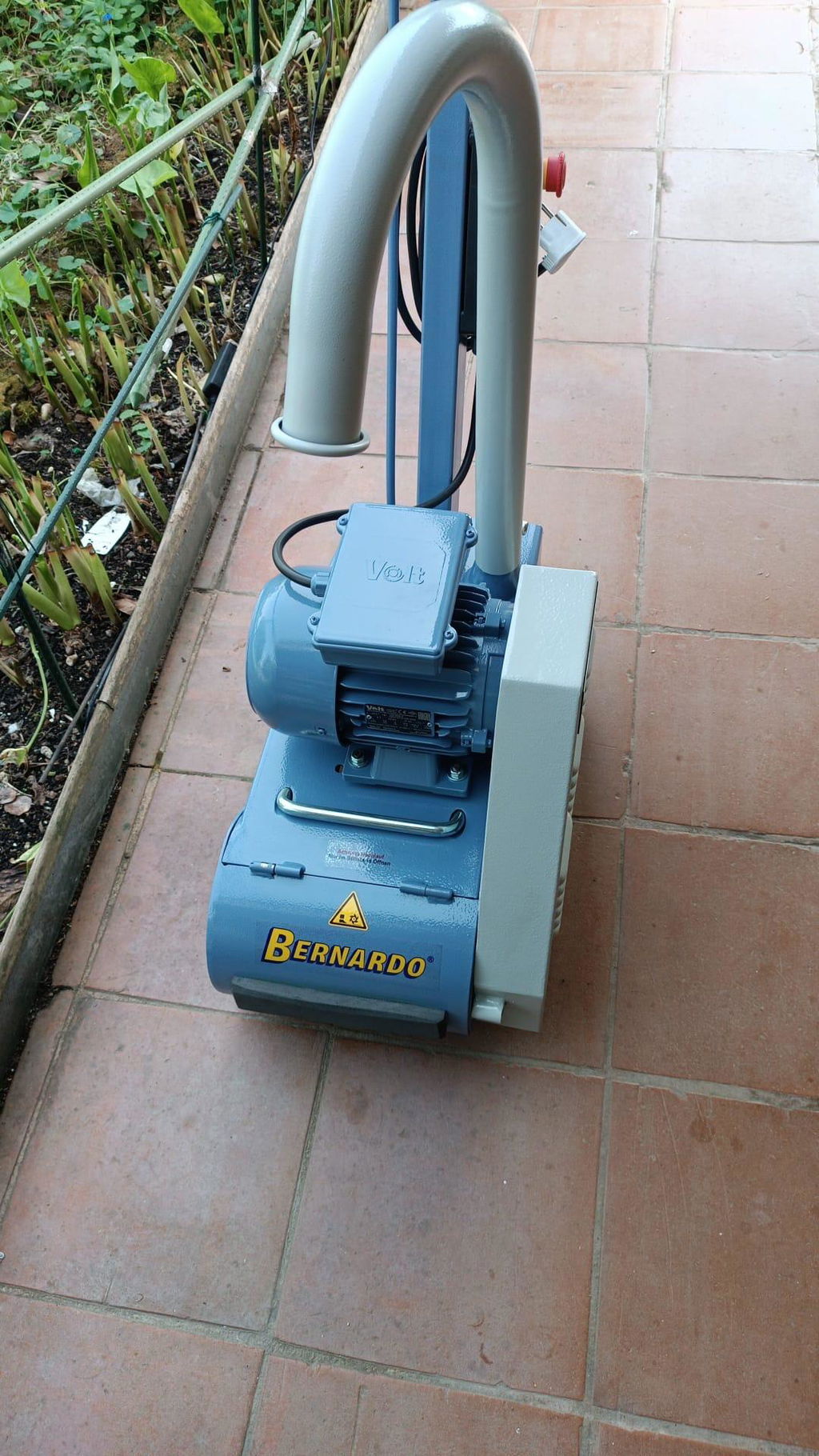


The panel saw for wood is a fundamental tool for professional carpentry workshops. This guide analyzes the 10 best panel saws available on the Italian market, selected for their quality-price ratio, technical characteristics, and reliability.
The 10 Best Wood Panel Saws
1. Bernardo FKS 1250 N Panel Saw - Best Entry Level
Technical specifications
- Sliding table: 1250 mm anodized aluminum
- Blade: Ø 254 mm tiltable 0-45°
- Table: ground cast iron
- Power supply: 230V single-phase, 1.8 kW
- Micrometric parallel fence
- Weight: 180 kg
Why choose it
Entry-level panel saw with excellent value for money. 1250 mm carriage for cuts up to 120 cm, cast iron table for stability, standard single-phase power supply. Ideal for starting craftsmen and small carpentry shops.
Advantages
- Single-phase power supply
- Stable cast iron table
- Compact dimensions
- Affordable price
Limitations
- Carriage limited to 120 cm
- Motor not for intensive use
- Scoring saw not included
2. Bernardo STS 1300 eco - Best Value for Money
Technical specifications
- Sliding table: 1300 mm
- Blade: Ø 254 mm
- Motor: 2.2 kW, 230V single-phase
- Structure: cast iron and steel
- Table support rollers
- Integrated dust extraction
Why choose it
"Eco" version of the STS series with professional performance at a contained price. More powerful 2.2 kW motor, support rollers, integrated dust extraction. Perfect for daily use in artisanal carpentry.
Advantages
- Excellent value for money
- Robust structure
- Panel support rollers
- 2.2 kW motor
Limitations
- Basic accessories
- 1300mm carriage
3. Bernardo FKS 1600 N - The Most Versatile
Technical specifications
- Sliding table: 1610 mm
- Blade: Ø 254 mm
- Power supply: 230V, 2.0 kW
- Table: precision ground cast iron
- Quick carriage locking
- Weight: 200 kg
Why choose it
1610 mm carriage covers 80% of professional needs. Precision ground table, quick locking for serious production, durable Bernardo construction.
Advantages
- Versatile 1610mm carriage
- High precision table
- Quick locking
- Single-phase power supply
Limitations
- Medium-high price
- Weight 200kg
- Scoring saw not included
4. Bernardo STS 1600 / 230V - Powerful Single-Phase
Technical specifications
- Carriage: 1600 mm
- Blade: Ø 315 mm (large)
- Motor: 3.0 kW single-phase
- Cutting depth: 100 mm at 90°
- Table: cast iron
- Tilt: 0-45°
Why choose it
Unique with Ø 315mm blade and single-phase power. Cuts panels up to 100mm thick and solid wood without needing three-phase. Maximum versatility for mixed panel-solid wood carpentry.
Advantages
- 315mm blade in single-phase
- 100mm cutting depth
- Powerful 3.0 kW motor
- Versatile for panels/solid wood
Limitations
- Higher price
- High energy consumption
- Noisier
5. Bernardo TK 315 P - 1600 - With Scoring Saw
Technical specifications
- Carriage: 1600 mm aluminum
- Main blade: Ø 315 mm
- Scoring saw: Ø 120 mm integrated
- Motor: 3.0 kW three-phase 400V
- Telescopic fence
- Double dust extraction
Why choose it
Integrated scoring saw eliminates chipping on veneered and melamine panels. Essential for kitchen and cabinet production where a perfect finish is needed. 315mm blade for cutting depth.
Advantages
- Integrated scoring saw
- Chip-free cuts
- 315mm blade
- Telescopic fence included
Limitations
- Requires three-phase 400V
- Medium-high price
- Precise scoring saw adjustment
6. Bernardo Basic 2000 Pro - Complete Professional
Technical specifications
- Carriage: 2000 mm aluminum
- Blade: Ø 315 mm
- Motor: 4.0 kW three-phase 400V
- Central support roller
- Integrated scoring saw
- Digital angle display
- Table extensions
Why choose it
2-meter carriage for panels up to 190cm. Central roller facilitates sliding heavy panels, standard scoring saw, digital display. Perfect balance of performance-price for professional carpentry shops.
Advantages
- 2000mm carriage
- Standard scoring saw
- Digital display
- 4.0 kW motor
- Central roller
Limitations
- Requires three-phase
- Significant footprint
- Weight 280kg
7. Bernardo FKS 1600 Pro - Compact High-End
Technical specifications
- Carriage: 1600 mm
- Blade: Ø 315 mm
- Table: laser-ground cast iron
- Telescopic fence
- Micrometric locking
- Three-phase 400V
Why choose it
Professional performance in compact dimensions. Laser-ground table for maximum precision, 315mm blade, optimized zero-vibration structure. Ideal for workshops with limited space.
Advantages
- Compact
- Laser-ground table
- 315mm blade
- Zero vibration
Limitations
- 1600mm carriage
- Optional scoring saw
- Requires three-phase
8. Bernardo Basic 2600 Pro - For Large Panels
Technical specifications
- Sliding table: 2600 mm
- Blade: Ø 315 mm
- Motor: 4.0 kW three-phase
- Integrated scoring saw
- Table extensions
- Digital telescopic fence
- Support rollers
- Weight: 320 kg
Why choose it
2600mm sliding table for panels up to 250cm (sliding doors, boiserie). Full support table extensions, digital fence, enhanced dust extraction. For specialized woodworking shops dealing with large panels.
Advantages
- 2600mm sliding table
- Professional scoring saw
- Digital readout
- Complete extensions
Limitations
- Footprint 5+ meters
- Weight 320kg
- High price
9. Procut 3200 - Digital Innovation
Technical specifications
- Sliding table: 3200 mm
- Blade: Ø 315mm (400mm optional)
- Touchscreen display
- Electronic height adjustment
- Motorized scoring saw
- Digital encoder
- 99 memory programs
- Motor: 5.5 kW three-phase
Why choose it
Advanced digital technology: touchscreen for precise angles, 99 program memory, electronic adjustment. Maximum productivity for repetitive production and woodworking shops with multiple operators.
Advantages
- Touchscreen display
- 99 program memory
- Electronic adjustment
- 3200mm sliding table
- Digital encoder
Limitations
- High price
- Requires training
- Complex maintenance
10. Bernardo Classic 3200 C - Absolute Top Model
Technical specifications
- Sliding table: 3200 mm aeronautical aluminum
- Blade: Ø 400 mm
- Scoring saw: Ø 150 mm dedicated motor
- Main motor: 5.5 kW three-phase
- Table: Meehanite cast iron
- Ball recirculation bearings
- Double arm fence
- Industrial dust extraction 2 points
- Weight: 450 kg
Why choose it
Absolute excellence from Bernardo for top woodworking shops and small industries. 400mm blade cuts up to 130mm deep, independent scoring saw, anti-vibration Meehanite table, CNC bearings. Designed for 10 hours/day for decades.
Advantages
- 400mm blade (130mm cut)
- Independent scoring saw
- 3200mm sliding table
- Decades of durability
- Ball bearings
Limitations
- Significant investment
- Requires dedicated space
- Weight 450kg
Buying Guide
Sliding Table Length
1200-1300mm: Small woodworking shops, max 120cm panels 1600mm: Versatile, covers 80% of needs (max 160cm) 2000-2600mm: Large panels, doors, boiserie (max 250cm) 3000-3200mm: Industrial workshops, any size
Rule: Choose a sliding table 10-15cm longer than the largest panel you usually cut.
Blade Diameter and Cutting Depth
Ø 254mm: 80mm depth (standard panels) Ø 315mm: 100mm depth (thick panels, solid wood) Ø 400mm: 130mm depth (beams, special materials)
A large blade is needed for: solid wood, plywood >22mm, angled cuts on thick materials, maximum versatility.
Power Supply: Single-Phase vs Three-Phase
Single-phase 230V
- Pros: Widely available, no adjustments, plug & play
- Cons: Max 3 kW, less suitable for intensive use
- Ideal: Small woodworking shops, individual craftsmen, limited budget
Three-phase 400V
- Pros: Power 4-5.5+ kW, efficient motors, intensive use
- Cons: Requires installation (€1000-2000)
- Ideal: Professional woodworking shops, daily use, machines >3kW
Scoring Saw: When is it Needed?
A scoring saw is a second blade (Ø 120mm) that scores 1-2mm before the main blade, eliminating chipping.
Needed for:
- Melamine panels
- HPL laminates
- Laminated panels
- Coated MDF
- Kitchen/cabinet production
Not needed for:
- Only solid wood
- Raw plywood
- Rustic work
- Limited budget
Professional Features
Cast iron table: Stability, flatness, durability, vibration absorption. Essential for daily use.
Telescopic fence: For panels >150cm, supports material along its entire length, eliminates flexing.
Sliding table locking: For repetitive cuts and series production, increases operational speed.
Dust extraction: Keeps the area clean, improves visibility, protects operator health.
Space and Installation
Required space (example 1600mm sliding table):
- Length: 4-4.5 meters
- Width: 2.5-3 meters
- Height: min 2.5 meters
Formula: Length = Sliding Table + 2m | Width = Table + 1.5m
Requirements:
- Flat floor (tolerance 3mm/meter)
- Adequate power supply
- Dust extractor connection
- Lighting 500+ lux
Budget and Costs
Initial costs:
- Machine: €1,900 - €6,000
- Shipping: €150 - €400
- Installation: €200 - €500
- Accessories: €200 - €800
- Electrical upgrade: €0 - €2,000 Total: €2,500 - €9,000
Annual costs:
- Energy: €150 - €400
- Blades: €100 - €300
- Maintenance: €100 - €250
- Consumables: €50 - €150 Total: €400 - €1,100
ROI: 6-36 months depending on usage. If you previously outsourced at €20-30/sheet × 10-15 sheets/month = savings of €2,400-€5,400/year.
Comparison Table
Model
Sliding Table
Blade
Power Supply
Scoring Saw
Price
Ideal for
| FKS 1250 N | 1250mm | 254mm | 230V | No | €1,943 | Entry level |
| STS 1300 eco | 1300mm | 254mm | 230V | No | €1,976 | Craftsmen |
| FKS 1600 N | 1610mm | 254mm | 230V | No | €2,428 | Versatility |
| STS 1600 230V | 1600mm | 315mm | 230V | No | €2,647 | Powerful single-phase |
| TK 315 P 1600 | 1600mm | 315mm | 400V | Yes | €2,904 | With scoring saw |
| Basic 2000 Pro | 2000mm | 315mm | 400V | Yes | €3,111 | Professional |
| FKS 1600 Pro | 1600mm | 315mm | 400V | No | €3,282 | Compact top model |
| Basic 2600 Pro | 2600mm | 315mm | 400V | Yes | €3,465 | Large panels |
| Procut 3200 | 3200mm | 315mm | 400V | Yes | €5,120 | Digital |
| Classic 3200 C | 3200mm | 400mm | 400V | Yes | €5,941 | Absolute top model |
Frequently Asked Questions
Difference between a panel saw and a circular saw?
A panel saw has a sliding table with precision guides where you place the panel. With a circular saw, the piece remains stationary. A panel saw offers: greater precision, safety (hands away from the blade), ease of use, repeatability. For professional work on panels, a panel saw is superior.
How many teeth should the blade have?
- 24-40 teeth: Solid wood, fast cuts
- 40-60 teeth: General use, panels, plywood
- 60-80 teeth: Laminated panels, finishes
- 80-100 teeth: HPL laminates, delicate materials
Professional: 1 x 40-tooth blade + 1 x 80-tooth blade.
Is single-phase or three-phase better?
Single-phase for: small workshop, limited budget, non-intensive use, max 3kW Three-phase for: professional woodworking shop, daily use, machines >3kW, if already available
How long does a panel saw last?
With proper maintenance:
- Frame/table: 30+ years
- Motor: 15-20 years
- Bearings: 10-15 years
- Belts: 3-5 years
What maintenance is required?
Daily (5min): Table cleaning, blade check Weekly (15min): Guide lubrication, dust extraction cleaning Monthly (30min): Alignment check, motor cleaning Annually (1-2h): Bearing check, parallelism verification
Cost: €100-250/year for materials.
Can I install it myself?
Up to 200kg: Possible with 2-3 people + pallet truck + jacks + spirit level Over 200kg: Professional assistance recommended (€300-800)
How much power is needed?
Single-phase 230V:
- 1.8 kW = 8-9A (16A socket OK)
- 2.2 kW = 10-11A (dedicated socket)
- 3.0 kW = 13-14A (dedicated line)
Three-phase 400V:
- 4.0 kW = 6A per phase
- 5.5 kW = 8A per phase
Can blades be sharpened?
Yes, carbide-tipped blades can be sharpened 5-8 times.
Sharpening costs:
- Ø 254mm: €15-25
- Ø 315mm: €20-30
- Ø 400mm: €30-40
Sharpen every 50-80 hours of intensive work.
What does the price include?
Included: Assembled machine, parallel fence, CE guards, manual, warranty Not included: Shipping, installation, extra blades, dust extractor, extra extensions
Always check the equipment before purchase.
Which Panel Saw to Choose
For most artisan woodworking shops, the FKS 1600 N (€2,428) or the STS 1600 230V (€2,647) offer the best compromise: 1600mm sliding table for panels up to 160cm, single-phase power, Bernardo construction. If you work with laminated or melamine panels, add €300-500 for a model with a scoring saw like the TK 315 P (€2,904).
Higher budget? The Basic 2000 Pro (€3,111) includes everything: 2-meter sliding table, scoring saw, digital display, central roller. This is the panel saw we recommend for those who want to buy once and not think about it for 20 years.
In the complete wood panel saw collection you will find all 32 Bernardo and Record Power models with technical specifications, updated prices, and immediate availability.
Unsure which model to choose? Contact our team at +39 0825-1494022: we'll help you find the right panel saw for your workshop.
FAQs
New or used panel saw: which is better?
A used brand-name panel saw (SCM, Altendorf, Felder) costs €2,000-4,000 but requires checking alignments, bearings, and guides. For a new entry-level Bernardo, prices start at €1,943 with a 24-month warranty and assistance. If you lack experience evaluating used machinery, new equipment helps you avoid surprises.
How much space does a panel saw need?
Calculate: carriage length + 2 meters × table width + 1.5 meters. For a 1600 mm carriage, you need at least 4×2.5 meters. For a 3200 mm carriage, you need 5.5×3 meters. Also consider space for loading and unloading panels.
Can I cut plastic and aluminum with a panel saw?
Yes, with specific blades and reduced speed. For plastic (plexiglass, PVC), use fine-toothed blades (80+ teeth) and low speed to prevent material melting. For thin aluminum (up to 3 mm), use blades for non-ferrous metals. For thicker materials, a dedicated metal saw is better.

Sandra Gaspar
Sandra Gaspar is the founder of Krollit. With a degree in Business Administration and over 18 years of experience in the sector, since 2007 she has been helping hobbyists, artisans, and industries choose the best machines for woodworking, metalworking, and sheet metal working. Thanks to partnerships with leading international brands, she has built a network of over 10,000 professional clients throughout Europe.