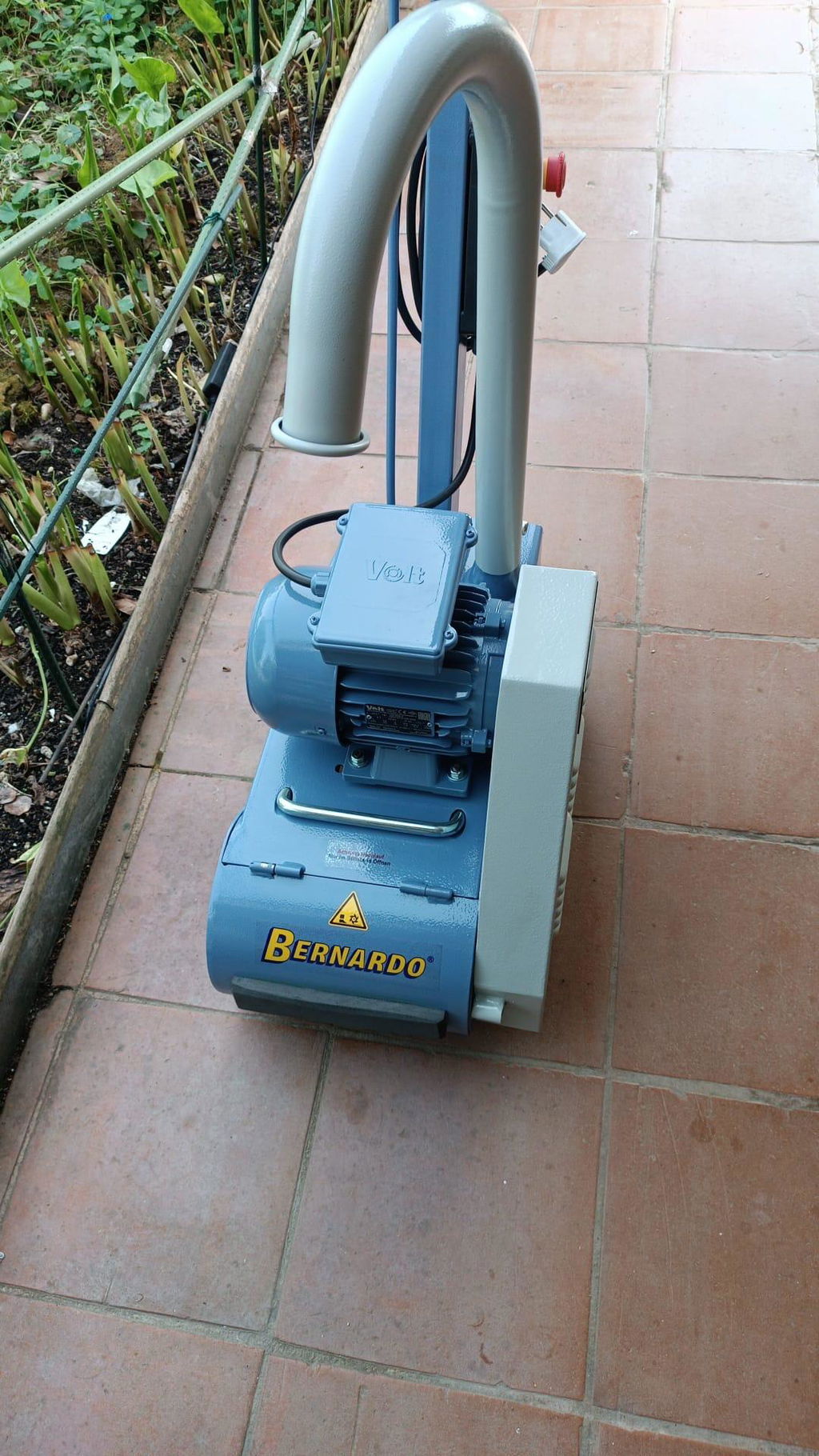


This comparison separates powered Bernardo dust extractors from passive Record Power pre-separators; they are not interchangeable.
This ranking analyzes 10 models with verified technical specifications, ordered by application: first models for woodworking, then those for metalworking.
Table of Contents
Cyclonic Technology: Why It Surpasses Traditional Systems
A cyclonic extractor utilizes centrifugal force to separate chips and coarse dust before they reach the filter. Air enters the cylinder tangentially, heavy residues fall into the container below due to inertia, and purified air passes to the fine filter.
Practical Difference: A traditional dust collector sends everything to the filter, which clogs in 20-40 hours of operation. A cyclone keeps the filter clean 5-8 times longer. Result: constant flow, zero suction drops during the workday.
When Needed: If you connect planers, sanding machines, or table saws that produce large volumes of chips, a cyclone is essential. For sanding machines with fine dust only, consider models with an integrated HEPA filter.
Cyclonic Extractor Ranking 2026
1. Bernardo RLA 2700
Bernardo RLA 2700: powered 400 V cyclone dust extractor with declared airflow of 2,700 m³/h and maximum suction pressure of 2,800 Pa. Size the installation appropriately.
2. Record Power Defender 55 L
Record Power Defender Interceptor 55 L: passive Ø100 mm cyclone pre-separator without a motor. Requires a compatible external extractor.
3. Record Power Defender 150 L
Record Power Defender Interceptor wall-mounted 150 L: passive Ø100 mm pre-separator requiring an external extractor.
4. Bernardo RLA 1800 / 400V – Professional Entry-Level
Price: €1,415.20
Ideal for: small woodworking shops, artisans with 1-2 machines
Dual filtration system (cyclone + cartridge) for woodworking. The steel plate structure eliminates vibrations typical of plastic housings. Y-adapter included for connecting two machines simultaneously.
Specifications: dual filtration, aerodynamic steel impeller, cartridge filter with cleaning brushes, fan resistant to small wood pieces.
Key Feature: Accessible price with true cyclonic technology – not just a simple dust collector with a "cyclone effect."
5. Bernardo RLA 2000 / 400V – Automation with Timer
Price: €1,600-1,900 range
Ideal for: workshops with multiple stations, programmed use
Enhanced version of the RLA 1800 with adjustable timer and remote control. Connects up to three machines simultaneously. Automatic on/off synchronized with machines reduces energy consumption by 30-40%.
Specifications: dual filtration, timer + remote control, 3 machine connections, level control window.
Key Feature: The remote control avoids walking back and forth to turn on the extractor – real time savings in the workshop.
6. Bernardo RLA 1900 / 400V – Continuous Operation
Price: €1,500-1,700 bracket
Ideal for: continuous daily use, 6-8 hours/day
Polyester cartridge filter designed for extended cycles. The robust structure reduces mechanical load on the housings, extending service life. Aerodynamic steel impeller for constant flow even after years of use.
Specifications: double filtration, polyester filter, aerodynamic steel impeller, fine dust cleaning brushes.
Strong point: designed for those who turn on the extractor at 8 am and turn it off at 6 pm.
7. Bernardo RLA 1500 / 400V – Minimum Budget
Price: €1,100-1,300 bracket
Ideal for: advanced hobbyists, small artisan workshops
Same double filtration system as the RLA series but in a compact version. Adapter for two machines included. Unbeatable performance/cost ratio for beginners or those with smaller volumes.
Specifications: sheet steel structure, double filtration, polyester cartridge filter, durable fan.
Strong point: Bernardo cyclonic technology at the price of a traditional mid-range chip extractor.
8. Bernardo RLA 3700 – Maximum Bernardo Performance
Price: €2,800-3,200 bracket
Ideal for: industrial joineries, automated production lines
Flow rate 3700 m³/h with maximum depression 2800 Pa – centralized system figures in a mobile system. Three Ø100mm connections for simultaneous connection to band saws, planers, and sanders. Automatic filter cleaning with serial manometer for flow control.
Specifications: 3700 m³/h, 2800 Pa, 3×Ø100mm, 4.32 m² filter, 290L bag, 240L container, automatic cleaning, remote control + timer.
Strong point: the serial manometer signals when the flow drops below the minimum threshold – integrated predictive maintenance.
9. Bernardo FSG 1000 – Specific for Metal
Price: €800-1,100 bracket
Ideal for: grinders, surface grinders, metalworking
Filtration device for fine metal dust without independent drive. 118-liter tank with trolley for easy emptying. Connection to systems with a minimum motor power of 1.5 HP.
Specifications: 118L tank with trolley, 2-machine connection, scratch-resistant coating, inspection window.
Attention: designed exclusively for metal dust – do not use for wood.
10. Bernardo FSG 1100 – Metal with Quick Change
Price: €900-1,200 bracket
Ideal for: mechanical workshops with frequent material changes
Evolution of the FSG 1000 with an extendable collection container for quick bag replacement. Same technical capabilities but 50% reduced bag change time.
Specifications: 118L tank, extendable container, Y-manifold, scratch-resistant powder coating.
Strong point: the extendable container allows for changing the bag without disassembling components.
How to Choose: Flow Rate, Filtration, Power Supply
Calculate Required Flow Rate
Each machine requires a specific minimum flow rate:
Jointer/Planer: 500-800 m³/h
Band Saw: 400-600 m³/h
Sander: 800-1200 m³/h
Circular Saw: 300-500 m³/h
To connect multiple machines simultaneously, sum the flow rates and add a 20% margin. Example: planer (700) + band saw (500) + 20% = 1440 m³/h minimum.
Filtration Level
This comparison separates powered Bernardo dust extractors from passive Record Power pre-separators; they are not interchangeable.
Electrical Power Supply
Bernardo RLA models require 400V three-phase. If you don't have three-phase, the options are:
This comparison separates powered Bernardo dust extractors from passive Record Power pre-separators; they are not interchangeable.
Frequently Asked Questions
What is the difference between a one-stage and a two-stage cyclone?
This comparison separates powered Bernardo dust extractors from passive Record Power pre-separators; they are not interchangeable.
How often should I replace the filter?
This comparison separates powered Bernardo dust extractors from passive Record Power pre-separators; they are not interchangeable.
Can I connect a cyclonic dust collector for wood to metalworking machines?
No. Metal dust requires specific filters and explosion-proof systems. Use only FSG 1000/1100 for metal. Mixing the two types of dust is dangerous and invalidates the warranty.
How much space is needed?
This comparison separates powered Bernardo dust extractors from passive Record Power pre-separators; they are not interchangeable.
Which model for starting with a limited budget?
RLA 1500 (from €1,100) if you have three-phase power. If you only have 230V, consider traditional DC 400 chip extractors (€400-500) and plan for a cyclone upgrade as you grow.
Decision Summary
This comparison separates powered Bernardo dust extractors from passive Record Power pre-separators; they are not interchangeable.
Limited budget: Bernardo RLA 1800 (€1,415) – double cyclone+cartridge filtration, professional structure.
This comparison separates powered Bernardo dust extractors from passive Record Power pre-separators; they are not interchangeable.
High flow rates: Bernardo RLA 3700 (€2,800-3,200) – 3700 m³/h, 3 connections, automatic cleaning.
Metalworking: Bernardo FSG 1000/1100 (€800-1,200) – unique models specific for metal dust.