

Building a DIY wooden staircase requires careful planning, suitable materials, and the right tools. The fundamental steps are: measuring the height between the two floors, calculating the number and dimensions of the steps using the formula 2R + T = 63 cm, cutting stringers and treads with a table saw, assembling the structure, and finishing with a planer and sander. In this guide, you will find detailed instructions for indoor, outdoor, ladder, and loft stairs.
Building a wooden staircase is an ambitious project but within reach for those with good manual skills and the appropriate tools. According to DIY industry statistics, 68% of domestic woodworking projects involve structural elements such as stairs, lofts, and canopies. With over 17 years of experience in distributing woodworking machinery, Krollit has assisted thousands of hobbyists and professionals in carrying out such projects.
What types of wooden stairs can you build?

A wooden staircase can be built in various configurations, each suitable for specific space requirements, usage, and budget. The choice depends on the intended use, available space, and the builder's skill level.
The main types are:
- Single-flight stairs: The simplest to build, ideal for height differences up to 280 cm. Requires a linear development of at least 350-400 cm.
- Two-flight stairs with landing: Necessary when linear space is insufficient. The intermediate landing allows for a change of direction at 90° or 180°.
- Ladder stairs: Perfect for lofts, bunk beds, and occasional access. Simpler construction, takes up very little space.
- Wooden spiral staircase: The ultimate space-saving solution, but requires advanced carpentry skills and complex geometric calculations.
- Outdoor stairs: Requires treated wood to withstand weather conditions (larch, Douglas fir, or pressure-treated wood).
How to calculate the measurements for a wooden staircase?

Calculating measurements is the most critical step in building a wooden staircase. An error of even a few millimeters will multiply with each step, compromising safety and comfort. The fundamental rule is Blondel's formula: 2R + T = 63 cm (where R is the riser and T is the tread), which ensures an ergonomic and safe stride.
Standard measurements for wooden staircase steps
Parameter
Recommended measurement
Acceptable range
| Riser (step height) | 17 cm | 15-19 cm |
| Tread (step depth) | 29 cm | 25-32 cm |
| Stair width | 80 cm | 60-120 cm |
| Tread thickness | 3-4 cm | Minimum 3 cm |
| Stringer thickness | 5-6 cm | Minimum 4 cm |
| Optimal inclination | 35-38° | 30-45° |
| Handrail height | 90-100 cm | Minimum 90 cm |
How to calculate the number of steps
To calculate how many steps you need, divide the total height between the two floors by the desired riser height. For example, for a height difference of 280 cm with a 17 cm riser, you will need about 16-17 steps (280 ÷ 17 = 16.47). Round to the nearest whole number and recalculate the exact riser height: 280 ÷ 17 = 16.47 cm per step.
The length development is calculated by multiplying the number of steps by the tread depth: 16 × 29 cm = 464 cm of horizontal space. If you do not have this space available, you will need to plan for a two-flight staircase with an intermediate landing.
Which wood to choose for building a staircase?

The ideal wood for building a staircase must be resistant, dimensionally stable, and have a moisture content between 8% and 12%. The choice of material directly affects the durability, safety, and aesthetics of the finished staircase.
Wood type
Janka Hardness (N)
Recommended use
Price range
| Oak | 6,000 | High-quality interior stairs, high wear resistance | €€€ |
| Beech | 5,800 | Treads and steps, excellent value for money | €€ |
| Laminated beech | 5,800 | Stringers and supporting structure, very stable | €€ |
| Larch | 3,500 | Outdoor stairs, naturally weather resistant | €€ |
| Fir | 2,200 | Ladder stairs, low-traffic stairs, light structures | € |
| Pine | 3,000 | Loft stairs, moderate use | € |
Practical advice: For the load-bearing stringers, always use laminated timber. It is more stable than solid wood, does not warp over time, and offers superior structural strength. For the treads, laminated beech is the most popular choice: it resists foot traffic well and has an elegant appearance.
What tools are needed to build a wooden staircase?
Building a wooden staircase requires precision tools for cutting, planing, drilling, and assembly. The quality of the tools directly affects the accuracy of the final result: professional machines ensure clean cuts, smooth surfaces, and perfect joints.
Essential tools
- Table saw: for precise longitudinal cuts on stringers and treads. Essential for exact angles and repeatable cuts.
- Wood bandsaw: perfect for curved cuts and shaping, useful for making winder steps and connections.
- Jointer-planer: to bring boards and stringers to the desired thickness and obtain perfectly flat and parallel surfaces.
- Wood router: essential for creating the dadoes for the treads in the stringers (dovetail or shoulder joint routing).
- Drill press: for precise and perpendicular drilling, necessary for fastening pins and structural connections.
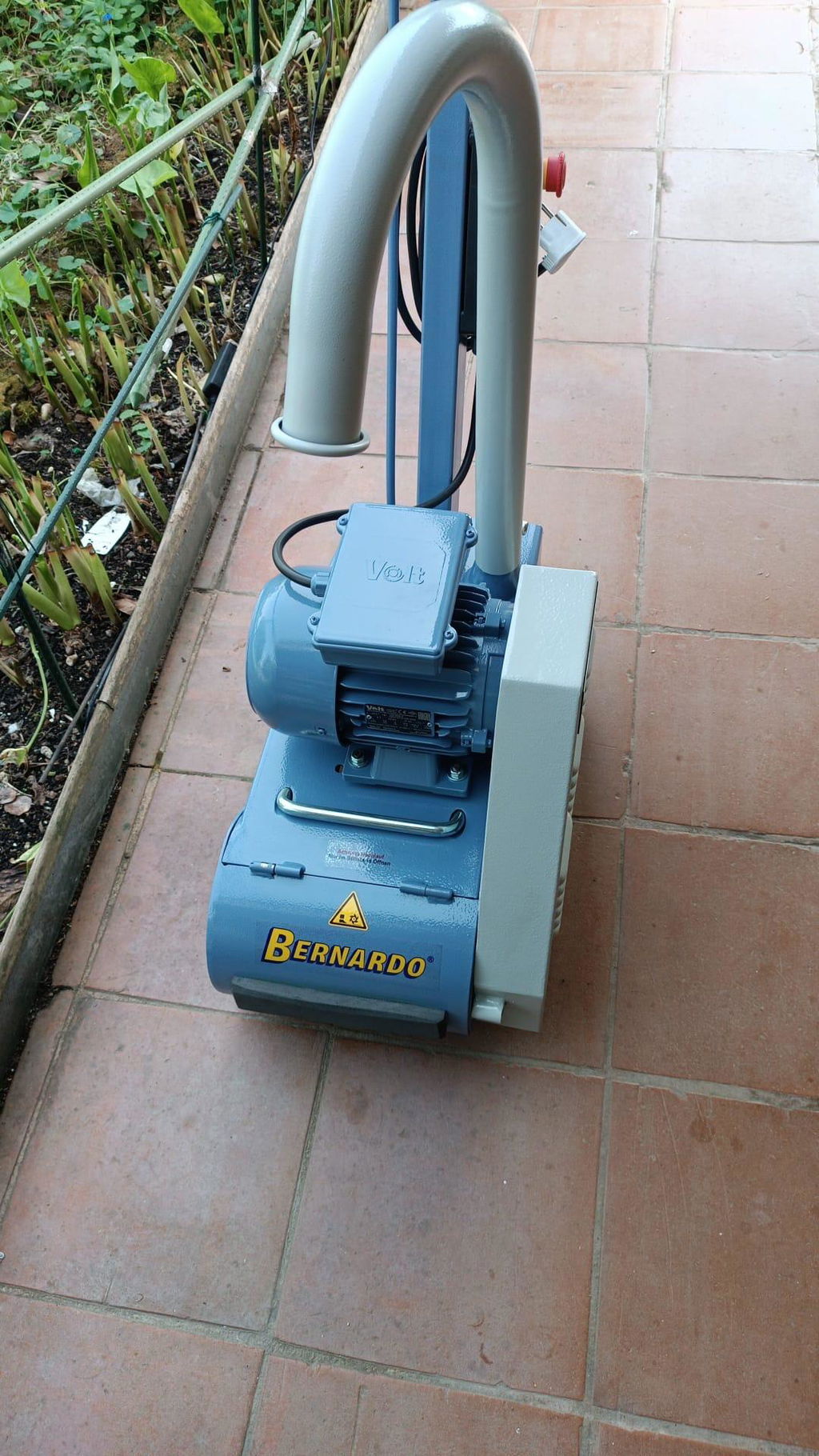
- Wood sander: for finishing treads and handrails, eliminating sharp edges and dangerous splinters.
Complementary tools
- Work bench: stable surface for assembly and precision work.
- Tape measure, carpenter's square, and level: for precise measurements and marking.
- Cordless drill/driver and wood screw set: for structural fastening.
- Clamps and joint clamps: to hold pieces firmly during gluing and assembly.
- Dust extraction system: to keep the work area clean and safe during processing.
Tip: If you are a hobbyist tackling various woodworking projects, a woodworking combination machine combines a table saw, jointer, thicknesser, router, and mortiser in one machine, optimizing space and investment. Consult the ranking of the best woodworking combination machines.
How to build an indoor wooden staircase: step-by-step guide

Building an indoor wooden staircase requires 7 main phases: design, material preparation, stringer cutting, joint creation, ground assembly, positioning, and finishing. Each phase requires precision and attention to detail.
Phase 1: Design and measurements
- Measure the total height from the lower floor to the upper floor (top edge of the floor).
- Calculate the number of steps by dividing the height by the desired riser (recommended: 17 cm).
- Check the available horizontal space and calculate the stair run (number of steps × tread depth).
- Draw the design to scale on graph paper, including all measurements and the angle of inclination.
- Verify Blondel's formula: 2 × Riser + Tread should result in a value between 60 and 66 cm (ideal 63 cm).
Common mistake to avoid: don't forget to consider the thickness of the upper floor in the total height calculation. Even 2-3 cm difference will result in uneven steps.
Phase 2: Cutting the stringers
Stringers are the diagonal supports that hold the entire staircase. For an 80 cm wide staircase, 2 stringers are needed; for widths over 100 cm, 3 are needed.
- Calculate the length of the stringers using the Pythagorean theorem: square root of (height² + horizontal run²).
- Use laminated wood boards with a minimum section of 50 × 250 mm (100 × 200 mm for heavy stairs).
- Draw the zigzag profile on the inner side of the stringer with a carpenter's square, marking the riser and tread of each step.
- Cut the profile with the table saw for straight cuts and the jigsaw for internal parts.
Phase 3: Preparing the Steps
- Cut the treads (horizontal part of the step) to the width of the staircase + 2-3 cm for the front overhang (nosing).
- Cut the risers (vertical part) to the precise height.
- Plane all pieces to a uniform thickness using a jointer-planer: minimum 30 mm for treads, 18-20 mm for risers.
- Round the front edge of the tread with a router or sander to eliminate sharp edges (prevents breakage and injury).
Phase 4: Creating the Joints

There are three main methods for attaching steps to stringers:
- Supported steps: the tread rests directly on the zigzag profile of the stringer. Simplest system, fixed with screws and glue.
- Housed steps: the tread and riser fit into grooves cut into the stringers. More professional result but requires a router and great precision.
- Steps on triangles: wooden triangles screwed to the stringer support the tread. A good compromise between simplicity and strength.
Phase 5: Ground Assembly
Essential tip: assemble the entire staircase on the ground before positioning it. Assembly will be much easier, and you can ensure everything is perfectly square.
- Position the stringers parallel on the floor at the correct distance.
- Fix the first step at the bottom and the last step at the top to stabilize the structure.
- Insert all intermediate steps, checking with a spirit level that they are perfectly horizontal.
- Fix each step with wood glue and screws (or wooden dowels for a cleaner look).
- Check overall squareness by measuring the diagonals.
Phase 6: Positioning and Fixing
- Lift the staircase into its final position (at least 2 people are needed).
- Check with a spirit level that the steps are perfectly level.
- Fix the wall stringer with expansion anchors or chemical anchor.
- Fix the base to the floor with metal brackets.
- Fix the top with a bracket to the upper floor.
Phase 7: Finishing and Treatment
- Sand all surfaces with a sander, starting from 80 grit up to 220 grit.
- Remove dust with a damp cloth and wait for it to dry completely.
- Apply protective treatment: penetrating oil for a natural effect, or polyurethane varnish for maximum wear resistance.
- Install the handrail at a height of 90-100 cm to ensure safety.
To learn more about finishing techniques, read our guide on how to paint wood.
How to Build a Wooden Ladder Staircase
A wooden ladder staircase is the simplest type to build and is perfect for accessing mezzanines, bunk beds, above-ground pools, or as a decorative furniture item. Construction requires few basic materials and tools.
Required Materials
- 2 uprights: spruce or pine battens with a square section of 60 × 60 mm (or 80 × 80 mm for sturdier ladders), length equal to the height + 30 cm for safety.
- Rungs: beech dowels with a diameter of 30-35 mm with non-slip knurling, or rectangular section battens 30 × 40 mm. One rung every 28-30 cm apart.
- D3 wood glue (moisture resistant for outdoor use).
Procedure
- Calculate the number of rungs: staircase height (cm) ÷ 30 cm = number of rungs needed.
- Mark the positions of the holes on the uprights, at regular 30 cm intervals.
- Drill the uprights with a drill press using a bit of the exact diameter of the rungs. The perpendicularity of the hole is crucial.
- Insert the rungs into the holes applying wood glue, ensuring they protrude uniformly from both sides.
- Secure each rung with a passing wooden pin (8-10 mm knurled beech rod) for additional mechanical hold.
- Sand and round all edges for comfort and safety.
- Apply protective oil or varnish (water-repellent for outdoor use).
How to Build an Outdoor Wooden Staircase
An outdoor wooden staircase must withstand rain, sun, humidity, and temperature fluctuations. The choice of wood and protective treatment is even more critical than for an indoor staircase.
Recommended Woods for Outdoors
- Larch: naturally weather-resistant due to its high resin content. Does not require chemical treatment.
- Douglas fir: excellent durability in class 3, good value for money for outdoor structures.
- Pressure-treated pine: treated in an autoclave with copper salts, achieving durability class 4. Cheaper but with an initial greenish appearance.
- Composite wood (WPC): wood-plastic mixture, zero maintenance but not workable with traditional techniques.
Specific Outdoor Precautions
- Provide a 2% slope on the steps to facilitate rainwater drainage.
- Leave a 5-8 mm gap between the step boards for drainage and ventilation.
- Never place wood directly on the ground: use galvanized metal supports or concrete bases.
- Apply water-repellent impregnator to all surfaces, including cuts and holes, before assembly.
- Plan for annual maintenance with outdoor oil or impregnator.
How to Build a Wooden Mezzanine Staircase
A mezzanine staircase is generally steeper than a standard staircase (45-65° incline) because space is limited. For small height differences (150-250 cm), it is the most practical and compact solution.
The calculation is simplified: divide the mezzanine height by 15 cm (minimum riser) to get the number of steps. For a mezzanine at 200 cm, about 13 steps are needed. The length of the staircase depends on the chosen angle of inclination: the steeper it is, the less space it occupies but the less comfortable it becomes.
For mezzanines with infrequent access, a ladder staircase or a retractable staircase can be valid alternatives that take up very little space when not in use.
Common Mistakes in Wooden Staircase Construction
After 17 years of experience in the woodworking machinery sector, we have compiled the most frequent errors reported by our customers:
- Approximate measurements: even 2-3 mm of error per step accumulates over 15-17 steps, creating a height difference of 3-5 cm on the last step.
- Wood with moisture content above 12%: shrinkage during drying causes squeaks, play in joints, and deformation.
- Undersized stringers: sections that are too small cause flexing under load and a feeling of instability.
- Failure to round edges: sharp wood edges chip easily and are dangerous for bare feet.
- On-site assembly: assembling the staircase directly in place is much more difficult. Always assemble on the ground first.
- Insufficient fastening: the staircase must be securely anchored to the floor, wall, and upper level to prevent swaying.
- Using inadequate tools: cutting 200 mm stringers with a jigsaw produces imprecise cuts. A professional table saw is the investment that makes a difference.
How Much Does it Cost to Build a DIY Wooden Staircase?
The cost of a DIY wooden staircase depends on the type of wood, the complexity of the project, and the tools already available. Here is an indicative estimate for a single-flight internal staircase with 15 steps:
Expense Item
Economical Material
Precious Material
| Wood for stringers and steps | €200-350 (spruce/pine) | €500-900 (oak/beech) |
| Hardware (screws, brackets, anchors) | €30-50 | €50-80 |
| Glue, filler, sandpaper | €20-30 | €30-50 |
| Varnish/protective oil | €30-50 | €60-100 |
| Handrail and supports | €40-80 | €100-250 |
| Total materials | €320-560 | €740-1,380 |
The savings compared to a staircase made by a craftsman (which starts from €2,000-3,000 for a basic model) are significant. The main investment, if you don't already have the machinery, concerns the tools: a good table saw and a jointer-planer are tools you will reuse in dozens of other projects.
Regulations and Safety for Wooden Staircases
In Italy, internal staircases in residential buildings must comply with DM 236/1989 for accessibility and UNI 10804 standards. The main parameters are: minimum width 80 cm for private internal staircases, maximum riser 20 cm, minimum tread 25 cm, handrail mandatory on at least one side for staircases with more than 3 steps, and minimum headroom under the staircase of 200 cm.
For structural safety, a wooden staircase must support a distributed load of at least 400 kg/m² and a concentrated load of 200 kg. These values are easily achievable with glulam of adequate section and correct joint dimensioning.
Frequently Asked Questions
What is the best wood for building an indoor staircase?
The best wood for indoor staircases is laminated beech for the supporting stringers and oak for the steps. Beech offers excellent structural resistance at an affordable price, while oak ensures maximum durability against daily foot traffic wear. Spruce is only suitable for low-traffic staircases.
How long does it take to build a DIY wooden staircase?
Building a single-flight staircase typically takes an experienced hobbyist 3-5 days of work: 1 day for design and material purchase, 1-2 days for cutting and preparing pieces, 1 day for assembly and positioning, and 1 day for finishing and varnishing (plus drying times for the varnish).
Can I build a wooden staircase without a circular saw?
Technically yes, using a hand saw and a jigsaw, but the quality of the cuts will be significantly lower. For precise stringers and uniform steps, a table saw is almost indispensable. Alternatively, you can have the pieces cut to size at a professional wood cutting center.
How to build a wooden railing for the staircase?
The railing consists of a handrail (round or shaped section of 40-50 mm), vertical columns (balusters, every 12-15 cm apart), and main newel posts (at corners and every 150 cm). Fix the newel posts to the step or stringer with through bolts, insert the balusters into holes drilled in the step and handrail, and fix the handrail onto the newel posts. The minimum height must be 90 cm from the edge of the step.
How to build a spiral staircase out of wood?
A spiral staircase requires a central supporting pole (minimum diameter 100 mm) around which trapezoidal, fan-shaped steps are fixed. Each step rotates 22-30° relative to the previous one. It is a complex project that requires precise geometric calculations and advanced carpentry skills: we recommend relying on a professional or starting with a prefabricated kit.
How to treat an outdoor wooden staircase?
For outdoor stairs, apply an oil-based protective impregnating agent to all surfaces (including cuts and holes) before assembly. Subsequently, apply 2-3 coats of outdoor oil or marine varnish. Repeat the treatment every 12-18 months to maintain protection. The most durable woods for outdoor use are larch, Douglas fir, and pressure-treated pine.

Sandra Gaspar
Sandra Gaspar è la fondatrice di Krollit. Con una laurea in Economia Aziendale e oltre 18 anni di esperienza nel settore, dal 2007 aiuta hobbisti, artigiani e industrie a scegliere le migliori macchine per la lavorazione di legno, metallo e lamiera. Grazie a partnership con marchi leader internazionali, ha costruito un network di oltre 10.000 clienti professionisti in tutta Europa.