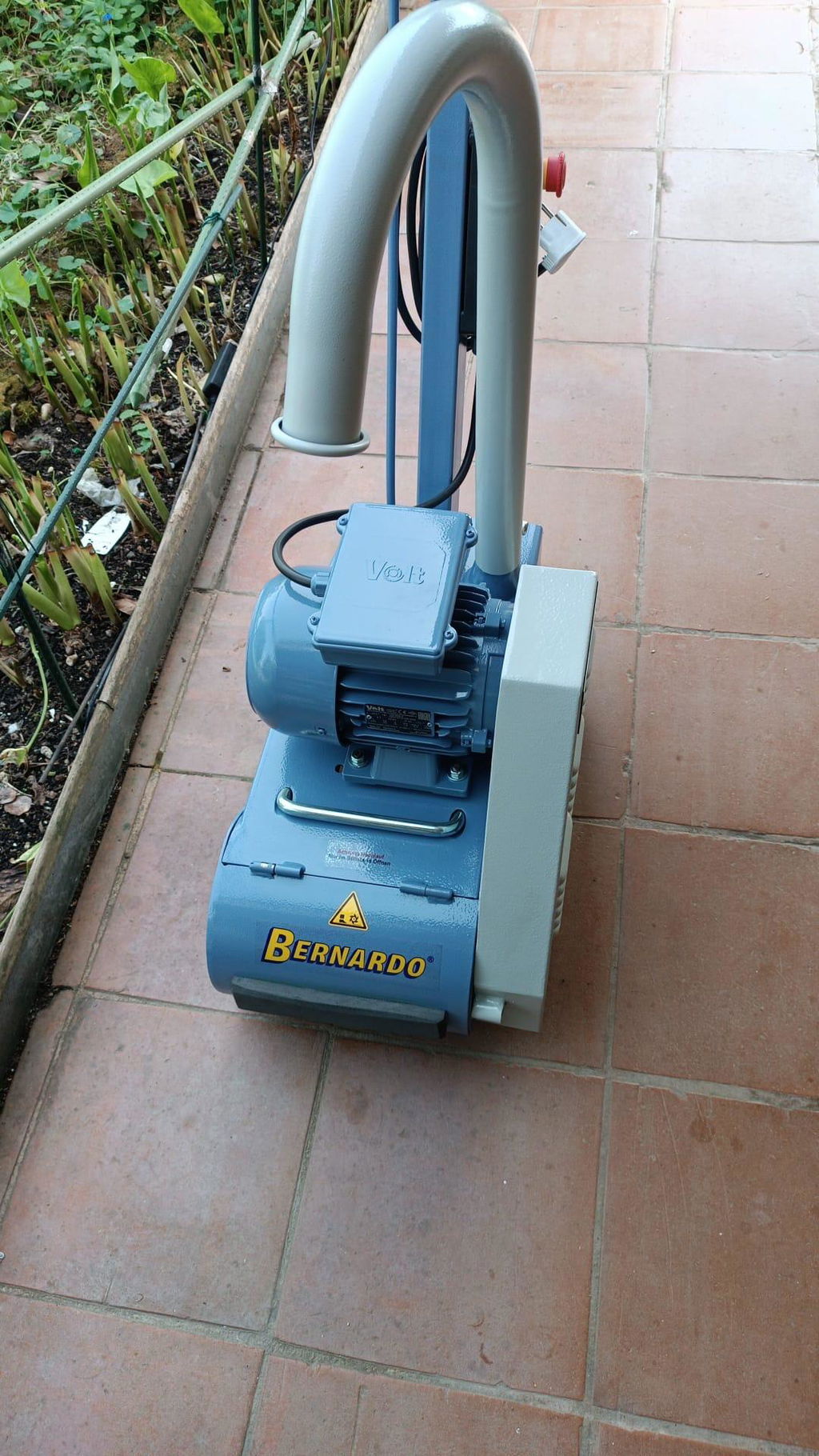

Maximum sheet thickness: steel, stainless steel and aluminium compared
|
|
Time to read 11 min

|
|
Time to read 11 min
A shear rated at 1.5 mm cuts approximately 1.0 mm of stainless steel and 2.2 mm of aluminium. The same rated capacity corresponds to three different thicknesses, and the specification sheet states why in a way almost nobody notices: “400 N/mm²” appears beside the capacity. This is the strength of the mild steel to which the rating refers. Changing the material changes the limit, and the conversion factor is not the same for cutting, bending and rolling. Below are the coefficients, the calculations behind them and the limits beyond which no coefficient applies. Official Bernardo distributor since 2007.
Every cutting or bending capacity stated by a European manufacturer refers to a specific material. Bernardo specifies this in the technical table: “Max. sheet thickness (400 N/mm²)”. Those 400 N/mm² are the tensile strength of a common structural steel, typically S235JR, known in the workshop as mild steel or black sheet.
This is not a commercial convention: it is the reference that allows machines from different brands to be compared. Problems arise when a workshop processes stainless steel or aluminium and treats that figure as universal.
The force required to cut or bend is proportional to the material’s strength. If a machine has a fixed maximum force, maximum thickness is inversely proportional to strength. Everything else follows from this.
Calculate the ratio between the material’s strength and the reference value of 400 N/mm², then divide the rated thickness by that ratio.
Permissible thickness = rated thickness × (400 / material Rm)
AISI 304 has an Rm of around 600 N/mm². The ratio is 600/400 = 1.5, so thickness drops to 1/1.5 = 0.65 times the rated value. Aluminium 5754 H22 is around 240 N/mm²: a ratio of 0.6 and a thickness of 1.65 times the rating.
This formula applies to cutting and bending. Rolling requires a different calculation, as explained below.
Values calculated from rated capacities, using 0.65 for AISI 304 stainless steel and 1.5 for 5000-series aluminium. Prices include VAT.
| Model | Type | Mild steel | 304 stainless steel | Aluminium | Price |
|---|---|---|---|---|---|
| Bernardo HS 800 | lever 800 mm | 0,8 mm | 0,5 mm | 1,2 mm | €511,19 |
| Bernardo PTS 1050 S | lever 1,050 mm | 1,0 mm | 0,6 mm | 1,5 mm | €1.213,94 |
| Bernardo HTS 1050 | guillotine 1,050 mm | 1,5 mm | 1,0 mm | 2,2 mm | €2.586,49 |
| Bernardo FS 1270 × 1,6 | foot-operated 1,270 mm | 1,6 mm | 1,0 mm | 2,4 mm | €2.976,90 |
| Bernardo HLS 1050 × 2,0 | lever 1,050 mm | 2,0 mm | 1,3 mm | 3,0 mm | €3.440,52 |
| Bernardo HS 5 | lever 100 mm | 4,0 mm | 2,6 mm | 6,0 mm † | €170,80 |
| Bernardo HS 12 | lever 265 mm | 4,0 mm | 2,6 mm | 6,0 mm † | €299,01 |
| Bernardo HSG 8 | lever, with round-bar hole | 5,0 mm | 3,2 mm | 7,5 mm † | €237,91 |
| Bernardo PBS 22 | lever for profiles 150 mm | 6,0 mm | 3,9 mm | 9,0 mm † | €835,72 |
| Bernardo HST 1300 × 4 | hydraulic 1,300 mm | 4,0 mm | 2,6 mm | 6,0 mm † | €16.050,54 |
| Bernardo HSB 2000 × 6 | hydraulic 2,000 mm | 6,0 mm | 3,9 mm | 9,0 mm † | €24.956,84 |
| Bernardo HSB 3200 × 12 | hydraulic 3,200 mm | 12,0 mm | 7,8 mm | 18,0 mm † | €43.213,47 |
† The aluminium value is a force limit, not a structural limit. Above the nominal thickness, blade clearance must be increased according to the manufacturer’s table and the hold-down must be able to clamp the material. On hydraulic guillotines, hold-down opening becomes the constraint before force does: the aluminium column must be checked for the individual model, not applied blindly.
The stainless steel column always represents a reduction, so it is always on the safe side. If you need a machine mainly for stainless steel, start with the stainless steel thickness you need and divide it by 0.65: that is the nominal steel capacity to look for in the catalogue. For 2 mm of 304, you need a 3 mm rating.
The reasoning is identical for a universal lever-operated or folding machine: the machine develops a maximum torque at the beam, and stronger material uses it up sooner. The Bernardo BB 2000 RS is rated at 0.8 mm over 2,000 mm at 400 N/mm², corresponding to approximately 0.5 mm of 304 and 1.2 mm of aluminium.
For a press brake, the starting figure is tonnage rather than thickness, and a direct calculation is useful. The workshop formula is:
F [kN per metre] = 1.42 × Rm × S² / V
Here Rm is the strength in N/mm², S is the thickness and V the die opening, both in millimetres. The rule of thumb for choosing V is eight times the thickness for materials from 0.7 to 6 mm.
One metre of 2 mm sheet on a V16 die requires:
| Material | Rm | Force per metre |
|---|---|---|
| Mild steel S235 | 400 N/mm² | 14,2 t |
| Steel S355 | 510 N/mm² | 18,1 t |
| Stainless steel AISI 304 | 600 N/mm² | 21,3 t |
| Aluminium 5754 H22 | 240 N/mm² | 8,5 t |
The difference between mild steel and stainless steel is 7 tonnes per metre at the same thickness. Over a three-metre bend that becomes 21 tonnes, which explains why a press sized for mild steel struggles when the first stainless steel job arrives.
This is the part you do not find written anywhere and that is worth understanding, because it produces a different figure.
When cutting or air bending, the process geometry adapts to the thickness: the die is changed and blade clearance is adjusted. Force therefore increases in proportion to thickness, and the conversion coefficient is the one shown above.
In a rolling machine, however, the geometry is fixed: the distance between the lower rolls does not change. The required bending moment increases with the square of thickness, rather than linearly. The conversion coefficient is therefore the square root of the strength ratio, and the reduction is much smaller.
On a rolling machine, switching from mild steel to AISI 304 costs approximately 19% of thickness, not 35%. A machine rated for 2 mm of mild steel handles around 1.6 mm of stainless steel, not 1.3 mm.
Multiply these coefficients by the thickness stated on the specification sheet.
| Material | Typical Rm | Cutting and bending | Rolling |
|---|---|---|---|
| Mild steel S235 | 400 N/mm² | 1.00 (reference) | 1,00 |
| Steel S355 | 510 N/mm² | 0,78 | 0,89 |
| Stainless steel AISI 430 | 480 N/mm² | 0,83 | 0,91 |
| Stainless steel AISI 304 | 600 N/mm² | 0,65 | 0,82 |
| Stainless steel AISI 316 | 620 N/mm² | 0,64 | 0,80 |
| Aluminium 6082 T6 | 320 N/mm² | 1,25 | 1,12 |
| Aluminium 5754 H22 | 240 N/mm² | 1,65 | 1,29 |
| Annealed aluminium 1050 | 90 N/mm² | 4,40 † | 2,10 † |
| Annealed copper | 230 N/mm² | 1,74 | 1,32 |
| Half-hard brass CuZn37 | 400 N/mm² | 1,00 | 1,00 |
† Theoretical values beyond the machine’s mechanical capacity. See below.
Saying “I work with stainless steel” tells us little. The strength difference between the three families found in workshops is 30%.
AISI 430 is ferritic, magnetic and the least strong of the three. It is used for furnishings, panels and guards. It costs 35% less than 304 and reduces machine capacity by only 17%.
AISI 304 is the reference: austenitic, non-magnetic in the annealed condition, and what is usually meant by “stainless steel” without further specification.
AISI 316 adds molybdenum to resist chlorides and behaves on the machine like a slightly harder 304.
However, the coefficients do not capture one characteristic: austenitic stainless steels work-harden. They become harder as they deform, which changes two things in practice. When cutting, excessive blade clearance hardens the material before separation, leaving a hard burr and wearing the blade faster: stainless steel needs a smaller clearance, around 5% of thickness rather than the 8% used for mild steel. When bending, springback is more pronounced: 304 must be bent a few degrees beyond the desired angle, whereas the difference is minimal with mild steel.
The range for aluminium is enormous, and the material name alone tells us nothing.
Annealed 1050, almost pure aluminium used for sheet-metal roofing and cladding, is below 100 N/mm². The theoretical coefficient is 4.4. In practice, no shear reaches it, because the machine’s structural limit is reached much earlier.
5754 H22, the most common alloy for light fabrication, is around 240 N/mm², with a coefficient of 1.65. This is the value to use when no other information is available.
6082 T6, a heat-treated structural alloy, reaches 320 N/mm², with a coefficient of 1.25. It is only slightly more forgiving than mild steel.
Aluminium suppliers know this and state the alloy on the delivery note. Buyers often look only at thickness. It is worth obtaining the alloy designation before choosing a machine, because 6082 is three and a half times as strong as 1050.
Two practical points also matter with aluminium: it is soft, so it tends to be dragged under the blade and leave a burr, and blade clearance must be increased rather than reduced, to around 10% of thickness. Manual lever and guillotine shears have adjustable clearance precisely for this reason.
All the calculations so far concern force. But a machine has a second, structural limit that is independent of the material.
A shear has a hold-down opening, which must clamp the sheet before the blade descends, and a blade clearance adjustment with a finite range. A folding machine has a maximum opening between the beam and table: on the BB 2000 RS it is 59 mm, and beyond that dimension the workpiece will not fit, whatever the material. A rolling machine has a roll diameter that imposes a minimum bending radius.
The principle to remember: the aluminium coefficient applies only within the machine’s adjustment range. Beyond it, the blade works poorly, the cut is crooked and the support deforms. Thick aluminium requires a machine with a larger nominal capacity, not the same machine used beyond its rating.
This does not arise with the reduction for stainless steel: capacity is always below nominal, so the structural limit is never reached.
The technical table for HS-series lever shears includes a footnote: not over the full length.
This means that the HS 5’s stated 4 mm capacity applies to a short bite, not the entire 100 mm blade. Full thickness is achieved on a narrow piece where the lever has a favourable mechanical advantage; usable thickness decreases towards the blade tip.
This is why a 4 mm lever shear and a 1.5 mm guillotine are not comparable: the first cuts thick material over a small width, the second thinner material over the entire width. For trimming whole sheets, look at cutting length; for cutting flat and round bars, look at thickness. This explains the price difference between the two families, from €170.80 to over €3,000.
Four steps, in this order.
First, write down the full material designation. Not “stainless steel” but “AISI 304”; not “aluminium” but “5754 H22”. Without the designation, the calculation cannot be made.
Second, take the thickness you actually need and divide it by the table coefficient. The result is the nominal mild steel capacity to look for in the catalogue.
Third, check working length and opening, which are separate limits and cannot be converted.
Fourth, ask if you are close to the limit. If the calculated value is within 10% of the rating, obtain confirmation from the manufacturer that the machine can handle continuous use at that capacity, not just a peak load. We make this check daily on 0825-1494022; for bending, start with sheet metal folding machines, for curving with sheet metal rolling machines, and for thick material with hydraulic guillotine shears.
What does 400 N/mm² mean on a shear’s specification sheet?
It is the tensile strength of the material used for the stated capacity: structural steel such as S235, known in workshops as mild steel or black sheet. All European manufacturers use this reference, allowing machines from different brands to be compared.
How much thickness capacity do I lose with stainless steel?
Around 35% for cutting and bending AISI 304 at 600 N/mm². A 1.5 mm shear drops to 1.0 mm, and a 4 mm shear to 2.6 mm. With AISI 430 the reduction is only 17%, because it is less strong than 304.
How much do I gain with aluminium?
It depends on the alloy. For 5754 H22, the most common in light fabrication, around 65% more. For structural 6082 T6, only 25%. The gain applies only within the adjustment ranges for blade clearance and hold-down opening.
Why is the coefficient different for rolling?
Because the geometry is fixed: the roll spacing does not change with thickness, so the required moment increases with thickness squared rather than linearly. The coefficient becomes the square root of the strength ratio, and the reduction for stainless steel drops from 35% to 19%.
Which machine is needed to cut 2 mm stainless steel?
One rated for at least 3 mm mild steel, because 3 × 0.65 is 1.95. In the range, this means moving up to hydraulic guillotines such as the HST 1300 × 4, rated at 4 mm and therefore suitable for 2.6 mm of 304 over a length of 1,300 mm.
Does blade clearance need to change with the material?
Yes, and it is the adjustment with the greatest effect on cut quality. As a guide, use 5% of thickness for stainless steel, 8% for mild steel and 10% for aluminium. Excessive clearance work-hardens stainless steel before separation and leaves a hard burr that must be removed by hand.
How many tonnes are needed to bend stainless steel?
One metre of 2 mm AISI 304 on a V16 die requires around 21 tonnes, compared with 14.2 for the same thickness of mild steel. The formula is 1.42 × Rm × thickness² divided by die opening, giving kN per metre.
What does “not over the full length” mean on lever shears?
The maximum rated thickness is achieved by taking a bite from a narrow piece where the lever has the most favourable mechanical advantage, not along the whole blade. An HS 5 achieves its 4 mm capacity over a few centimetres, not the nominal 100 mm cutting length.
How do copper and brass behave?
Annealed copper is around 230 N/mm², so it behaves like fabrication aluminium and allows around 70% greater thickness than mild steel. Half-hard CuZn37 brass reaches 400 N/mm² and matches the reference steel exactly, with no increase.


100% Secure Payments
Klarna/Visa/Mastercard/PagoLight