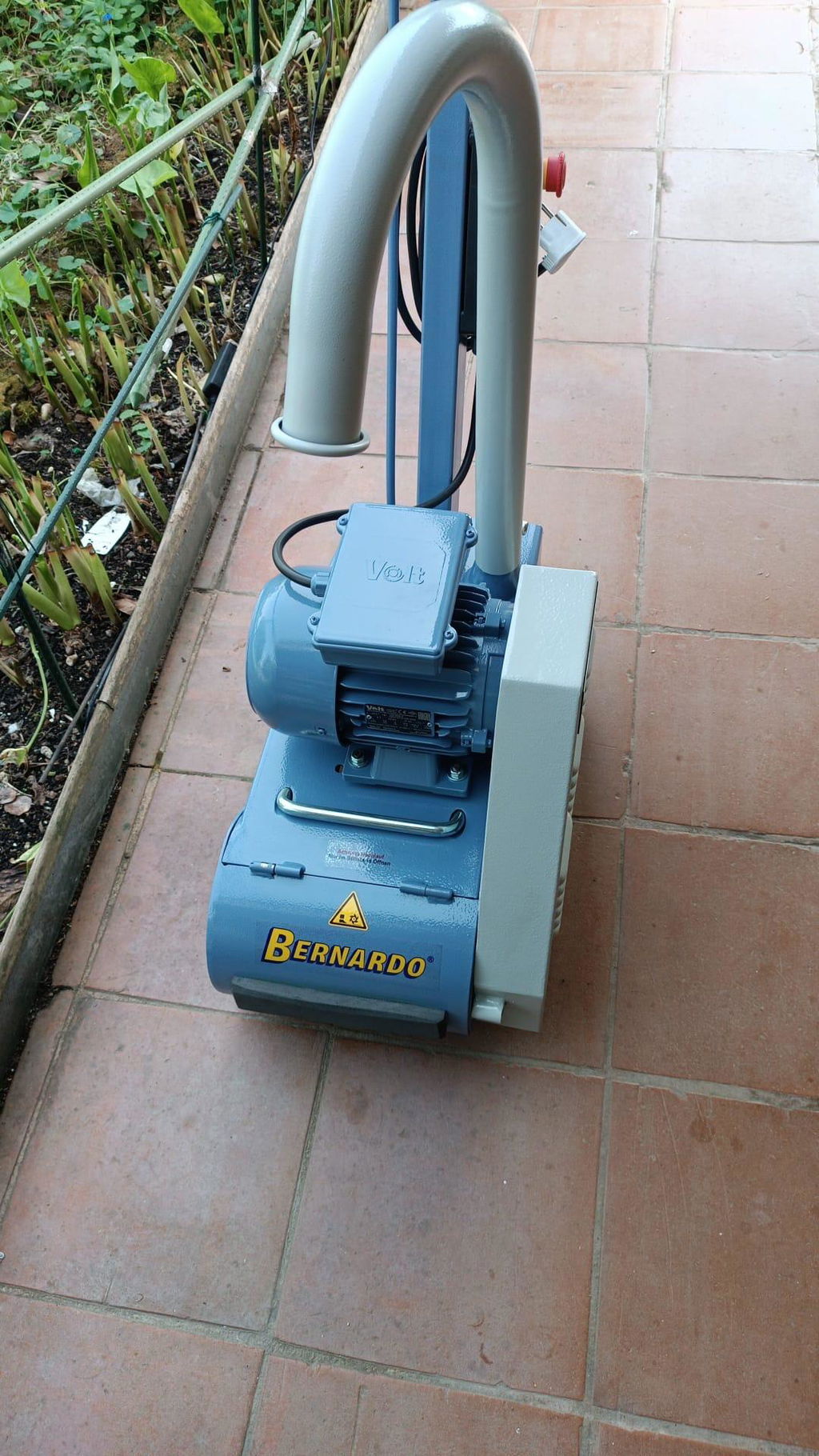


Bernardo PT 260 S Planer Thicknesser – 230/400V with spiral cutter block
Bernardo PT 260 S Planer Thicknesser – 230/400V with spiral cutter block - 230 V is backordered and will ship as soon as it is back in stock.
Iscriviti alla nostra newsletter
Ricevi gli ultimi aggiornamenti su tutte le nostre nuove collezioni, saldi, offerte e date di arrivo dei prodotti.
-
Descrizione
-
Sicurezza del prodotto
-
Recensioni
Descrizione
The Bernardo PT 260 S jointer-planer offers a planing width of 260 mm, a jointer table of 1,050 mm, a helical cutter block Ø 55 mm with 24 TCT inserts at 6,700 rpm, a thicknessing height of 5-150 mm, a feed rate of 6 m/min, a 1.8 kW motor available in both 230V single-phase and 400V three-phase, and an integrated dust collector with bag. Weight 89 kg. Made in Austria, distributed in Italy by Krollit as an official Bernardo distributor since 2007.
- Planing width (jointer): 260 mm
- Jointer table (length): 1,050 mm
- Cutter block: Ø 55 mm helical, 24 TCT inserts, 6,700 rpm
- Thicknessing height: 5 – 150 mm
- Thicknessing feed rate: 6 m/min
- Motor: 1.8 kW S1 / 2.5 kW S6 – 230V single-phase or 400V three-phase
- Weight: approx. 89 kg
Who uses the PT 260 S and for what
The Bernardo PT 260 S is a professional combined planer with a 260 mm planing width, TCT helical cutter block, semi-stationary structure, and dual power supply options. The integrated dust collector with a dust bag and the aluminum planing tables with noise-reducing slots distinguish the PT 260 S as an intermediate machine between benchtop planers and heavy stationary machines. Its 89 kg weight provides sufficient stability for daily artisan use without requiring a special foundation. The thicknessing table, guided on 4 columns, ensures uniform feeding even for heavy workpieces up to 150 mm in height. In Krollit customers' workshops, it is a typical choice for small carpentry shops (1-3 employees) looking for a compact planer with performance superior to benchtop models, offering flexibility between single-phase and three-phase power.
Its place in the Bernardo range
The PT 260 S occupies a precise position in the Bernardo range: above the single-phase PT 250/305 S (strictly benchtop format) and below the stationary AD 260 (with longer tables, weighing 200+ kg). The difference with the PT 250 S is not only dimensional (260 vs 255 mm) but constructive: longer tables, integrated dust collector, dual power supply, higher structural weight. Compared to the PT 305 S, the PT 260 S foregoes the extra 45 mm of width but offers the advantage of an integrated dust collector and three-phase availability. The typical choice: PT 260 S for those who want a compromise between portability and professional performance at 260 mm; PT 305 S for those who prioritize maximum width in single-phase.
Krollit Logistics and Support
Bernardo shipping in 5-9 business days (7 days to the South). At 89 kg, it requires careful handling: using a pallet truck or two people for repositioning is recommended. Original Bernardo replacement TCT inserts, belts, and accessories are available from stock with 3-5 business day shipping. Customer support is available in Italian.
Who is the PT 260 S for?
| Profile | Compatibility | Reason |
|---|---|---|
| Passionate hobbyist | Adequate | Machine designed for professional use: for purely hobbyist use, the expense might be disproportionate. Consider the lower-cost PT 250 S if a 255 mm width is sufficient. |
| Small carpentry / artisan (1-5 employees) | Recommended | 260 mm width with integrated dust collector and dual power supply: a practical combination for artisan workshops with daily use. 1,050 mm jointer table handles medium-long workpieces. |
| Continuous / industrial production | Recommended | In the 400V three-phase version with 89 kg structural weight, it is dimensioned for prolonged shifts. For industrial production with larger widths, consider the stationary AD 260 S or the ADM range. |
Not suitable for: operations requiring a thicknessing height over 150 mm (consider the stationary range); widths over 260 mm (consider the PT 305 S at 300 mm or AD 310 at 310 mm); production with workpieces over 1.8 m requiring longer tables.
Jointer
| Specification | Value |
|---|---|
| Planing width | 260 mm |
| Jointer table length | 1,050 mm |
| Table height | 885 mm |
| Max. jointer depth of cut | 3 mm |
| Fence | 640 × 125 mm |
| Fence tilt | 90° – 45° |
Thicknesser
| Specification | Value |
|---|---|
| Effective thicknessing width | 250 mm |
| Working height (min – max) | 5 – 150 mm |
| Thicknesser table length | 480 mm |
| Max. thicknessing depth of cut | 2 mm |
| Feed rate | 6 m/min |
Cutter block and speed
| Specification | Value |
|---|---|
| Cutter block diameter | Ø 55 mm |
| Cutter block type | Helical with 24 TCT inserts |
| Cutter block speed | 6,700 rpm |
Motor and power supply
| Specification | Value |
|---|---|
| Motor power S1 (100%) | 1.8 kW (2.4 HP) |
| Motor power S6 (40%) | 2.5 kW (3.4 HP) |
| Power supply | 230V single-phase or 400V three-phase |
| Dust extraction port | Ø 75 mm |
Dimensions and weight
| Specification | Value |
|---|---|
| Machine dimensions (L × W × H) | 1,110 × 720 × 1,030 mm |
| Net weight | approx. 89 kg |
Compliance
| Specification | Value |
|---|---|
| Marking | CE |
| Directive | Machinery Directive 2006/42/EC |
Standard equipment
- Helical cutter block Ø 55 mm with 24 mounted TCT inserts
- 5 spare TCT inserts
- Integrated dust collector
- Dust bag
- Push handle
Frequently Asked Questions
Is the 230V or 400V version better?
The 400V three-phase version is preferable if the workshop has a three-phase line available: the motor has more constant torque and better thermal management during continuous use. The 230V single-phase is the only choice for those who only have a standard domestic outlet.
The practical difference is seen in intensive use: the 400V three-phase motor maintains power better on startup and manages heat better during prolonged shifts. In intermittent use, the two versions offer similar performance. For workshops with a three-phase line, there is no advantage in choosing the 230V.
Does the integrated dust collector replace an external dust collector?
For hobbyist-artisan use, yes; for intensive professional use, it is preferable to connect an external dust collector via the Ø 75 mm port. The integrated dust collector is sized to handle chips produced during standard processing.
The integrated dust collector with bag is a practical solution for workshops that do not have fixed dust extraction systems. For resinous woods or MDF, which produce abundant fine dust, it is recommended to connect to an external dust collector like the MSA 750 or higher to better manage the air in the workshop and reduce respiratory risk.
What is the difference with the stationary AD 260 S?
The AD 260 S has longer cast iron tables (1,450 mm vs 1,050 mm) and a higher weight (approx. 200 kg). The PT 260 S is in a compact format with aluminum tables. Same width, differentiated performance.
For intensive continuous use (over 6 hours daily), the AD 260 S offers greater vibrational stability; for hobby and artisan use, the aluminum tables of the PT 260 are adequate. The price difference between the two machines is significant, so the choice depends on the expected workload.
Can I take a 4 mm jointing cut to quickly flatten a rough board?
No, the maximum jointing depth of cut is 3 mm. For removals greater than this, multiple consecutive passes with progressive adjustment of the infeed table are necessary.
Removals of 3 mm per pass are already substantial for a planer in this range: on hardwoods like oak or ash, it is advisable to limit to 1.5-2 mm to avoid overloading the motor and preserve surface quality. Effective planing of very warped boards always requires multiple progressive passes, regardless of the planer's power.
How much space is needed in the workshop?
The machine dimensions are 1,110 × 720 × 1,030 mm. For workpiece movement, clear space of at least 1.8 m in front and behind is needed, for a total operating area of approximately 4.5 × 1.2 m.
The working height of 885 mm is optimal for operators of average height. The 89 kg weight allows placement on a standard industrial floor without special foundations. For thicknessing mode on workpieces over 1 m, a roller support on the outfeed is recommended to prevent deflection.