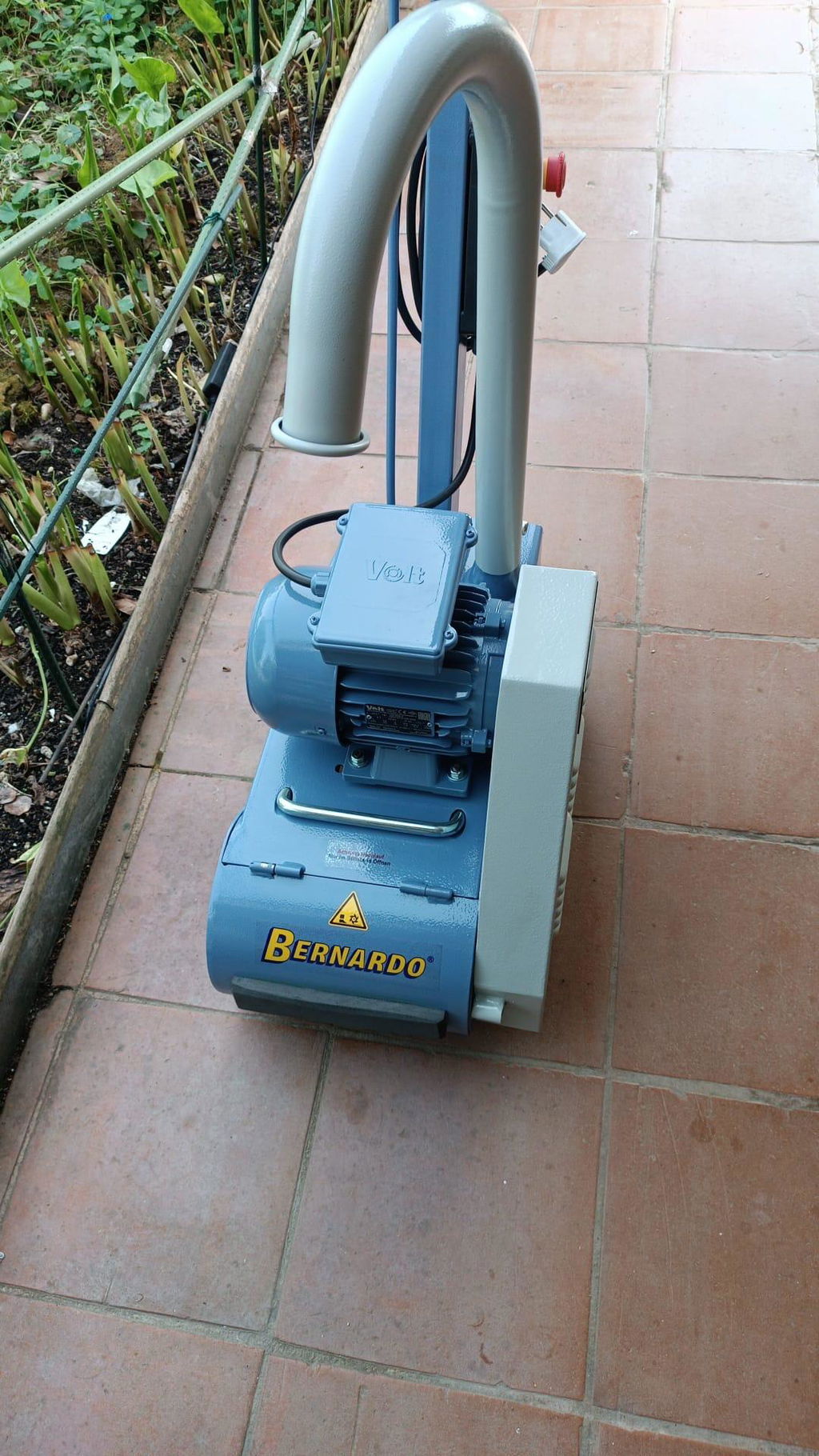


Note: Some of the products shown may be fitted with optional accessories. Subject to technical and aesthetic changes.
This promotion is not valid on discounted products or on bundled offers.
Bernardo WB 70 S Manual Angle Bender – flat steel up to 70×5 mm cold, 70×15 mm hot
Bernardo WB 70 S Manual Angle Bender – flat steel up to 70×5 mm cold, 70×15 mm hot is backordered and will ship as soon as it is back in stock.
Couldn't load pickup availability
Delivery and Shipping
Delivery and Shipping
At Krollit, we guarantee a safe and reliable shipping process. Orders are handled with the utmost care and traceability until delivery.
For international shipments, please send your request via the dedicated contact form.
Upon delivery, always sign the delivery note with the words “subject to inspection” to allow for proper handling of any irregularities or discrepancies in the product.
Our goal is to ensure you receive prompt service and a worry-free shopping experience.

Bernardo WB 70 S Manual Angle Bender – flat steel up to 70×5 mm col...
Description
The Bernardo WB 70 S manual angle bender cold bends steel flats up to 70×5 mm and round bars Ø 18 mm, and hot bends up to 70×15 mm and Ø 25 mm. Capacity on copper 70×10 mm, on aluminum 70×15 mm, steel angle profiles 60×8 mm cold and 70×15 mm hot. Weight 20.5 kg. Includes: sharp/rounded plate, R10/R15 and R20/R25 radius plates, round bar plate, offset plate, eccentric clamp, angle and material stops. Manufactured in Austria, distributed in Italy by Krollit as an official Bernardo distributor since 2007.
- Steel flat capacity (cold): 70 × 5 mm / 40 × 10 mm
- Steel flat capacity (hot): 70 × 15 mm / 50 × 20 mm
- Steel round bar capacity: Ø 18 mm cold / Ø 25 mm hot
- Steel angle capacity: 60 × 8 mm cold / 70 × 15 mm hot
- Copper capacity: 70 × 10 mm
- Aluminum capacity: 70 × 15 mm
- Weight: approx. 20.5 kg
Who uses the WB 70 S and for what
The Bernardo WB 70 S is a compact manual angle bender for locksmiths' workshops, maintenance workers, metal hobbyists, and artisan workshops. It works cold and hot on steel, copper, and aluminum: cold for thin pieces (up to 5 mm on steel flat), hot for thicker pieces (up to 15 mm on steel flat). The six interchangeable plates (sharp/rounded, two radius plates R10/R15 and R20/R25, round bar plate, offset plate, eccentric clamp) cover the vast majority of artisanal bending needs: sharp angles, standard bending radii, bending of round bars. The included angle and material stops allow repeatability in serial bending. In Krollit customers' workshops, it is chosen by blacksmiths, gate and artistic railing manufacturers, metal furniture restorers, metalworking schools, and maintenance workshops that perform occasional but frequent bends.
Its place in the Bernardo range
In the Bernardo range of manual angle benders, the WB 70 S is the entry model for artisan use. Above it is the WB 200 S (flat capacity 100×7 mm cold and 100×15 mm hot, weight 33 kg) for more demanding bends. The practical difference is in scale: the WB 70 S handles flats up to 70 mm wide, the WB 200 S reaches 100 mm. For blacksmiths who primarily work with thin flats (up to 5 mm), small round tubes, and light angles, the WB 70 S is correctly sized. For workshops that regularly perform bends on heavy angles or wide flats, the WB 200 S is needed. Above the manual benders, Bernardo offers motorized benders (TBM 2020, TBM 3020) for sheet metal production up to 3 meters in length.
Krollit Logistics and Support
Bernardo shipping in 5-9 business days (7 days for Southern Italy). At 20.5 kg, it can be moved by one person. It must be secured to a sturdy workbench using the mounting holes on the base. Interchangeable plates and original Bernardo spare parts are available from stock with 3-5 business day shipping. Customer support in Italian is available.
Who the WB 70 S is for
| Profile | Compatibility | Reason |
|---|---|---|
| Passionate metal hobbyist | Recommended | Handy and complete tool for occasional bending of steel, copper, aluminum. Six interchangeable plates cover the vast majority of artisanal work. |
| Artisan blacksmith / gate builder | Recommended | Sufficient capacity for standard bends of angles, thin flats, and round bars. Included stops allow repeatability in series. Weight 20.5 kg easy to manage. |
| Mechanical workshop / professional production | Adequate | For frequent bending of flats over 70×5 mm cold or angle profiles over 60×8 mm, consider WB 200 S. For sheet metal production, consider TBM motorized benders. |
Not suitable for: bending steel flats over 70×5 mm cold or over 70×15 mm hot (design limits); long sheet metal production (consider manual bench benders TB or motorized TBM); high-cadence repetitive bending (the machine is manual, not automatic).
Technical specifications
Capacity on steel flat
| Specification | Value |
|---|---|
| Cold | 70 × 5 mm / 40 × 10 mm |
| Hot | 70 × 15 mm / 50 × 20 mm |
Capacity on bars
| Specification | Value |
|---|---|
| Steel round (cold) | Ø 18 mm |
| Steel round (hot) | Ø 25 mm |
| Steel square (cold) | 16 × 16 mm |
| Steel square (hot) | 20 × 20 mm |
Capacity on angle
| Specification | Value |
|---|---|
| Steel angle (cold) | 60 × 8 mm |
| Steel angle (hot) | 70 × 15 mm |
Capacity on other metals
| Specification | Value |
|---|---|
| Copper | 70 × 10 mm |
| Aluminum | 70 × 15 mm |
Dimensions and weight
| Specification | Value |
|---|---|
| Machine dimensions (L × W × H) | 760 × 280 × 220 mm |
| Net weight | approx. 20.5 kg |
Compliance
| Specification | Value |
|---|---|
| Marking | CE |
Included equipment
Standard equipment
- Sharp/rounded bending plate
- Radius bending plate R20 / R25
- Radius bending plate R10 / R15
- Round bar plate
- Offset plate
- Eccentric clamping block
- Angle stop
- Material stop
Warranty
Warranty terms and support procedures are available on the dedicated Krollit page.
View Krollit warranty termsFAQ / Frequently asked questions
Frequently Asked Questions
What do 'cold' and 'hot' mean in the capacities?
Cold: the workpiece is bent at room temperature. Hot: the workpiece is heated (with a torch or forge) before bending, reaching red heat (700-900°C) to reduce material resistance.
Hot bending allows working with thicknesses and hardnesses that would otherwise be impossible manually. At 800°C, mild steel has its resistance reduced to about 20% of its cold value, allowing bends that would otherwise require hydraulic presses. The WB 70 S, like all manual benders, uses both techniques: the nominal 'hot' capacity is understood with the workpiece properly heated.
How many bends per minute can I make?
As this is a manual bender, the rate depends on the operator. For standard bends on thin flats, a skilled person can achieve 5-10 bends per minute. For hot bends, the pace is dictated by the workpiece heating time.
The WB 70 S is designed for artisanal use: speed is not a key feature. For high-cadence series production, consider motorized benders. The included angle and material stops improve repeatability between consecutive bends, reducing workpiece positioning times.
Can I bend tubes (not round bars)?
Solid tubes can be bent like round bars up to Ø 18 mm cold and Ø 25 mm hot. Hollow tubes require attention: without filling (sand or molten lead), they will flatten during bending.
For correct bending of hollow tubes, dedicated tube benders or roll benders are recommended (Bernardo has a separate range of tube benders). The WB 70 S only bends hollow tubes if properly filled to prevent flattening, a traditional but laborious artisanal technique. For regular bending of hollow tubes, it is recommended to invest in a dedicated tube bender.
Does it need to be fixed to a workbench or can it be used freestanding?
It must be secured to a sturdy workbench using the mounting holes on the base. The force exerted on the lever during bending requires stability.
The workbench must be sized to withstand significant lateral forces during bending: a light or unstable workbench makes the bender imprecise and dangerous. For workshops without a suitable workbench, a dedicated base is available as an optional accessory. Krollit provides information on compatible bases upon request.
What is the difference with the WB 200 S?
The WB 200 S has higher capacities (flat 100×7 mm cold vs 70×5, angles 100×10 vs 60×8 cold) and weighs 33 kg (vs 20.5). It is sized for more demanding bends.
The choice depends on the typical work in the workshop. For artisan blacksmiths who mainly work with thin flats and small bars, the WB 70 S is adequate. For workshops that regularly perform angles over 60×8 mm or flats wider than 70 mm, the WB 200 S is the logical choice. The price difference is small: for growing workshops, it may be strategically preferable to start directly with the WB 200 S.
-
Product safety
-
Reviews
Product safety