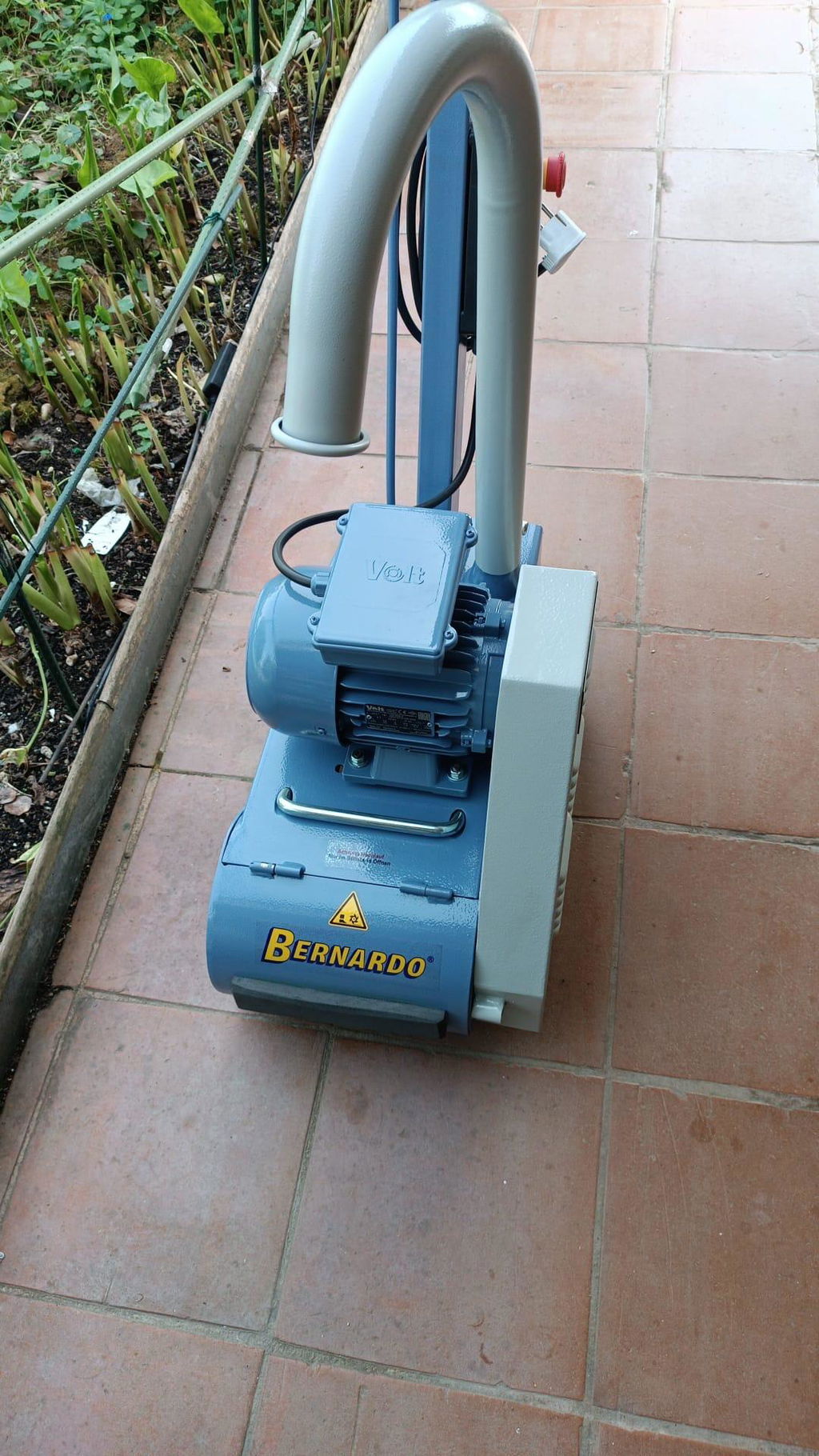


Note: Some of the products shown may be fitted with optional accessories. Subject to technical and aesthetic changes.
This promotion is not valid on discounted products or on bundled offers.
Bernardo AP 1520-150 Universal Industrial Hydraulic Press – 150 tons, 1,520 mm width, 11 kW motor
Bernardo AP 1520-150 Universal Industrial Hydraulic Press – 150 tons, 1,520 mm width, 11 kW motor is backordered and will ship as soon as it is back in stock.
Couldn't load pickup availability
Delivery and Shipping
Delivery and Shipping
At Krollit, we guarantee a safe and reliable shipping process. Orders are handled with the utmost care and traceability until delivery.
For international shipments, please send your request via the dedicated contact form.
Upon delivery, always sign the delivery note with the words “subject to inspection” to allow for proper handling of any irregularities or discrepancies in the product.
Our goal is to ensure you receive prompt service and a worry-free shopping experience.

Bernardo AP 1520-150 Universal Industrial Hydraulic Press – 150 ton...
Description
The Bernardo AP 1520-150 universal industrial hydraulic press offers a pressing force of 150 tons, a useful working width of 1,520 mm, a useful height of 275 mm, a lower table of 600×1,520 mm with a Ø 100 mm through-hole, a piston stroke of 300 mm, bending capacity up to 8 mm, adjustable speeds (advance 10 mm/sec, work 5 mm/sec, return 10 mm/sec), an 11 kW motor, and a solid cast iron structure. Weight 3,500 kg. Top of the range of AP universal presses: maximum useful width combined with maximum force. Manufactured in Austria, distributed in Italy by Krollit as official Bernardo distributor since 2007.
- Pressing force: 150 tons
- Useful working width: 1,520 mm
- Useful working height: 275 mm
- Lower table: 600 × 1,520 mm with Ø 100 mm through-hole
- Bending capacity: up to 8 mm
- Motor: 11 kW – 400V three-phase
- Weight: approx. 3,500 kg
Who uses the AP 1520-150 and for what
The Bernardo AP 1520-150 is the top of the range of AP universal presses, combining the maximum useful width (1,520 mm) with the maximum force (150 tons) in the family. It is the choice for industrial workshops that regularly process large pieces and require high distributed pressures. The advance speed of 10 mm/sec is the maximum value in the AP family, comparable to the AP 1020-150 (both with 11 kW motor): faster series production compared to the AP 1520-100 (8 mm/sec with 7.5 kW motor). The 600×1,520 mm table with a Ø 100 mm through-hole and a useful height of 275 mm cover standard industrial processing of wide workpieces. In Krollit customer laboratories, it is chosen by industrial metal fabrication shops, large-format sheet metal working shops, industrial frame manufacturers, and component manufacturers who require mixed processing on wide workpieces.
Its place in the Bernardo range
The AP 1520-150 is at the top of the Bernardo AP universal press range. Below it, other AP models (1020-150, 1520-100) offer trade-offs on one of the two dimensions (width or tonnage) for lower costs. Above the AP in the Bernardo range are DKS gantry presses (200/300/400 t) for long workpieces with a mobile frame, and dedicated AKPL press brakes for industrial series bending. The difference with DKS: AP is universal (bending + pressing), DKS is dedicated to pressing on long workpieces with a mobile frame. The difference with AKPL: AP handles occasional bending, AKPL is an industrial press brake with cylinder synchronization and NC control. For general industrial workshops with mixed processing and wide workpieces, the AP 1520-150 is the most complete choice in the universal category. For dedicated specialized applications, the DKS or AKPL are sized differently.
Krollit Logistics and Support
Bernardo shipping in 5-9 business days (7 days for Southern Italy). With 3,500 kg, it requires a crane or forklift of adequate capacity. Dimensions 2,650 × 1,400 × 2,340 mm: verify access to the workshop. Original Bernardo tools, spare parts, and accessories available from stock with shipping in 3-5 business days. Customer support available in Italian.
Who is the AP 1520-150 for
| Profile | Compatibility | Reason |
|---|---|---|
| Passionate hobbyist | Not recommended | Top-of-the-range industrial machine. Exclusively professional application. |
| Industrial metal fabrication | Recommended | Maximum useful width (1,520 mm) and maximum force (150 t) of the AP range. Suitable for complete industrial processing of wide workpieces: bending, pressing, shrinking, straightening. |
| Structure production / sheet metal working shop | Recommended | For workshops that require the universal top of the Bernardo range. For dedicated applications (only pressing on long workpieces, only industrial bending) consider DKS or AKPL. |
Not suitable for: exclusively pressing long workpieces (DKS range is specialized and more suitable); series production of industrial bending (AKPL range with NC); pieces over 1,520 mm useful width; occasional use (oversizing, consider smaller AP models).
Technical specifications
Pressing capacity
| Specification | Value |
|---|---|
| Max pressing force | 150 tons |
| Piston stroke | 300 mm |
| Useful working width | 1,520 mm |
| Useful working height | 275 mm |
| Bending capacity | up to 8 mm |
Table
| Specification | Value |
|---|---|
| Lower table | 600 × 1,520 mm |
| Table through-hole | Ø 100 mm |
Speed
| Specification | Value |
|---|---|
| Advance speed | 10 mm/sec |
| Working speed | 5 mm/sec |
| Return speed | 10 mm/sec |
Motor and power supply
| Specification | Value |
|---|---|
| Motor power | 11 kW |
| Power supply | 400V – 50Hz – three-phase |
Dimensions and weight
| Specification | Value |
|---|---|
| Machine dimensions (L × D × H) | 2,650 × 1,400 × 2,340 mm |
| Net weight | approx. 3,500 kg |
| Structure material | Solid cast iron |
Compliance
| Specification | Value |
|---|---|
| Marking | CE |
| Directive | Machinery Directive 2006/42/EC |
Included equipment
Standard equipment
- Bernardo AP 1520-150 universal hydraulic press
- Lower table with Ø 100 mm through-hole
- Integrated hydraulic system with high-performance pump
- Universal protective devices
- Set of tools and tie rods
Warranty
Warranty terms and support procedures are available on the dedicated Krollit page.
View Krollit warranty termsFAQ / Frequently asked questions
Frequently Asked Questions
Is the price difference worth it compared to the AP 1520-100?
It depends on the typical work. The AP 1520-150 has 50 more tons and an advance speed of 10 mm/sec (vs 8) thanks to the 11 kW motor (vs 7.5 kW). For series production on jobs requiring higher force, the difference pays off; for occasional use, the 1520-100 is sufficient.
The choice between the two depends on the duty cycle and the required tonnage. For workshops with regular processing at 100-130 tons, the 1520-100 at the limit of its capacity wears out more quickly: the 1520-150 operates at optimal regime (50-70% of nominal capacity). For predominantly use below 80-90 tons, the 1520-100 is correctly sized with a significantly lower cost.
Can I bend thick sheet metal with the AP 1520-150?
Yes, up to 8 mm thick (nominal bending capacity of the AP family). For series production on thick sheet metal or for superior bending quality, consider dedicated industrial AKPL press brakes.
The 8 mm capacity refers to mild steel with correctly sized V-tools. For sheet metal over 8 mm, the AP is not suitable, and for series production, the AKPL offers specific features (cylinder synchronization, NC control, precise backgauge) that the AP does not have. For those who regularly bend sheet metal up to 8 mm occasionally and also do pressing/shrinking, the AP 1520-150 is the correct universal choice.
Does the solid cast iron structure limit the machine's movement in the workshop?
Yes, the 3,500 kg cast iron makes moving it a non-trivial operation. For occasional repositioning, a heavy-duty pallet jack or forklift is needed. For fixed use, the machine is sized to remain in position.
Cast iron is a dense and stable material, suitable for stability in operation but not for portability. For workshops undergoing spatial organization, it is important to plan the final position in advance. Once positioned, the AP 1520-150 is designed for multi-decade use in the same position. For occasional movements, contact industrial installers.
What is the expected service life of an industrial press in this range?
For standard industrial use, a Bernardo press from the AP range is designed for a service life of over 20 years with regular maintenance. Wear parts (piston seals, bearings, hydraulic pump) are replaceable.
The solid cast iron structure does not wear out: the 3,500 kg weight is a structural dimensioning that ensures multi-decade durability. Components subject to maintenance are replaceable parts with original Bernardo spares available. For continuous intensive use, seal replacement typically occurs every 3-5 years; other components have a longer lifespan.
How much does it consume in standard production?
The 11 kW motor typically consumes 11-12 kWh per hour of actual operation at full load. In standard production with a 60-70% duty cycle, the average consumption is 7-8 kWh per hour.
For workshops with significant electricity costs, it is recommended to organize cycles to minimize standby times with the motor running. Turning it off between spaced cycles reduces average consumption. For continuous use, consumption is close to the maximum nominal. Optional energy recovery systems are available on advanced industrial versions.
-
Product safety
-
Reviews
Product safety