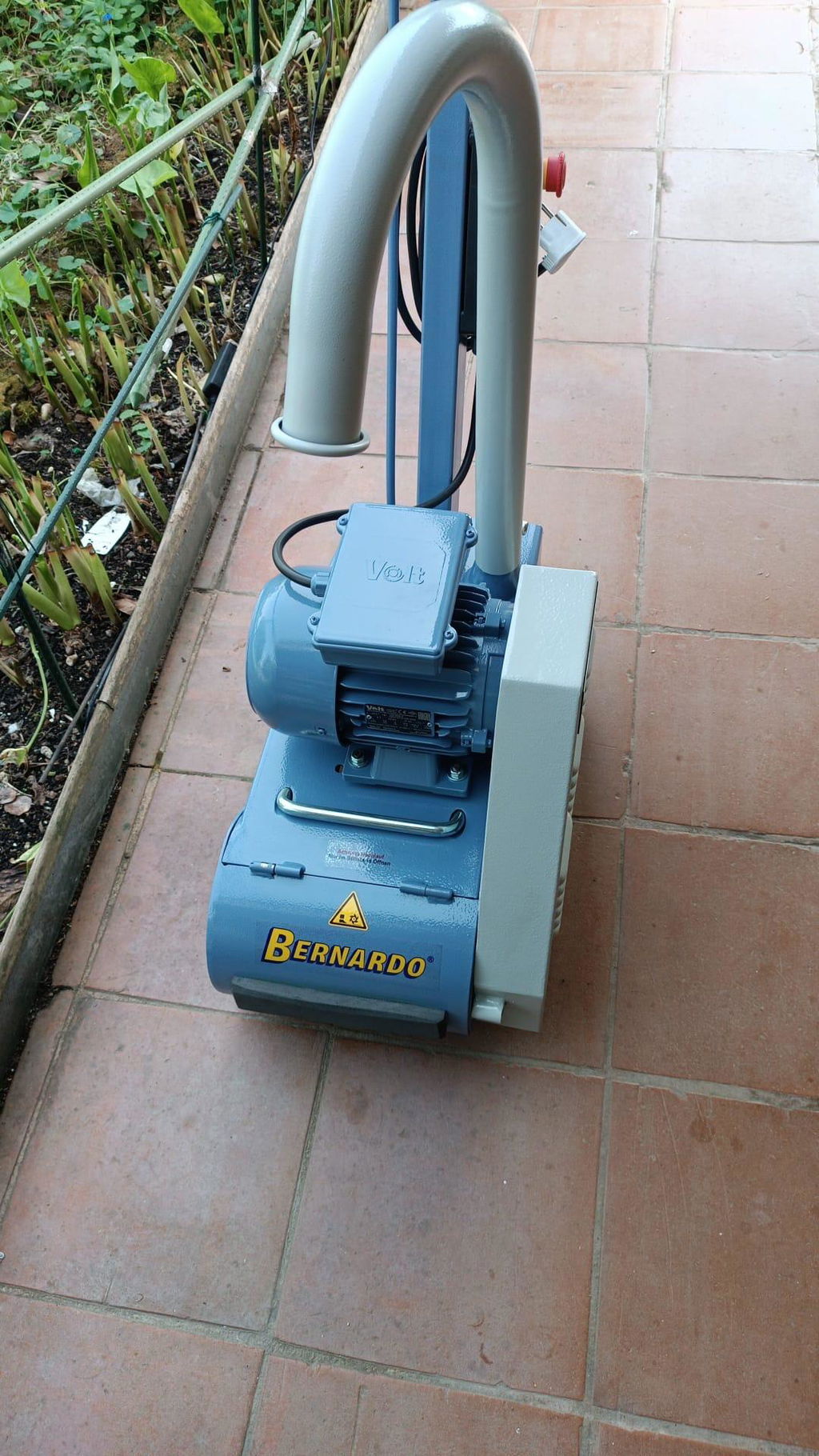


Note: Some of the products shown may be fitted with optional accessories. Subject to technical and aesthetic changes.
This promotion is not valid on discounted products or on bundled offers.
Bernardo T 650 vertical spindle moulder – 230V single-phase, 2.8 kW S1 (3.9 kW S6) motor, 4 speeds 1,800-9,000 rpm
Bernardo T 650 vertical spindle moulder – 230V single-phase, 2.8 kW S1 (3.9 kW S6) motor, 4 speeds 1,800-9,000 rpm is backordered and will ship as soon as it is back in stock.
Couldn't load pickup availability
Delivery and Shipping
Delivery and Shipping
At Krollit, we guarantee a safe and reliable shipping process. Orders are handled with the utmost care and traceability until delivery.
For international shipments, please send your request via the dedicated contact form.
Upon delivery, always sign the delivery note with the words “subject to inspection” to allow for proper handling of any irregularities or discrepancies in the product.
Our goal is to ensure you receive prompt service and a worry-free shopping experience.

Bernardo T 650 vertical spindle moulder – 230V single-phase, 2.8 kW...
Description
The Bernardo T 650 / 230V vertical spindle moulder offers a 690×480 mm table (with optional roller table 500×480 mm), a 2.8 kW S1 100% (3.9 kW S6 40%) 230V single-phase motor, 4 selectable speeds 1,800/3,000/6,000/9,000 rpm with LED display, a Ø 30 mm spindle with 100 mm vertical travel and 105 mm usable length, a max tool diameter of 200 mm (180 mm retractable), a 200 mm table opening, a Ø 100 mm dust extraction port, an included Ø 75 mm sanding sleeve, and a non-deformable steel structure. Weight 160 kg. Produced in Austria, distributed in Italy by Krollit as an official Bernardo distributor since 2007.
- Motor: 2.8 kW S1 100% (3.9 kW S6 40%) – 230V single-phase
- Spindle speed: 4 selectable: 1,800 / 3,000 / 6,000 / 9,000 rpm
- Table: 690 × 480 mm (with optional roller table)
- Spindle: Ø 30 mm, 100 mm travel, 105 mm usable length
- Max tool diameter: 200 mm (180 mm retractable)
- Additional function: Ø 75 mm sanding sleeve included
- Weight: 160 kg
Who uses the T 650 and for what
The Bernardo T 650 / 230V is the compact vertical spindle moulder in the T series, sized for medium-sized workshops with a 230V single-phase line. The 2.8 kW continuous duty motor (3.9 kW intermittent duty S6) is the highest power in the range available in a single-phase version: it allows for professional processing of standard wood types without requiring a 400V three-phase line. The 4 speeds from 1,800 to 9,000 rpm with LED display cover standard profiling and tenoning with tools up to Ø 200 mm. The included Ø 75 mm sanding sleeve is a distinctive feature of the T 650: it allows the machine to be used for sanding/grinding small pieces without having to purchase separate equipment. The selectable right/left rotation makes it suitable for sanding against the grain for delicate wood types. In Krollit customer workshops, it is chosen by artisanal carpentry shops with a 230V domestic line, medium-sized artisanal workshops, advanced woodworking hobbyists, and multi-function workshops that alternate milling and sanding on medium-sized pieces.
Its place in the Bernardo range
The T 650 occupies the intermediate range of the Bernardo T spindle moulder family. Below it: T 500 PR (1.5 kW motor, 99 kg weight, also available in 230V and 400V) entry-level. Above it: T 600 R (2.2 kW motor, 196 kg weight, 2 speeds 3,500/7,000) intermediate with larger table. Top of the family: T 1300 and T 1300 E with 5.5 kW three-phase motor. The T 650 has distinctive features: the most powerful single-phase motor in the 230V range (2.8 kW vs 1.5 kW of the T 500 PR), 4 speeds (vs 2 of the T 600 R, 4 of the T 500 PR), included sanding sleeve. For workshops without three-phase power, the choice between T 650, T 600 R 230V, and T 500 PR 230V depends on the required power and budget: T 500 PR for medium entry-level use, T 650 for standard professional use (the most powerful in single-phase), T 600 R 230V for a larger table.
Krollit logistics and support
Bernardo shipping in 5-9 working days (7 days to the South). At 160 kg, it requires a pallet jack or two people to unload and move with care. Dimensions 770 × 480 × 1,200 mm. Sanding sleeves, cutters, accessories, and original Bernardo spare parts available from stock with 3-5 working day shipping. Customer support available in Italian.
Who the T 650 is for
| Profile | Compatibility | Reason |
|---|---|---|
| Passionate advanced woodworking hobbyist | Recommended | 230V single-phase compatible with any domestic socket, powerful 2.8 kW motor, 4 speeds cover various operations. Sanding sleeve adds sanding functionality. |
| Artisanal carpentry without three-phase line | Recommended | Most powerful Bernardo spindle moulder in 230V version (2.8 kW vs 1.5 kW of the T 500 PR). Suitable for standard artisanal daily use. |
| Multifunction wood workshop | Recommended | Included Ø 75 mm sanding sleeve allows sanding/grinding without separate machines. Space and investment saving for compact workshops. |
Not suitable for: continuous professional intensive use (the T 1300 in three-phase is correctly sized); workshops with pieces over 200 mm tool diameter (consider T 1300 with tools up to 335 mm); applications requiring integrated table extension (T 1300 E); very hard tropical woods with large tools (2.8 kW motor at its limit).
Technical specifications
Table
| Specification | Value |
|---|---|
| Table dimensions | 690 × 480 mm |
| Roller table (optional) | 500 × 480 mm |
| Working height | 900 mm |
| Table opening | 200 mm |
Spindle and tools
| Specification | Value |
|---|---|
| Spindle diameter | 30 mm |
| Spindle vertical travel | 100 mm |
| Usable spindle length | 105 mm |
| Max tool diameter | 200 mm |
| Max retractable tool diameter | 180 mm |
Speed
| Specification | Value |
|---|---|
| Speed positions | 4 |
| Spindle speed | 1,800 / 3,000 / 6,000 / 9,000 rpm |
| Display | Electronic LED display |
Motor and power supply
| Specification | Value |
|---|---|
| Motor power S1 100% | 2.8 kW (3.8 HP) |
| Motor power S6 40% | 3.9 kW (5.3 HP) |
| Power supply | 230V – 50Hz – single-phase |
| Rotation | Selectable right/left |
Additional functions
| Specification | Value |
|---|---|
| Sanding sleeve | Ø 75 mm included |
| Dust extraction port | Ø 100 mm |
Dimensions and weight
| Specification | Value |
|---|---|
| Machine dimensions (L × W × H) | 770 × 480 × 1,200 mm |
| Approximate weight | 160 kg |
| Structure material | Non-deformable steel + cast iron milling unit |
Compliance
| Specification | Value |
|---|---|
| Marking | CE |
Included equipment
Standard equipment
- Bernardo T 650 / 230V spindle moulder
- Electronic speed indicator
- Ø 75 mm sanding sleeve
- Right/left rotation device
- Integrated safety guides
- Protection device and pressure shoe
Warranty
Warranty terms and support procedures are available on the dedicated Krollit page.
View Krollit warranty termsFAQ / Frequently asked questions
Frequently asked questions
What do S1 and S6 mean in motor power ratings?
S1 100% is continuous duty: 2.8 kW is the power the motor can deliver for hours without overheating. S6 40% is intermittent duty: 3.9 kW for cycles of 4 minutes of work + 6 minutes of rest.
For daily use in production, the reference power is S1 (2.8 kW continuous). For specific high-load operations (large tools, hard woods), the S6 boost up to 3.9 kW can be used for a short time. Exceeding the S6 duty cycle causes the motor to overheat, potentially triggering the thermal protection.
Is the included sanding sleeve really usable for serious sanding?
Yes, for sanding and grinding small pieces. For sanding large panels or series production, dedicated sanders (BDS, BS from the Bernardo range) are needed.
The Ø 75 mm sleeve is sized for light finishing of profiles, chamfers, and sanding curved surfaces. The adapted spindle speed (1,800-3,000 rpm are optimal for abrasion). For sleeve replacement: compatible Ø 75 mm abrasive belts are standard on the market. For series production of panel sanding, the Bernardo BDS 75 (dedicated sander) is correctly sized.
Does the 2.8 kW motor really work on any 230V socket?
On standard 3 kW meters, it works but at the limit. At startup, it can reach peaks that trip the circuit breaker. For continuous use, a dedicated commercial or industrial meter is recommended.
For workshops with other machines running simultaneously, check the available power. The T 650 at S6 startup can reach 3.9 kW: on a 3 kW meter, it's at the limit. For workshops with predominant use of one machine at a time, operation is regular. For intensive use, a dedicated industrial meter (at least 4.5 kW) is recommended.
Can I also work with hard woods (oak, beech)?
Yes, with adequate speeds (3,000-6,000 rpm on standard beech) and good quality tools. For very hard tropical woods with large tools, the 2.8 kW motor may be at its limit.
Hard woods require lower cutting speeds and slower feed rates. The 4 speeds of the T 650 adequately cover standard European woods. For daily use on oak, beech, cherry, the machine is correctly sized. For regular production on tropical woods (iroko, teak, padauk) or tools over Ø 180 mm, consider the T 1300 with a 5.5 kW motor.
Is right/left rotation really useful?
Yes, for sanding against the grain on delicate woods and for specific milling geometries. It changes the cutting direction of the cutter relative to the piece, altering how the wood is removed.
Reversing the rotation requires using cutters designed for bidirectional use or specific cutters for each direction. For standard operations, counter-clockwise rotation is the convention. For finishing wood with opposing grain or to eliminate tear-out on knotty woods, reversing the rotation produces better results. This professional feature is rare in entry-level moulders from other brands.
-
Product safety
-
Reviews
Product safety


Reviews
Optional accessories
-

-

-

Bernardo
Bernardo Automatic Starting System ALV 2 / M 230
€118,03 (22% VAT incl.)Unit price /Unavailable -
 Sale
SaleBernardo
Bernardo Spiral Suction Hose PU dia. 100 mm (6 m)
€137,71 (22% VAT incl.)€152,46Unit price /Unavailable -

Bernardo
Bernardo universal dividing head set 100 x 40 x 30 mm
€201,65 (22% VAT incl.)Unit price /Unavailable -

Bernardo
Bernardo Machine Tool Accessory Live Center AF 32
€684,02 (22% VAT incl.)Unit price /Unavailable -

Bernardo
€580,82 (22% VAT incl.)Unit price /Unavailable -

-

-

Bernardo
Bernardo MOVIMENTAZIONE UFW 300 Transport Trolley
€98,36 (22% VAT incl.)Unit price /Unavailable