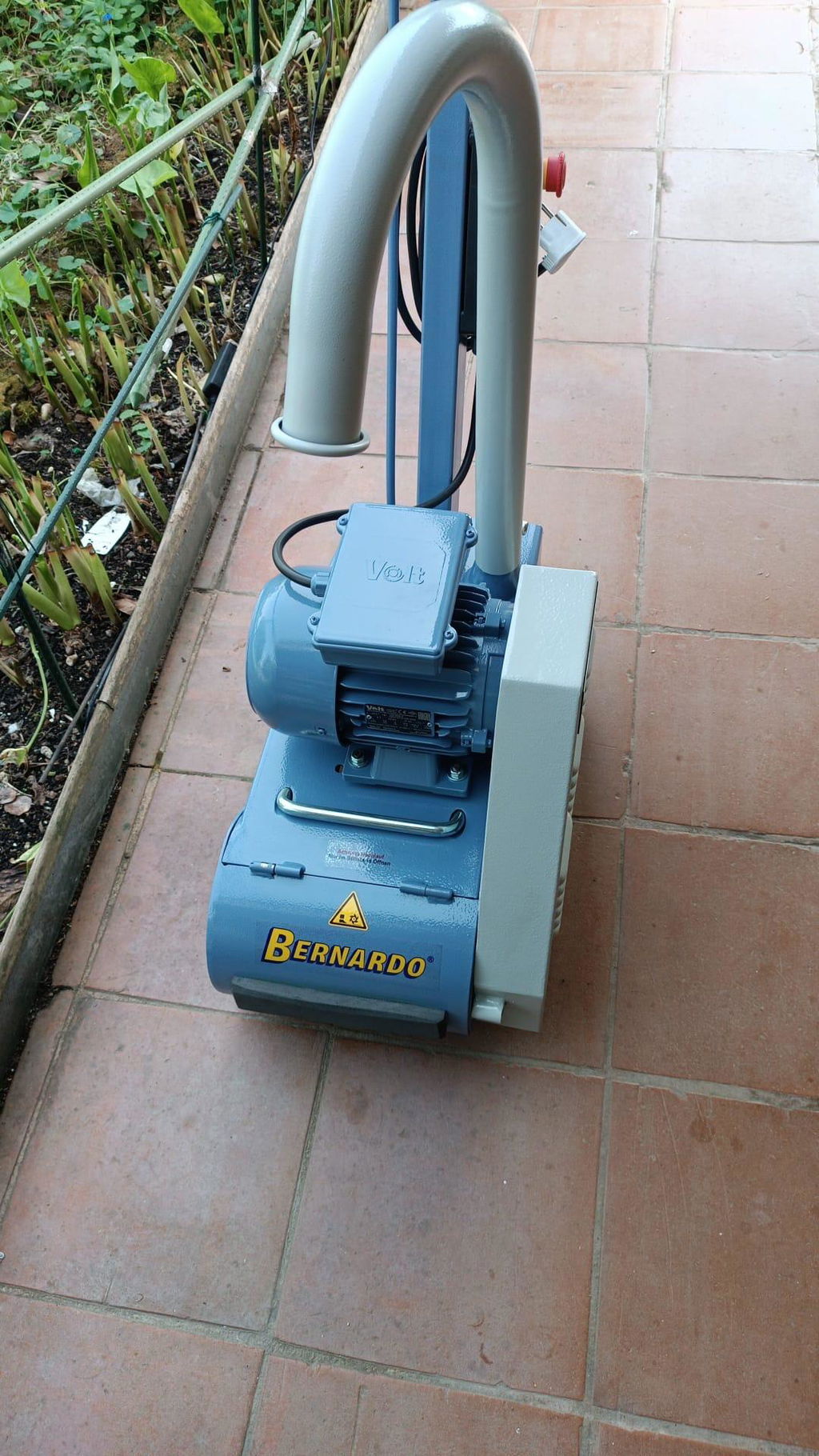


Bernardo DC 450 CF fine dust extractor - 400V semi-professional - flow rate 2800 m³/h, 4.0 m² filter surface, 1.5 kW motor, 400V, weight 49 kg
Bernardo DC 450 CF fine dust extractor - 400V semi-professional - flow rate 2800 m³/h, 4.0 m² filter surface, 1.5 kW motor, 400V, weight 49 kg is backordered and will ship as soon as it is back in stock.
Arrivo previsto per inizio Ottobre
Iscriviti alla nostra newsletter
Ricevi gli ultimi aggiornamenti su tutte le nostre nuove collezioni, saldi, offerte e date di arrivo dei prodotti.
-
Descrizione
-
Sicurezza del prodotto
-
Recensioni
Descrizione
The Bernardo DC 450 CF - 400V dust collector is a mid-range dust collector for professional workshops with a cartridge filter for fine dust. It offers an air flow of 2800 m³/h, a filter surface of 4.0 m², a maximum vacuum of 1800 Pa, a suction diameter of 1 × Ø 130 mm / 2 × Ø 100 mm, a collection bag volume of 300 liters, a 1.5 kW (S1 100%) / 2.1 kW (S6 40%) 400V motor, a sound level of 87 dB, dimensions of 860 × 670 × 2210 mm, and a weight of 49 kg. It has an integrated trolley for easy handling and a robust steel structure. Suitable for joinery and woodworking workshops. Made in Austria, distributed in Italy by Krollit as the official Bernardo distributor since 2007.
- Air flow: 2800 m³/h
- Filter surface: 4.0 m²
- Maximum vacuum: 1800 Pa
- Suction diameter: 1 × Ø 130 mm / 2 × Ø 100 mm
- Collection volume: 300 liters
- S1 100% motor: 1.5 kW
- Voltage: 400V
- Weight: 49 kg
Who uses the DC 450 CF - 400V and for what
The Bernardo DC 450 CF - 400V dust collector is sized for professional workshops with 2-3 machines connected simultaneously. The 2800 m³/h flow rate and the 1 × Ø 130 mm / 2 × Ø 100 mm connection allow for flow distribution to multiple workstations via the included Y-adapter. For correct sizing, each machine typically requires 600-1,200 m³/h: the DC 450 CF - 400V model with a 2800 m³/h flow rate handles 2-3 machines active simultaneously. The FP 2 cartridge filter effectively captures fine dust (PM 10 and below), a crucial feature for operator safety: wood dust is carcinogenic, and chronic exposure is regulated by European occupational risk regulations. In Krollit customers' workshops, the DC 450 CF - 400V is chosen by professional woodworking shops with multiple machines, mixed workshops with standard dust collection needs, and growing workshops.
Its place in the Bernardo range
The Bernardo DC dust collector range is organized into 3 families: Compact family: DC 180 (850 m³/h, hobbyist) and DC 250 CF (1,500 m³/h, semi-professional). For workshops with a single machine at a time or occasional use. Medium family: DC 350 CF (2,800 m³/h), DC 450 CF (2,800 m³/h, single bag 300 L vs 200 for the 350), DC 550 CF (4,400 m³/h with double bag). For professional workshops with multiple machines connected. Industrial family: DC 650 CF (5,310 m³/h, 3 bags), DC 750 CF (7,800 m³/h, 4 bags), DC 850 CF (9,500 m³/h, top of the range). For joineries and production departments with multiple machines and fixed extraction systems. DC 450 CF / 400V is the three-phase version with a single 300 L bag (vs DC 350 CF with a 200 L bag). For workshops with three-phase power, it is the correctly sized choice: motor with soft start, superior durability in continuous use.
Krollit logistics and support
Bernardo shipping in 5-9 working days (7 days to the South). With a weight of 49 kg, it requires two people for unloading and handling, or a pallet jack. Dimensions 860 × 670 × 2210 mm: check the workshop height. Original Bernardo replacement filter cartridges, collection bags, and accessories are available from stock with 3-5 working days shipping. Italian-speaking customer support available.
Who the DC 450 CF - 400V is for
| Profile | Compatibility | Reason |
|---|---|---|
| Advanced hobbyist | Adequate | Oversized for standard hobbyist use. For more limited use, consider DC 180 or DC 250 CF. |
| Professional woodworking shop | Recommended | 2800 m³/h flow rate and 1 × Ø 130 mm / 2 × Ø 100 mm connection suitable for 2-3 connected machines. Integrated trolley for movement between workstations. |
| Mixed metal-wood workshop | Recommended | FP 2 filter cartridge sized for fine dust: effectively captures both coarse chips and fine particulate matter. |
Not suitable for: industrial workshops with long fixed piping systems or large capacity machines (the industrial family DC 650/750/850 is correctly sized); applications requiring prolonged work autonomy without emptying bags (the industrial family with multi-bags 190 L offers greater total capacity); workshops with 5+ machines connected simultaneously; applications with flammable or explosive dusts (certified ATEX dust collectors are required).
Suction capacity
| Specification | Value |
|---|---|
| Maximum air flow | 2800 m³/h |
| Maximum vacuum | 1800 Pa |
| Suction diameter | 1 × Ø 130 mm / 2 × Ø 100 mm |
Filtration
| Specification | Value |
|---|---|
| Cartridge type | FP 2 filter cartridge |
| Filter surface | 4.0 m² |
Collection system
| Specification | Value |
|---|---|
| Collection volume | 300 liters |
| System type | Single bag 300 L |
Motor and power supply
| Specification | Value |
|---|---|
| Motor power S1 100% | 1.5 kW |
| Motor power S6 40% | 2.1 kW |
| Rotation speed | 2950 rpm |
| Voltage | 400V |
| Frequency | 50 Hz |
Noise level
| Specification | Value |
|---|---|
| Sound level | 87 dB |
Dimensions and weight
| Specification | Value |
|---|---|
| Machine dimensions (L × W × H) | 860 × 670 × 2210 mm |
| Weight | 49 kg |
Compliance
| Specification | Value |
|---|---|
| Marking | CE |
| Directive | Machinery 2006/42/EC |
Standard equipment
- Bernardo DC 450 CF - 400V dust collector
- FP 2 cartridge filter
- 300 liter collection bag
- Y-adapter (1 × 130 mm / 2 × 100 mm)
- Integrated transport trolley
- User manual in Italian
Frequently Asked Questions
Is the 2800 m³/h flow rate really sufficient for my machines?
It depends on the number and type of machines. For effective dust collection, each woodworking machine typically requires 600-1,200 m³/h: a miter saw 600-800 m³/h, a panel saw 1,000-1,500 m³/h, a jointer/planer 1,500-2,000 m³/h. The DC 450 CF - 400V with a 2800 m³/h flow rate handles 2-3 machines active simultaneously.
For correct sizing, also consider system pressure losses: each meter of Ø 100 mm flexible hose reduces by approximately 50-100 Pa, each 90° bend adds 100-150 Pa. The maximum vacuum of the DC 450 CF - 400V is 1800 Pa: with piping longer than 10-15 m, the actual flow rate is significantly reduced. For complex systems, consult a qualified installer.
Is the FP 2 cartridge filter really effective against fine dust?
Yes. The FP 2 cartridge is sized for filtering fine dust (PM 10 and smaller particles). Filtering efficiency is typically 99% or higher for particulate matter above 1 μm.
Wood dust is classified as carcinogenic to the nasal cavity (IARC Group 1). Professional woodworking shops are subject to European regulations on exposure (Directive 2017/2398/EU). FP cartridge filters meet the efficiency requirements for standard professional use. For ultra-fine dust (exotic woods, composite MDF/impregnated chipboard), consider HEPA H13 cartridges (99.95% efficiency) as an optional accessory.
How long do the filter cartridges last?
In standard daily artisan use, an FP 2 cartridge typically lasts 2-3 years before requiring replacement. The sign is a progressive reduction in airflow despite cleaning.
Filter cartridges are consumables with a finite lifespan. Periodic cleaning (weekly or when a reduction in flow is noticed) significantly extends their life: compressed air from outside to inside, never with liquids or aggressively to avoid damaging the filter media. Original Bernardo FP 2 cartridges are available from stock with 3-5 working days shipping.
Can I connect the dust collector in my workshop to residential electrical lines?
For the DC 450 CF - 400V (400V, 1.5 kW S1 motor), check available power. An industrial 400V three-phase line is required: the motor will not work on residential meters.
For intensive use, a dedicated meter is recommended. The motor's starting current can reach 1.5-2x the nominal power (S6 40%): 2.1 kW. On borderline meters, starting may trip the circuit breaker, especially with other machines on. For professional workshops, a dedicated industrial meter for the dust collection system is recommended.
How noisy is it?
Declared sound level 87 dB during operation. For reference: moderate road traffic 70 dB, normal conversation 60 dB, critical level for the ear after 8 hours of exposure 85 dB.
The 87 dB level is typical for dust collectors in its class. For prolonged use in enclosed spaces, the use of noise-canceling headphones (mandatory PPE in professional woodworking shops according to safety regulations) is recommended. To reduce noise in shared workshops, consider acoustic isolation booths or positioning the dust collector in a dedicated compartment.
Sicurezza del prodotto
Recensioni
Accessori
-

Bernardo
Accessory for Bernardo dust extraction system Fine dust filter cartridge FP 2
€297,06 (22% VAT incl.)Unit price /Unavailable -

Bernardo
Accessory for Bernardo dust extraction system Fine dust filter cartridge FP 3
€408,22 (22% VAT incl.)Unit price /Unavailable -
 Sale
SaleBernardo
Bernardo Spiral Suction Hose PU dia. 100 mm (6 m)
€137,71 (22% VAT incl.)€152,46Unit price /Unavailable -
 Pre-order
 -

-

Bernardo
€27,54 (22% VAT incl.)Unit price /Unavailable -

Bernardo
Bernardo Automatic Starting System ALV 2 / M 230
€118,03 (22% VAT incl.)Unit price /Unavailable -
 Pre-order
Bernardo
Bernardo clamping kit for FP 2 / FP 3 / DC series CF
€19,67 (22% VAT incl.)Unit price /Unavailable