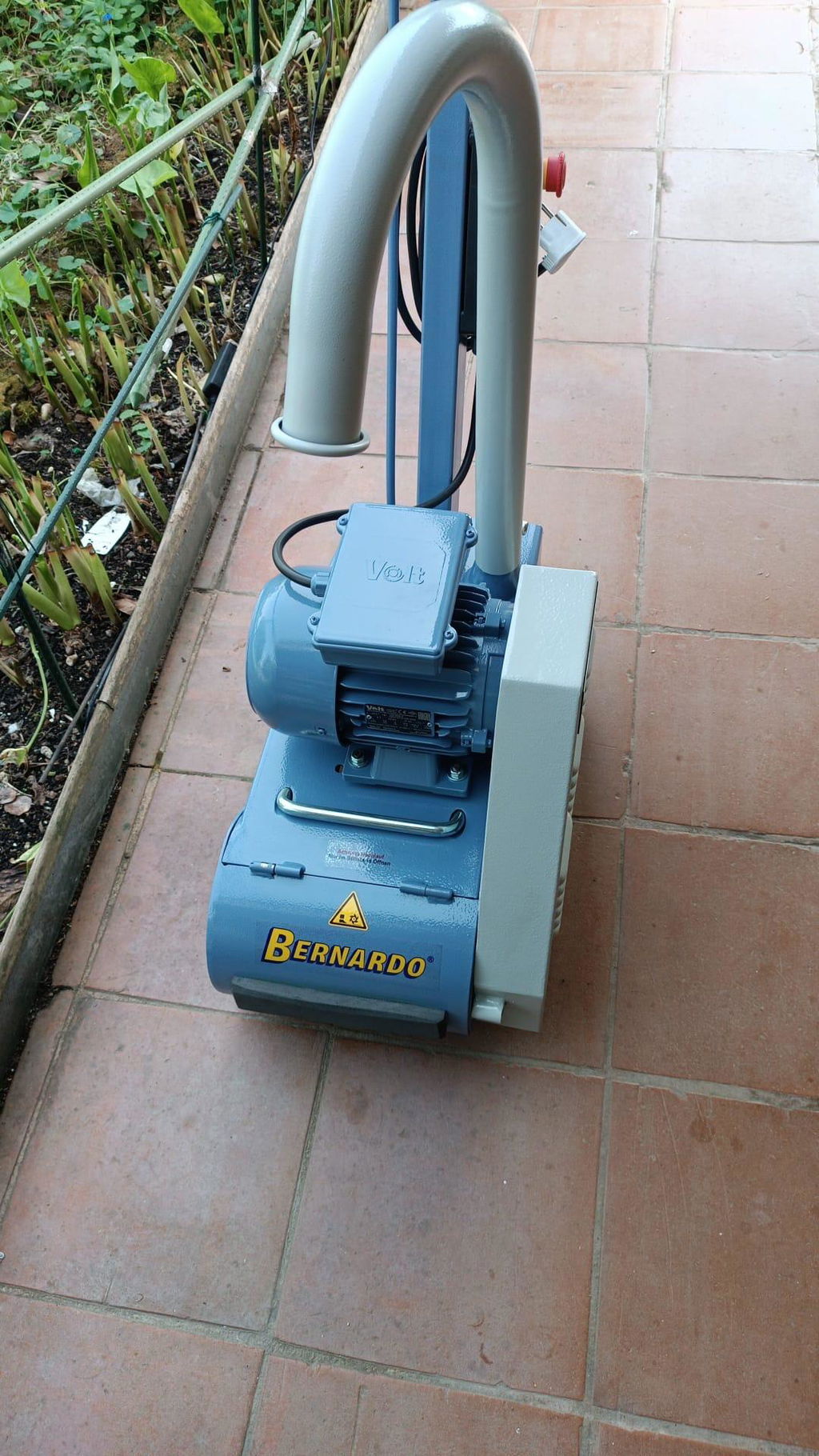


A bench grinder is a stationary machine with rotating grinding wheels (Ø150-400mm, 2,850-3,000 RPM) used for sharpening tools, deburring metals, and polishing surfaces. What is it used for? Primarily for sharpening chisels and planer blades (25-35° angle), sharpening HSS drill bits (118° angle), removing weld beads, and polishing small parts. To choose the right one, you need to consider power (150W-2.2kW), wheel diameter, RPM speed, and type. Let's look at everything in detail.
What is a Bench Grinder
A bench grinder (also called a bench grinding machine) is a stationary power tool that is fixed to a workbench with screws or clamps. Unlike an angle grinder (portable, for cutting and deburring large pieces), the bench version is designed for precision work: the workpiece is brought to the grinding wheel, not vice versa.
The heart of the machine is a central electric motor that transmits motion directly to the shaft. Grinding wheels are mounted on each side, secured with metal flanges and cushioning washers (blotters) made of compressed paper 0.36-0.5mm thick.
Main Components
- Electric motor: powers from 150W (hobbyist) to 2.2kW (industrial), speeds 1,400-3,000 RPM
- Shaft/spindle: standard bores 12.7mm, 16mm, 20mm or 32mm
- Abrasive wheels: one or two, diameters from 125mm to 400mm, widths 16-50mm
- Wheel guards: cover at least 180° of the wheel (mandatory for safety)
- Spark arrestors: maximum distance 5-6mm from the abrasive surface
- Tool rests: adjustable, maximum distance 2mm from the wheel
- Bearings: encapsulated ball bearings in professional models (longer lifespan)
What It's Used For: The 5 Main Applications
Here's what a bench grinder is actually used for in carpentry and workshops:
1. Sharpening Woodworking Tools
The most common application in carpentry. You can sharpen chisels, gouges, planer blades, and lathe tools. Correct angles are essential:
Tool
Primary Angle
Secondary Angle
Notes
| Bench chisels | 25° | 30-35° | Used with mallet |
| Mortise chisels | 20° | 30-35° | Hardwood, heavy use |
| Planer blades | 25° | 30° | Universal angle |
| Gouges | 25-30° | 35° | Variable for profile |
Pay attention to temperature: exceeding 250°C, carbon steel loses its temper (the color turns blue). Use light touches, 10-15 second intervals, and frequent cooling in water.
2. Sharpening HSS Drill Bits
The drill bit angle determines its effectiveness on different materials:
Material
Point Angle
Clearance Angle
| Mild steel, iron | 118° (standard) | 8-12° |
| Hard steel, stainless steel | 135° | 6-8° |
| Aluminum, soft metals | 90-100° | 12-15° |
| Wood, plastic | 60-90° | 12-15° |
3. Metal Deburring
After cutting with a hacksaw, angle grinder, or welding, metal parts have burrs and sharp edges. A coarse-grit wheel (K36-K46) quickly removes excess material. For heavy weld beads, use K24-K36 grit.
4. Polishing
By replacing the abrasive wheel with a felt or cotton disc and using polishing pastes, you can achieve mirror finishes on metals. The correct sequence:
- Sisal disc + black paste (emery) → cleaning
- Cotton disc + brown paste (tripoli) → scratch removal
- Flannel disc + green paste (chromium oxide) → pre-polishing
- Soft disc + blue paste → mirror finish
5. Cleaning and Brushing
Combined models with a wire brush (KSE series) allow you to remove rust, paint, encrustations, and welding residues from metal surfaces.
Types of Bench Grinders
There are four main configurations, each with specific applications:
1. Double Grinder (most common)
Mounts two abrasive wheels on the same axle. Typical configuration: one coarse-grit (K36) for roughing and one fine-grit (K60-K80) for sharpening. Standard speed: 2,850-3,000 RPM.
Models:
- DS Series: DS 150 S (€189), DS 200 S (€250), DS 250 S (€364), DS 300 S (€1,188)
- DSA Series with LED and cooling tank: DSA 200 (€244) — our Best Buy choice
- Professional Flott Series: TS 200 SD P (€1,388)
Ideal for: tool sharpening, general deburring, universal workshop use.
2. Combined Grinder Wheel + Belt
One side mounts the abrasive wheel, the other an abrasive belt (common sizes: 685×50mm or 1016×75mm). The belt is excellent for sanding flat and curved surfaces that the grinding wheel cannot reach, with quick grit changes.
Bernardo Models: KSA 150 (€171), KSA 200 (€210), KMS 200 S (€360). All KSA models include LED and cooling tank as standard.
Ideal for: those needing both grinding and sanding in one machine.
3. Combined Grinder Wheel + Brush
One abrasive wheel + one steel wire brush. The brush removes rust, paint, encrustations, and weld residues without removing base material.
Krollit Models: KSE 200 (€215).
Ideal for: mechanical workshops, restoration, surface preparation for painting.
4. Wet Grinder (Sharpener)
Works on a radically different principle: the grinding wheel partially immersed in water rotates at a very low speed (90-150 RPM compared to 3,000 for dry versions). This combination eliminates the risk of losing temper, making these models ideal for quality blades.
Typical features: wheel Ø200-250mm, grit 200-220, power 150-200W.
Ideal for: professional sharpening of knives, planer blades, precision HSS tools.
5. Disc Grinder
A large vertical abrasive disc (Ø250-500mm) with an inclinable table. For sanding flat surfaces, creating precise bevels, finishing edges.
Models: TS 250 (€189), TS 300 (€275), TS 300 Pro (€484), TS 510 Vario with inverter (€2,290).
Ideal for: carpentry, edge processing, precise angled bevels.
How to Choose: The 6 Fundamental Criteria
To choose the right bench grinder, evaluate these parameters in order of importance. If you prefer a quick guide with recommended models, check out our ranking of the best bench grinders.
1. Motor Power
Power determines which materials you can work with and for how long without overheating:
Power
Usage
Session Duration
Power Supply
| 150-250W | Occasional hobbyist | 15-30 minutes | 230V |
| 400-550W | Regular use | 1-2 hours | 230V |
| 750W-1kW | Semi-professional | 2-4 hours | 230V/400V |
| 1.5-2.2kW | Continuous industrial | 8+ hours | 400V three-phase |
2. Wheel Diameter
Larger wheels distribute heat over a larger area and wear out more slowly:
Diameter
Usage
Machine Weight
| Ø125-150mm | Hobbyist, confined spaces | 5-10 kg |
| Ø175-200mm | Versatile, good compromise | 10-20 kg |
| Ø250mm | Semi-professional | 20-35 kg |
| Ø300-400mm | Industrial, intensive use | 35-60+ kg |
Practical rule: for home use, Ø150-200mm represents the optimal compromise between performance, size, and price.
3. Speed (RPM)
Speed drastically influences the sharpening result:
- 2,850-3,000 RPM: standard, for fast roughing and deburring
- 1,400-1,500 RPM: low speed, for sharpening (less overheating)
- 90-150 RPM: wet sharpeners, for delicate blades without risk of losing temper
Tip: if you primarily use the grinder for sharpening, look for low-speed models or those with a variable speed drive (inverter).
4. Grit of the Wheels
Grit determines aggressiveness and surface finish:
Grit
Classification
Application
| K24-36 | Very Coarse | Heavy roughing, weld beads |
| K46-54 | Coarse | General deburring |
| K60 | Medium | Universal use, coarse sharpening |
| K80 | Fine | Tool sharpening, finishing |
| K100-120 | Very Fine | Fine sharpening, pre-polishing |
| K200-220 | Finest | Wet wheels, precision knives |
The most versatile combination is K36 + K80, included in most double grinders.
5. Wheel Material (Color Matters)
The color of the grinding wheel indicates the abrasive material and determines which metals it can work with:
- Gray (corundum 96%): general use on common steels, economical but heats up a lot
- White (corundum 99%): the professional choice for sharpening—cuts "cooler", ideal for HSS and hardened steels
- Green (silicon carbide): for hard metals (carbide), non-ferrous metals, cast iron
- Pink (corundum 99%): special steels, saw sharpening
Expert tip: replace standard gray wheels with white wheels for sharpening—the difference is huge.
6. Included Accessories
Evaluate the standard equipment that makes a difference in daily use:
- LED light: illuminates the work area (DSA models)
- Cooling tank: for immersing tools during sharpening
- Adjustable spark arrestors: essential for safety
- Adjustable tool rest: for precise sharpening at specific angles
- Magnifying glass: for precision work (some pro models)
Table: Which Grinder for Your Use
User Profile
Features
Krollit Models
Budget
|
Occasional Hobbyist (<5h/week) |
Ø150mm, 250W, double or combined | DS 150 S, KSA 150 | €171-189 |
|
Advanced Hobbyist (5-15h/week) |
Ø200mm, 400-550W, with LED and cooling | DSA 200, KSA 200 | €210-244 |
|
Semi-Professional (15-30h/week) |
Ø200-250mm, 900W+, robust construction | DS 200 S, KMS 200 S, DS 250 S | €250-364 |
|
Professional (>30h/week) |
Ø300mm, 2.2kW, 400V three-phase | DS 300 S, Flott TS 200 SD P | €1,188-1,388 |
|
Carpentry (edge sanding) |
Vertical disc, inclinable table | TS 250, TS 300 Pro, TS 510 Vario | €189-2,290 |
|
Blade Sharpening (knives, planers) |
Wet, 90-150 RPM | Specific models | €150-400 |
Safety: Mandatory Regulations and Procedures
A bench grinder is a potentially dangerous tool. An exploding grinding wheel projects fragments at speeds of 126-450 km/h.
Reference Regulations
- EN 12413: safety requirements for bonded abrasive products
- EN ISO 16089: safety of stationary grinding machines
- Legislative Decree 81/08: PPE obligations (Articles 75-78)
Mandatory PPE
- EN 166 safety glasses: even with spark arrestors, shards can bounce
- Hearing protection: mandatory above 85 dB(A)
- FFP2 mask: recommended for dry processes
- Gloves: only for wheel changes, never during operation (risk of entanglement)
The Ring Test: Check Before Each Assembly
Before mounting a new wheel, perform the sound test:
- Dry wheel, not mounted
- Suspend it by the center hole
- Tap gently 2.5-5cm from the edge
- Rotate 45° and repeat
Clear, metallic sound = intact wheel. Dull sound = damaged wheel, DO NOT use.
Critical Safety Distances
- Work rest: maximum 2mm from the wheel
- Spark guard: maximum 5-6mm from the wheel
- Guard: must cover at least 180° of the wheel
Maintenance: Wheel Dressing and Replacement
When to Dress the Wheel
Dressing removes worn grains and accumulated material. Signs that it's needed:
- Shiny surface ("glazed")
- Reduced cutting efficiency
- Increased heat generation
- Abnormal vibrations
Tools: diamond dresser (precision) or star dresser (roughing). Frequency: every 2-3 hours of intensive use.
When to Replace the Wheel
- Visible cracks or negative ring test
- Diameter reduced to below 70% of original
- Distance from the flange less than 25mm
- Expiration date exceeded (3 years for resinoid, 10 years for vitrified)
Frequently Asked Questions
What is the difference between a bench grinder and a bench wheel?
They are the same thing. "Mola da banco" (bench wheel) is the traditional Italian term, while "smerigliatrice da banco" (bench grinder) is the more modern one. Both refer to a stationary machine with rotating wheels for sharpening and deburring.
What is a bench grinder used for?
It is mainly used for 5 operations: sharpening woodworking tools (chisels, planes, gouges), sharpening HSS drill bits, deburring metals after cutting or welding, polishing small metal parts, and cleaning rust from surfaces with a wire brush.
Can I use a bench grinder for wood?
Not directly on wood surfaces—abrasive wheels are for metal. For wood, use a disc grinder (TS series) with abrasive paper. However, a bench grinder is essential for sharpening woodworking tools (chisels, plane irons, gouges).
How many RPM are needed for sharpening?
For optimal sharpening: 1,400-1,500 RPM (low speed) to avoid overheating. At 3,000 RPM, you need very short intervals and frequent water cooling. For quality knives and blades, a water sharpener at 90-150 RPM is ideal.
What grit should I use to sharpen chisels?
Use K60-K80 grit for shaping the primary bevel on the grinder, then finish with water stones (1000 → 3000 → 6000 grit) and a leather strop for the final edge. K36 grit is too aggressive and risks damaging the tool.
Is a double or combined grinder better?
A double grinder (two wheels) is more versatile for sharpening and deburring with two different grits. A combined wheel+belt grinder is better if you also need to sand flat surfaces. For general woodworking use, we recommend the double grinder with white wheels.
What does it mean when the wheel becomes shiny?
A "glazed" wheel has lost its aggressiveness: the grains are worn and the pores are clogged with material. Dressing with a diamond or star dresser is needed to expose new cutting grains.
How do I avoid damaging the tempering of tools?
Three rules: light and short touches (10-15 seconds), frequent cooling in water, and using white wheels (cut cooler than gray ones). If the steel turns blue, you've exceeded 290°C and the tempering is compromised. For valuable blades, use a water sharpener.
Conclusion
The bench grinder is an essential tool for any workshop or woodworking shop. For most hobbyists, a model with Ø150-200mm wheels and 250-550W power is sufficient. Professionals should opt for Ø250mm+ with motors from 900W upwards.
Models with LED and cooling tank (DSA and KSA series) offer the best comfort for sharpening. For those who also need sanding, the combined wheel+belt grinders (KSA, KMS series) are the most versatile choice. For sharpening quality blades without risk, consider a water sharpener.
26 professional models Bernardo and Flott
From €171 • Shipping throughout Italy • Specialized technical assistance
✓ Prices include VAT • ✓ Official warranty • ✓ Original spare parts