

There's something magical about creating an object with your own hands that evokes winter, snow, and the warmth of the holidays. Forget old, heavy, and rough sleds: today, we're guiding you through building a modern oak sled, a minimalist Scandinavian-style design piece that's as beautiful to display in your living room as it is fun to pull across packed snow.
This project isn't just an assembly; it's an opportunity to learn a fascinating technique: laminated wood bending. Don't worry, it sounds complex, but with the right instructions and proper equipment (like what you find at Krollit), it's a job within reach of any DIY enthusiast.
This guide is structured like a professional assembly manual, with clear illustrations for each step. Ready to make some sawdust?
What is this project?
This is a complete guide to building a backless designer sled, featuring curved runners made of laminated oak. The structure is sturdy yet elegant, intended to be a valuable winter decor item or a light pull-sled. The design is clean, geometric, and modern, perfect for those who love Scandinavian style.
Technical Specifications and Required Materials

Before starting, let's make sure we have everything we need. The success of this project lies in the precision of the initial cuts and the quality of the materials.
Finished Project Data
- Dimensions (L x W x H): 80 cm × 32 cm × 23 cm
- Material: Solid oak
- Main technique: Lamination (wood bending)
- Bending radius: 180 mm
Material List (Oak Wood)
All measurements are in millimeters (mm).
| Label | Component | Quantity | Rough Measurements (mm) | Notes |
|---|---|---|---|---|
| R | Runner Lamellae | 24 total | 820 × 30 × 4 | 12 lamellae needed for each runner. Essential thickness: 4mm. |
| T | Frame Crossmembers | 2 pieces | 320 × 40 × 20 | Vertical supporting structure connecting the runners. |
| S | Seat Slats | 3 pieces | 320 × 80 × 20 | The wide slats for the upper seat. |
| F | Front Bar | 1 piece | 260 × 25 × 25 | Front reinforcement element with a hole for the rope. |
Hardware and Consumables
- Structural Adhesive: Polyurethane adhesive class D4 (Essential for water and snow resistance).
- Screws: Torx screws 4 × 50 mm (or similar specific for hardwood).
- Tow rope: Nylon or natural jute rope, Ø 6 mm.
- Jig Material: An MDF or plywood panel at least 18 mm thick to create the curve mold.
Recommended Equipment (Krollit Partner)
To achieve precise and safe results like those shown in our illustrations, the use of stationary workshop machines is highly recommended:
- Bandsaw: Essential for "slicing" solid wood to obtain thin 4 mm lamellae with precision and little material waste.
- Thickness Planer: Necessary to calibrate the lamellae to a perfectly uniform thickness and make them smooth for optimal gluing.
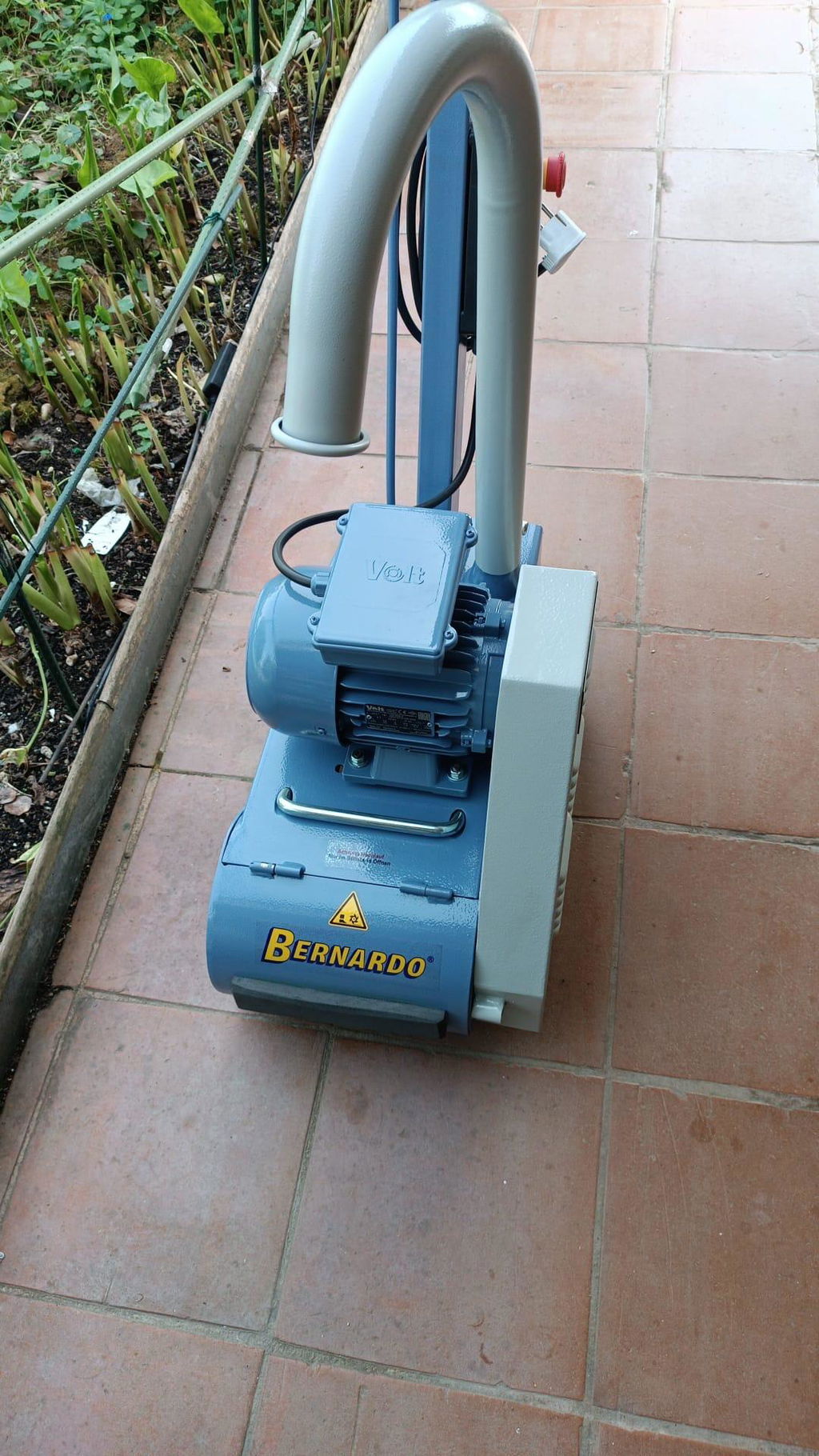
- Sander (belt or disc): To finish the curved runners after gluing, even out the edges, and give the final shape.
- Drill Press: To make perfectly perpendicular holes on the front bar and the necessary pilot holes in hard oak.
- Set of Clamps: You will need many (at least 6-8 for each runner) and they must be robust to exert the necessary pressure for bending.
Step-by-Step Construction Guide
Follow the visual instructions below. Each image illustrates a crucial assembly phase, from raw wood preparation to the finished product.
PHASE 1: Preparation and Bending of the Runners
The technical heart of the project is the two curved runners. We won't cut them from solid stock from a wide board (they would break along the grain!), but we will create them by gluing together thin, flexible layers that will be bent over a form.
STEP 1: Preparation of Lamellae and Jig
Cut the oak into 24 thin strips (4 mm thick). They must be thin enough to bend without breaking. In parallel, prepare your "jig" (the rigid mold) from 18mm MDF. Cut it following exactly the "J" shape with a 180mm radius as seen in the technical drawing. The curve of the jig must be perfectly smooth and square.

STEP 2: Laminated Gluing (The Bending Process)
This is the moment of truth. Prepare the first set of 12 lamellae. Spread an even layer of D4 polyurethane adhesive on every side that will be in contact with another (not on the outer faces of the stack). Stack the 12 lamellae one on top of the other. Starting from the curved tip, progressively tighten them against the MDF jig using clamps. Clamp very tightly to eliminate any gaps between the layers. Let it dry under pressure for at least 12-24 hours (follow your adhesive's instructions).

STEP 3: Finishing the Runners
Once the glue is completely dry, remove the clamps. You will have obtained a rough curved piece, incredibly solid and stable. Use a belt sander to clean glue squeeze-out from the edges and to perfectly square the runner to its final dimensions (section $30 \times 24 \text{ mm}$). Repeat the entire process (Step 2 and 3) to create the second runner, ensuring they are identical.

PHASE 2: Frame Assembly
Now that the most complex part is done, let's move on to the structural assembly of the sled.
STEP 4: Mounting the Support Crossmembers
Place the two finished runners parallel on a horizontal workbench. Take the two crossmembers (T) that will support the seat. Attention: It is essential to always pre-drill the oak with a bit slightly smaller than the screw before screwing, otherwise the hard wood will split. Fasten the crossmembers to the runners with $4 \times 50$ Torx screws, ensuring they are perfectly perpendicular and aligned.

STEP 5: Mounting the Seat
Take the three wide slats (S) prepared earlier. Place them on top of the newly mounted crossmembers. For a professional look, the spacing should be uniform: use 10 mm scrap spacers to insert between each slat as you position them. Pre-drill the slats and screw them securely to the crossmembers below.

PHASE 3: Final Details
STEP 6: Front Bar and Rope
The last structural piece is the front bar (F), which stiffens the tips of the runners and serves as a towing point. Drill a 10 mm through-hole exactly in the center of the bar (using a drill press ensures accuracy). Insert the bar between the tips of the runners; you can secure it with a little D4 glue and a screw inserted from inside the runner to hide it. Finally, pass the tow rope through the hole and secure it with a sturdy safety knot.

Final Result and Finish
Your modern sled is assembled! To protect the valuable oak wood from snow, ice, and moisture, it is essential to apply a protective finish. To maintain the natural, warm, and Scandinavian look of the wood, we recommend applying 2-3 coats of a high-quality hard oil (such as tung oil or specific outdoor blends) or a clear matte marine varnish.
Frequently Asked Questions About the Project (FAQ)
Why do I have to cut the wood into thin strips and then re-glue it? Can't I cut the curve from a solid board?
This is the most important question. Cutting such a sharp curve directly from a solid wood board would create a point of extreme weakness at the front (the curved tip). At that point, the wood fibers would be "cut across" (end grain) and the tip would break at the first impact. The technique of curved laminated wood, on the other hand, keeps the fibers long and continuous along the entire curve, just like in an arch, creating an incredibly flexible and resistant piece.
What type of glue should I use for this project?
It is essential to use a water-resistant glue, as the sled will be in contact with snow. The best choice is a D4 class polyurethane adhesive. In addition to perfectly resisting moisture, this glue has the characteristic of expanding slightly as it dries, filling any small imperfections between the lamellae and ensuring excellent structural integrity.
Is this sled just decorative or can it actually be used?
The sled is designed to be structurally sound. If made correctly with good oak and D4 glue, it can be safely used for light towing in the snow (e.g., to pull a small child). However, its carefully designed backless design and premium finish also make it ideal as a magnificent decorative item for a mountain home or for Christmas displays.
Where can I find the tools to cut the lamellae so thin?
Precision cutting of lamellae requires a well-set bandsaw and a thickness planer to uniform them. Woodworking machines like those offered in the Krollit catalog are ideal for demanding hobbyists and craftsmen who want to tackle projects of this level with the necessary precision and safety.
Have you completed this project? Share photos of your modern sled on our community page or tag us on social media! We're curious to see your work.