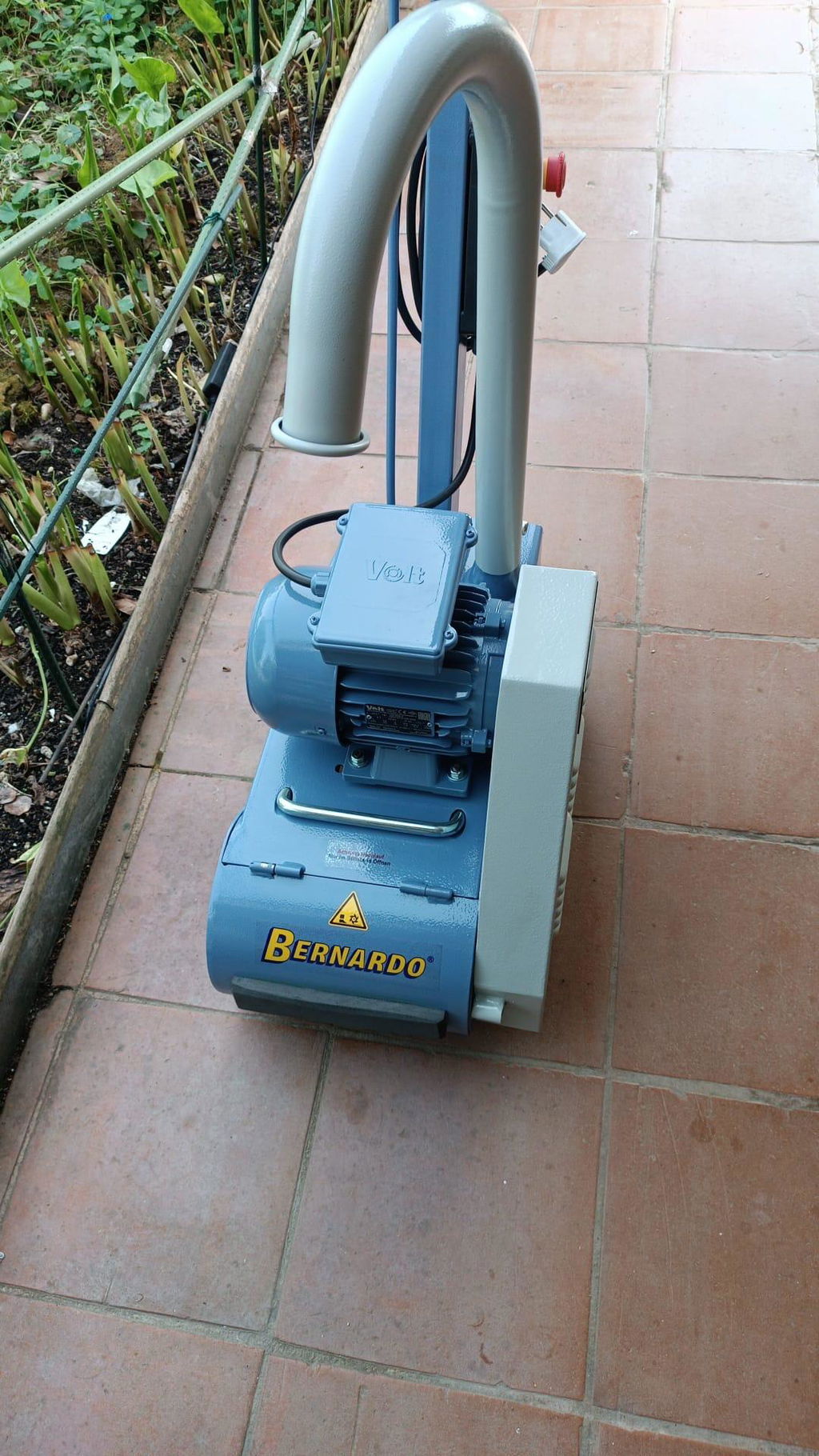


The best planer for your work depends on three factors: the type of processing (jointer, thicknesser, or both), the maximum width of the pieces, and the production volume. For hobbyists, a 200-260 mm jointer/thicknesser combination covers most needs. For professional woodworking shops, 310-410 mm models with a spiral cutterhead offer superior quality and less maintenance.
In this guide, we analyze each type, compare HSS blades and spiral cutterheads, and help you choose the right model. In the Krollit planer catalog, you will find 64 Bernardo and Güde models ranging from €59 to €11,370.
Jointer vs. Thicknesser: What's the Difference
Before choosing a planer, you need to understand the difference between the two fundamental operations. They are complementary and always performed in sequence.
Jointing: creating a reference surface
A jointer creates a perfectly flat face on rough lumber. The piece is manually slid over the tables, passing over the cutterhead with the blades. The operator controls pressure and speed.
It is used to eliminate irregularities in rough wood, create a flat reference face, straighten warped boards, and prepare the piece for subsequent thickness planing.
Thickness Planing: evening out
A thicknesser reduces the thickness of the piece uniformly and parallel to the already planed face. The wood is automatically fed by motorized rollers.
It is used to obtain precise and constant thicknesses, make the two faces parallel, and calibrate multiple pieces to the same thickness.
The correct order
In woodworking, the order is always: first jointing, then thicknessing. One face is jointed (it becomes the flat reference), then the opposite face is thickness planed (parallel to the reference). Finally, the operation is repeated on the edges to obtain a perfectly square piece.
The 5 Types of Planers
1. Jointer-thicknesser combination planer
The jointer-thicknesser planer combines both functions in one machine. The upper tables are used for jointing, the lower table (accessed by flipping the tables) for thickness planing. It is the most common solution for woodworking shops and workshops.
Advantages: a single machine for both operations, space-saving, lower cost compared to two separate machines.
Limitations: it takes time to switch between functions, and the two operations cannot be performed simultaneously.
Price range: €420 - €3,757. Available widths: 200, 250, 260, 305, 310, 410 mm.
2. Thicknesser (thickness planer only)
A machine dedicated solely to thickness planing. The workpiece is fed between the table and the cutterhead, pulled by rollers. Ideal as a second machine in well-equipped workshops or for calibrating large volumes.
Price range: €427 - €11,370. Widths: 310, 330, 410, 630 mm.
3. Jointer (jointer only)
Machine dedicated to jointing only. Two tables (infeed and outfeed) with the cutter head in the middle. For high-volume workshops requiring dedicated workstations.
Price range: €991 - €1,573. Widths: 150, 200 mm.
4. Handheld Electric Planer
Handheld tool for small jobs and touch-ups. It moves over the workpiece instead of vice-versa. Useful for on-site work, but does not replace a benchtop planer for precision work. Available from €59.
5. Hand Plane
For purists and fine work. Requires experience but offers total control. Ideal for touch-ups and finishes on pre-machined pieces. Sets available from €139.
Spiral Cutterhead vs HSS Blades: Which to Choose
This is the most important choice after the type. The spiral cutterhead (or helical) costs more but offers significant advantages.
Traditional HSS Blades
The cutterhead mounts 2, 3 or 4 long HSS (High Speed Steel) blades that cut the wood across its entire width simultaneously.
Pros: lower initial cost, blades can be resharpened with a dedicated sharpener, easily available spare parts, well-established technology.
Cons: noisier (simultaneous impact across the entire width), require precise adjustment after each blade change, damage (nail, hard knot) ruins the entire blade, less uniform finish on difficult woods.
Spiral (Helical) Cutterhead
The cutterhead mounts dozens of small carbide (HM/TCT) inserts arranged in a spiral. Each insert has 2-4 usable cutting edges. When one wears out, it is rotated. When all cutting edges are worn, only that insert is replaced.
Main advantages:
- 50% reduced noise - inserts cut in sequence, not simultaneously
- 20 times longer lifespan - carbide is much more resistant than HSS
- Better finish - less tear-out and chipping even on difficult woods
- Simple maintenance - only the damaged insert is rotated or replaced
- No adjustment - inserts are self-centering
Cons: higher initial cost (typically +€100-300), inserts cannot be resharpened, specific spare parts for each model.
Real price comparison
The price difference between the HSS and spiral versions of the same model is often contained:
- 200 mm model: HSS €420 → Spiral €573 (+€153)
- 305 mm model: HSS €893 → Spiral €1,000 (+€107)
- 260 mm top model: HSS €1,610 → Spiral €1,699 (+€89, currently on offer)
With these differentials, the investment in the spiral cutterhead quickly pays for itself in terms of quality, quietness, and maintenance savings. See all models with spiral cutterhead.
When to choose a spiral cutterhead
The investment is recommended if: you work in environments where noise is an issue, you frequently plane hard or exotic woods, you seek high-quality finishes without subsequent sanding, you want to reduce maintenance time, you work with medium to high volumes.
How to Choose Planing Width
The maximum width determines the pieces you can work with. This is an important choice because it cannot be "upgraded" later.
Width guide
150-200 mm: suitable for hobbyists, battens, frames, model making. Limitations become evident on wide boards. Compact and often portable machines.
250-260 mm: covers most needs of an artisanal carpentry workshop. Allows working standard boards and small carpentry. The most common compromise between capacity and footprint.
305-330 mm: for structured carpentry workshops. Allows planing wide boards, glued laminated panels, elements for large furniture.
410 mm: for very wide boards and regular production. Requires space and often three-phase power.
630 mm: industrial use, intensive production. Only one model in the catalog, with motorized table.
Practical rule
Choose a width that is 20-30% wider than the pieces you usually work with. If you plane 250 mm boards, choose at least 300-310 mm. This will give you room for occasionally wider pieces and greater stability during planing.
The 7 Essential Selection Criteria
1. Motor Power
Power determines the removal capacity and resistance to stalling on hardwoods:
- 1,200-1,600W: hobby use, softwoods (pine, fir, poplar)
- 1,600-2,200W: semi-professional, medium woods (beech, ash)
- 2,200-3,000W: professional, hardwoods (oak, walnut, cherry)
- Over 3,000W: industrial, intensive production
2. Number of knives
More knives mean more cuts per revolution of the cutterhead, resulting in a better finish:
- 2 knives: basic models, suitable for hobbyists
- 3 knives: professional standard
- 4 knives: high quality finish
- Spiral (18-72 inserts): excellent finish, the best available
3. Table Material
Die-cast aluminum: lighter and more economical. Suitable for portable machines and occasional use. Be careful of nails in the wood that can scratch the surface.
Cast iron: heavier and more robust. Reduces vibrations and ensures greater stability. Standard for professional machines. Perfectly ground surfaces that last over time.
4. Depth of Cut
Indicates how many mm of wood can be removed in a single pass:
- 2-3 mm: basic models, require more passes on rough wood
- 3-4 mm: semi-professional standard
- 4-5 mm: professional, fewer passes needed, more productivity
5. Table Length
Longer tables (1,000-1,600 mm) ensure more precise planing and allow long boards to be worked with greater stability. Professional models have extended tables, while compact ones sacrifice length for portability.
6. Dust Extraction System
Planing produces large amounts of chips. Check the diameter of the dust extraction port (commonly 100 mm) and plan to connect it to a dedicated extractor. Some models include an integrated extractor with a bag, useful for occasional use but insufficient for continuous work.
7. Electrical Supply
230V single-phase: standard domestic connection. Suitable for machines up to approximately 2,200W of power.
400V three-phase: requires industrial setup. Necessary for motors over 2,200W and for intensive use where constant torque is needed. Verify availability in your workshop before purchase.
Which Planer for Every Budget
Under €500 - For Beginners
For those new to planing or with occasional needs. Compact models, 230V power, aluminum tables. Typical width is 200-260 mm.
What to expect: functional machines for soft to medium woods, 2 HSS knives, 2-3 mm depth of cut. Suitable for hobbyists and small jobs.
Examples: entry-level jointer/planer combinations from €420, compact thickness planers from €427.
€500-1,000 - Advanced Hobbyists
More robust models, first spiral cutterheads available, widths up to 305 mm. Cast iron tables and integrated extractors begin to appear.
What to expect: superior build quality, ability to work with hardwoods, 2-3 knives or entry-level spiral cutterhead.
Examples: combinations with spiral cutterhead from €573, 305 mm HSS models from €893.
€1,000-2,000 - Semi-professional
The most interesting segment for those who work regularly. Cast iron tables, spiral cutterhead available on almost all models, widths 260-310 mm, some models with digital display.
What to expect: robust machines for daily use, quality finishes, reduced maintenance with a spiral cutterhead.
Best buy: 305 mm combination planer with spiral cutterhead around €1,000 - covers 90% of needs without requiring three-phase power.
€2,000-4,000 - Professional
Structured woodworking shops and carpenters. Widths 310-410 mm, spiral cutterhead with many inserts (52-72), digital display, heavy construction (150-300 kg), often three-phase power.
What to expect: high precision, productivity, excellent finishes even on difficult woods, long lifespan.
Over €10,000 - Industrial
For intensive production. 630 mm width, motorized table, industrial structure. Only one model in the catalog, intended for structured production facilities.
See all available planers sorted by price or features.
Safety and Maintenance
Protective Devices
Always wear the following when using planers:
- Safety glasses: chips and sawdust can hit your eyes
- Ear defenders: planers often exceed 90 dB (spiral models are quieter)
- FFP2 mask: fine wood dust is harmful if inhaled
- Push stick: essential for keeping hands away from blades on small pieces
Fundamental Rules
- Always check that the wood is free of nails, screws, and pebbles before planing
- Use a push stick for pieces with a cross-section smaller than 300x50 mm
- Never remove the cutterhead guards during operation
- Wait for complete stop before any intervention on the machine
- Always connect the dust extractor before starting
- Do not plane pieces shorter than the distance between the rollers (risk of tipping)
- Ensure the wood has less than 15% moisture content
Routine Maintenance
After each use: clean the tables of chips and resin (especially after resinous woods like pine and larch). Apply a thin layer of oil or wax to the tables to keep them smooth.
Periodically: check the sharpness of the blades (marks and burn marks on the wood indicate blades need replacing), check the tension of the drive belts, lubricate mechanisms according to the manual, check table alignment.
HSS blade change: use magnetic setters for precise adjustment. Ensure all blades protrude at the same height from the cutterhead. After changing, always make a test pass on a scrap piece.
Frequently Asked Questions
Is a combination planer or two separate machines better?
For most woodworking shops, the combination machine is the best choice: it costs less, takes up less space, and covers both needs. Two separate machines (jointer + planer) only make sense for high production volumes where simultaneous work on both operations is required, or for volumes that justify the investment and space of two dedicated stations.
What width to start with?
For a hobbyist, 250-260 mm is sufficient for most jobs. For an artisan woodworking shop, 305-310 mm offers the best versatility without necessarily requiring three-phase power. Below 200 mm, limitations become evident on many common projects.
Is a spiral cutterhead worth it?
Yes, if the price difference is less than 30% compared to the equivalent HSS model. The benefits in terms of noise reduction (-50%), durability (20x), and finish quality repay the investment in the medium term, especially for those who work regularly. On some models, the difference is less than €100.
How many passes are needed to plane a board?
It depends on the thickness to be removed and the depth of cut of the machine. With a 3 mm depth of cut and 10 mm to remove, at least 4 passes are needed. It is always better to make more light passes than a few aggressive passes, especially on hardwoods that tend to chip.
Can I plane wet wood?
No, the wood must have a moisture content below 15% (ideally 8-12%). Wet wood clogs the blades, leaves marks on the surface, and above all, deforms after planing as it dries, negating the calibration work. Use a moisture meter to check before planing.
Is 400V three-phase power needed?
For models up to 2,200W, 230V single-phase is sufficient. Beyond this power, or for intensive use with aggressive passes on hardwoods, three-phase guarantees more torque and stability. Check availability in your workshop before purchase: the installation of a three-phase system has significant costs.
Conclusion
The choice of planer depends on the type of work you do, the width of the pieces, and the production volume. For hobbyists, a 200-260 mm jointer/planer combination (€420-€700) covers most needs. For artisan woodworking shops, 305-310 mm models with a spiral cutterhead (€1,000-€2,500) offer the best value for money with professional finishes. For intensive production, 410-630 mm machines provide industrial capacity and performance.
The spiral cutterhead is currently the recommended choice for those who work regularly: the price difference is contained, and the benefits in terms of quality, quietness, and maintenance are significant.