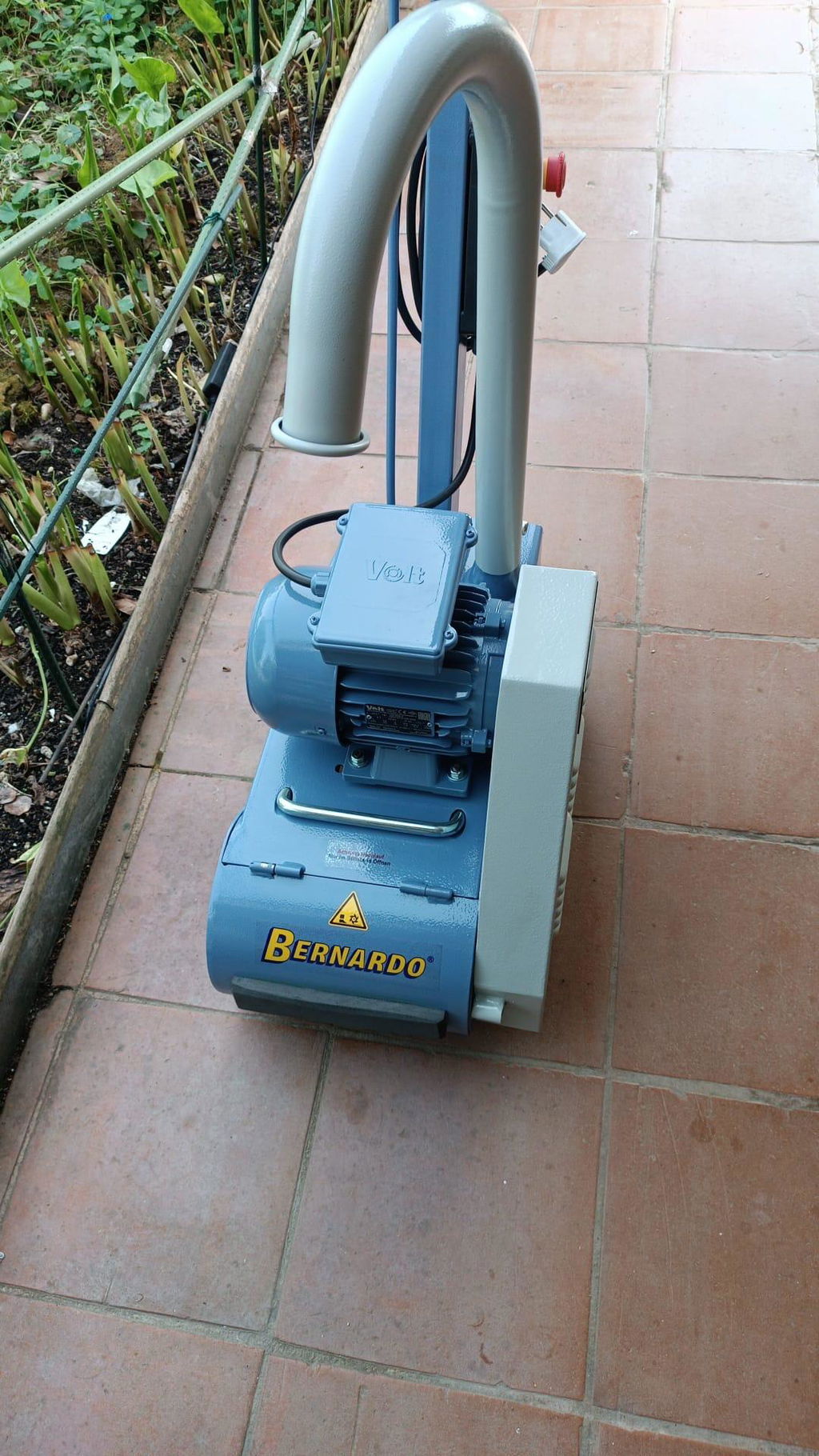


Note: Some of the products shown may be fitted with optional accessories. Subject to technical and aesthetic changes.
This promotion is not valid on discounted products or on bundled offers.
Bernardo MSA 1500 dust collector - capacity 1,500 m³/h, twin port Ø 100 mm, 1.5 kW 400V motor
Bernardo MSA 1500 dust collector - capacity 1,500 m³/h, twin port Ø 100 mm, 1.5 kW 400V motor is backordered and will ship as soon as it is back in stock.
Couldn't load pickup availability
Delivery and Shipping
Delivery and Shipping
At Krollit, we guarantee a safe and reliable shipping process. Orders are handled with the utmost care and traceability until delivery.
For international shipments, please send your request via the dedicated contact form.
Upon delivery, always sign the delivery note with the words “subject to inspection” to allow for proper handling of any irregularities or discrepancies in the product.
Our goal is to ensure you receive prompt service and a worry-free shopping experience.

Bernardo MSA 1500 dust collector - capacity 1,500 m³/h, twin port Ø...
Description
The Bernardo MSA 1500 dust extractor offers an airflow of 1,500 m³/h, a double Ø 100 mm connection for simultaneous hook-up of multiple machines, a 1.5 kW 400V three-phase motor, a statically and dynamically balanced steel fan, a filter bag plus 2 fine dust filters, a chip collection container, a trolley with handles for transport, and scratch-resistant powder coating. Dimensions 860×680×770 mm, weight 72 kg. Top of the range among MSA extractors for industrial workshops. Made in Austria, distributed in Italy by Krollit as an official Bernardo distributor since 2007.
- Airflow: 1,500 m³/h
- Suction connections: 2 × Ø 100 mm
- Motor: 1.5 kW – 400V three-phase
- Filtration: Filter bag + 2 fine dust filters
- Chip container: Removable, large capacity
- Transport: Integrated trolley with handles
- Weight: 72 kg
Who uses the MSA 1500 and for what
The Bernardo MSA 1500 is the top-of-the-range dust extractor in the MSA family, sized for industrial workshops with intensive extraction needs. The 1,500 m³/h airflow and double Ø 100 mm connection allow simultaneous hook-up to two professional machines (bench grinders, belt sanders, circular saws, large sanders), maintaining adequate extraction performance on both. The three-stage filtration (main filter bag + 2 fine dust filters) returns purified air to the environment, preventing the dispersion of fine dust typical of metalworking. The integrated trolley with handles facilitates repositioning in the workshop, a useful feature for flexible use of the extractor between different workstations. In Krollit customers' workshops, it is chosen by industrial mechanical workshops, professional blacksmiths with intensive use, high-volume grinding and sharpening, and laboratories requiring high-capacity extraction.
Its place in the Bernardo range
In the Bernardo MSA extractor range, the MSA 1500 is the top model for airflow and capacity. Below it: MSA 750 (airflow 1,100 m³/h, 0.75 kW motor, weight 36 kg) for workshops with intermediate needs; MSA 300 (airflow 870 m³/h, 0.75 kW 230V single-phase motor, weight 15.6 kg) for entry-level use or workshops without three-phase power. The practical difference between MSA 1500 vs MSA 750: 400 m³/h more airflow and double the motor power (1.5 kW vs 0.75 kW), with double the weight (72 vs 36 kg). For continuous intensive use, the MSA 1500 is correctly sized; for intermittent artisanal use, the MSA 750 is sufficient at a lower cost. The three filtration stages (bag + 2 fine filters) are an exclusive feature of the 1500 in the standalone range, making it suitable for machining hard metals or materials that produce fine dust (aluminum, cast iron, alloys with toxic components).
Krollit logistics and support
Bernardo shipping in 5-9 business days (7 days to the South). At 72 kg, it can be moved with the integrated trolley or by two people. Replacement filters (main bag and fine dust filters) and original Bernardo accessories are available from stock with 3-5 business days shipping. Customer support in Italian is available.
Who is the MSA 1500 for
| Profile | Compatibility | Reason |
|---|---|---|
| Passionate hobbyist | Suitable | Industrial extractor sized for professional use. For occasional hobby use, the MSA 300 (230V single-phase) is more practical and less expensive. |
| Industrial mechanical workshop | Recommended | Double Ø 100 mm connection allows simultaneous hook-up of two professional machines. 3-stage filtration handles fine dust from intensive machining. |
| Workshop with continuous use / production | Recommended | For daily intensive work cycles, the 1,500 m³/h airflow maintains effective extraction on two machines in simultaneous use. Integrated trolley facilitates repositioning. |
Not suitable for: workshops with only a 230V single-phase line (the MSA 300 is the correct choice); machines with suction connections other than Ø 100 mm (check adapters); exclusively punctual use on a single machine (the MSA 750 with 1,100 m³/h airflow is sufficient at a lower cost).
Technical specifications
Suction capacity
| Specification | Value |
|---|---|
| Airflow | 1,500 m³/h |
| Suction connections | 2 × Ø 100 mm |
Motor and power supply
| Specification | Value |
|---|---|
| Motor power | 1.5 kW |
| Power supply | 400V – 50Hz – three-phase |
Filtration
| Specification | Value |
|---|---|
| Main filter bag | Included |
| Fine dust filters | 2 included |
| Fan | Statically and dynamically balanced steel |
Dimensions and weight
| Specification | Value |
|---|---|
| Dimensions | 860 × 680 × 770 mm |
| Weight | 72 kg |
| Paint finish | Scratch and impact-resistant powder coating |
Transport
| Specification | Value |
|---|---|
| Trolley | Integrated with handles |
Compliance
| Specification | Value |
|---|---|
| Marking | CE |
Included equipment
Standard equipment
- Bernardo MSA 1500 extractor
- Main filter bag
- 2 fine dust filters
- Chip collection container
- Trolley with wheels
- Transport handles
Warranty
Warranty terms and support procedures are available on the dedicated Krollit page.
View Krollit warranty termsFAQ / Frequently asked questions
Frequently Asked Questions
Can I connect two machines simultaneously to the two connections?
Yes. The Ø 100 mm connections are sized for simultaneous hook-up of two machines, with a total airflow of 1,500 m³/h distributed between the two inlets.
Airflow distribution depends on the connecting hoses and the internal resistance of the connected machines. For two similar machines, the airflow is divided approximately equally (700-750 m³/h per machine). For different machines, the machine with lower resistance receives more airflow. For applications where maximum airflow is needed on a single machine, it is recommended to close the second connection with a dedicated cap.
How long do the fine dust filters last?
In standard industrial use, fine dust filters last 200-500 operating hours before requiring replacement. Frequency depends on the type of processing (hard metals consume filters more quickly than wood or plastic).
The sign that it's time to replace the filters is a noticeable reduction in suction capacity: the extractor continues to run but dust is not effectively captured. Original Bernardo replacement filters are available from stock with 3-5 business days shipping. For workshops with intensive use, it is advisable to keep a stock of filters.
What does 'statically and dynamically balanced fan' mean?
It means that the fan rotor is balanced so that it does not generate vibrations during rotation. This reduces noise, bearing wear, and vibration transmission to the structure.
Balancing is a quality manufacturing feature: low-end industrial fans are not balanced and produce vibrations that reduce operating life. On an extractor in continuous use, vibrations translate into increased maintenance, bearing replacement, and environmental noise. Bernardo's balancing offers smooth operation for many years without specific interventions.
Can I use it for woodworking as well as metalworking?
Yes, it is compatible with wood dust, MDF, plastic, as well as metal. The 3-stage filtration handles various types of particulate matter.
The MSA 1500 is designed as a general-purpose industrial extractor: it works on any solid waste material (dust, chips, shavings) that enters through the Ø 100 mm connections. For woodworking, the 1,500 m³/h airflow is sized for medium-to-large machines (combination machine, circular saw). For mixed metal-wood workshops, it is a versatile solution.
How much power does the 1.5 kW motor consume?
The 1.5 kW motor typically draws 1.5-1.7 kWh per hour during continuous operation. For daily use with 4-6 hour cycles, the average consumption is 6-10 kWh per day.
The consumption is manageable by standard industrial panels. Three-phase 400V is mandatory. For workshops with other machines running simultaneously, check the available power from the meter. For intermittent use with frequent on and off cycles, the 1.5 kW motor is sized for repeated cycles without thermal issues.
-
Product safety
-
Reviews
Product safety


Reviews
Optional accessories
-

-

Bernardo
Bernardo Aluminum Suction Hose Ø 80 mm 5 Meters
€54,10 (22% VAT incl.)Unit price /Unavailable -

Bernardo
Bernardo Flexible Aluminum Duct Ø100 mm Extendable 5 m
€56,06 (22% VAT incl.)Unit price /Unavailable -

Bernardo
€17,81 (22% VAT incl.)Unit price /Unavailable -

Bernardo
Accessory for Bernardo dust extraction system Internal reducer Ø100 → Ø80 mm in galvanized steel
€35,64 (22% VAT incl.)Unit price /Unavailable -

Bernardo
Accessory for Bernardo dust extraction system Metal Y-branch with flap Ø100
€79,50 (22% VAT incl.)Unit price /Unavailable -

Bernardo
Accessory for Bernardo dust extraction system Fine dust filter 2 pcs for MSA 1500 industrial
€76,75 (22% VAT incl.)Unit price /Unavailable -

Bernardo
Accessory for Bernardo Extraction System Pipe Clamp for DC 300 / DC 400 / DC 350 CF / DC 450 CF
€14,76 (22% VAT incl.)Unit price /Unavailable -

-

Bernardo
Bernardo dust collection filter bag for MSA 1500 extraction system
€54,10 (22% VAT incl.)Unit price /Unavailable