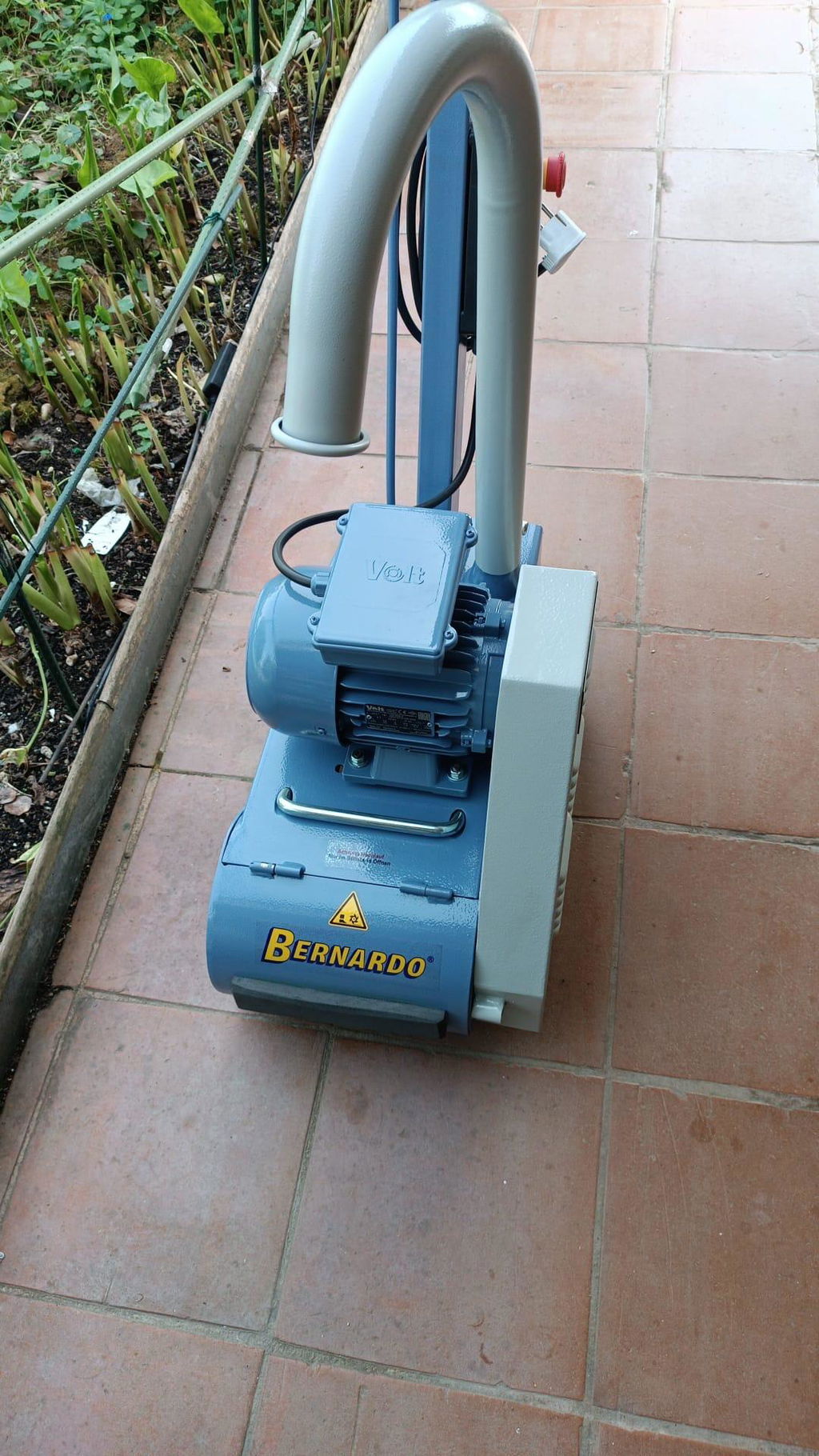


Bernardo HCP 60 Single Column Hydraulic Press – 60 tons, C-frame, 5.5 kW motor
Bernardo HCP 60 Single Column Hydraulic Press – 60 tons, C-frame, 5.5 kW motor is backordered and will ship as soon as it is back in stock.
Subscribe to our newsletter
Get the latest updates on all our new collections, sales, offers and product arrival dates.
-
Description
-
Product safety
-
Reviews
Description
The Bernardo HCP 60 single-column hydraulic press offers 60 tons of pressing force, a C-frame structure with front access, a ram with a 250 mm stroke, a 500×700 mm lower table with a Ø 100 mm through-hole, a 430×500 mm upper ram, a useful depth (throat) of 250 mm, a 5.5 kW motor, a 200-liter oil tank, an approach speed of 26 mm/sec and a working speed of 8.5 mm/sec, and a return speed of 47 mm/sec. Weight 4,000 kg. Suitable for stamping, deep drawing, punching, and industrial assembly. Manufactured in Austria, distributed in Italy by Krollit as an official Bernardo distributor since 2007.
- Pressing Force: 60 tons
- Structure: C-frame (front access)
- Lower Table: 500 × 700 mm with Ø 100 mm through-hole
- Useful Depth (throat): 250 mm
- Ram (stroke): 250 mm
- Motor: 5.5 kW – 400V three-phase
- Weight: approx. 4,000 kg
Who uses the HCP 60 and for what
The Bernardo HCP 60 is a single-column hydraulic press with a C-frame, sized for industrial workshops with stamping, deep drawing, punching, and assembly needs up to 60 tons. It is in the mid-range of the HCP family: more powerful than the HCP 30 (30 t) and faster in cycles than the HCP 100 and HCP 150 (working speed 8.5 mm/sec vs 5.5 and 3.5 mm/sec). This speed-force balance makes it suitable for series production of medium-sized components where cycle speed is important. The 500×700 mm table with a Ø 100 mm through-hole and the 250 mm throat offer front access for assembly and shrink-fitting. In Krollit's customers' workshops, it is chosen by mechanical workshops with series production of small to medium components, light to medium stamping, industrial spare parts manufacturers, and maintenance workshops.
Its place in the Bernardo range
In the Bernardo HCP range, the HCP 60 occupies the lower-mid range: below the HCP 30 (30 t, 3,400 kg), above the HCP 100 (100 t, 5,400 kg) and the HCP 150 (150 t, 7,700 kg, top of the range). The HCPs share a philosophy (C-frame, front access) but scale in capacity: larger molds require more powerful presses and consequently slower cycles (the working speed of 8.5 mm/sec of the HCP 60 is halved on the HCP 100 and triples in time on the HCP 150). For workshops with series production of small to medium parts that do not exceed 60 tons, the HCP 60 is the correctly sized choice. For heavy industrial applications on large components, move up to HCP 100/150 or switch to the DKS gantry range (DKS 200/300/400). The key difference between HCP vs DKS remains: HCP for quick front access on standard parts, DKS for long parts with a movable frame.
Krollit logistics and support
Bernardo shipping in 5-9 business days (7 days to the South). At 4,000 kg, it requires a pallet jack or forklift with adequate capacity for unloading. Dimensions 1,820 × 960 × 2,400 mm: check ceiling height. Original Bernardo spare parts such as pistons, seals, hydraulic pump, and accessories are available from stock with 3-5 business days shipping. Customer support available in Italian.
Who is the HCP 60 for
| Profile | Compatibility | Reason |
|---|---|---|
| Passionate hobbyist | Not recommended | Industrial machine with 4,000 kg weight and 60 tons. 400V three-phase line required. Exclusively professional application. |
| Mechanical workshop with series production | Recommended | 60 tons with rapid cycles (approach 26 mm/sec, working 8.5 mm/sec) for series production of small to medium components. Ø 100 mm through-hole allows punching and shrink-fitting. |
| Light to medium stamping / parts manufacturer | Recommended | Speed-force balance suitable for series production. The 250 mm throat and 500×700 mm table cover most standard light stamping parts. |
Not recommended for: applications requiring over 60 tons (consider HCP 100 or HCP 150); long parts requiring pressure at different points (DKS gantry range); workshops without a 400V three-phase line; automated series production with CNC positioning.
Pressing capacity
| Specification | Value |
|---|---|
| Max. pressing force | 60 tons |
| Ram stroke | 250 mm |
| Useful depth (throat) | 250 mm |
| Table - ram distance | 450 mm |
Table and ram
| Specification | Value |
|---|---|
| Lower table dimensions | 500 × 700 mm |
| Through-hole in the table | Ø 100 mm |
| Upper ram dimensions | 430 × 500 mm |
Speed
| Specification | Value |
|---|---|
| Approach speed | 26 mm/sec |
| Working speed | 8.5 mm/sec |
| Return speed | 47 mm/sec |
Hydraulic system
| Specification | Value |
|---|---|
| Motor power | 5.5 kW |
| Pump capacity | 40 l/min |
| Oil tank capacity | 200 liters |
| Power supply | 400V – 50Hz – three-phase |
Dimensions and weight
| Specification | Value |
|---|---|
| Machine dimensions (L × W × H) | 1,820 × 960 × 2,400 mm |
| Overall weight | approx. 4,000 kg |
Compliance
| Specification | Value |
|---|---|
| Marking | CE |
| Directive | Machinery 2006/42/CE |
Standard equipment
- Pre-assembled Bernardo HCP 60 press
- Hydraulic unit with 5.5 kW motor
- Lower table with through-hole
- Ground upper ram
- 200-liter tank with oil included
- Control panel with safety buttons
Frequently Asked Questions
Is the HCP 60 or HCP 100 better?
It depends on the maximum tonnage required. Up to 50-55 tons, the HCP 60 is correctly sized with faster cycles. For regular applications over 55 tons, the HCP 100 is the logical choice.
The HCP 60 has a working speed of 8.5 mm/sec vs 5.5 mm/sec for the HCP 100: in series production, this difference results in a 50% higher output rate. The HCP 100 has a larger table (600×1100 vs 500×700) and a Ø 120 mm through-hole (vs 100). For high-volume production of small to medium parts, the HCP 60 is preferable; for larger parts or higher forces, the HCP 100.
Is the HCP 60 suitable for deep drawing?
For light to medium deep drawing, yes (sheets up to 2-3 mm on standard shapes). For complex deep drawing or thicker materials, consider HCP 100/150.
The deep drawing capacity depends on sheet thickness, drawing depth, and mold geometry. The 250 mm ram stroke of the HCP 60 is less than the 300 mm of the HCP 100 and 150: for deep drawing, this difference can be limiting. For industrial deep drawing of standard parts, the HCP 60 is adequate; for special applications, verify the actual stroke required by the mold before making a choice.
Does it work with domestic three-phase sockets?
Typical domestic three-phase sockets (6 kW) can handle the HCP 60's 5.5 kW motor at its limit. For continuous use, a dedicated industrial meter is recommended.
The 5.5 kW motor can reach peak power at startup, potentially tripping the safety switch on undersized meters. For workshops with other machines running simultaneously, check available power. For intensive use, a dedicated commercial or industrial meter is recommended. Krollit does not provide on-site electrical service.
How much does it consume in standard production?
The 5.5 kW motor typically consumes 5-6 kWh per hour of actual operation at full load. In standard production with a 60-70% duty cycle, the average consumption is 3.5-4.5 kWh per hour.
Actual consumption depends on the fraction of time the motor is under load. For workshops with significant electricity costs, it is recommended to turn off the motor between spaced work cycles to reduce standby consumption. The HCP 60 is designed for intensive intermittent use: rapid cycles alternated with rest periods.
How much operating space is needed in the workshop?
The machine dimensions are 1,820 × 960 × 2,400 mm. For handling parts and front access, an operating area of at least 3.5 × 3 m with a minimum ceiling height of 2.8 m is required.
The 2,400 mm height allows installation in workshops with standard 3-meter ceilings without problems. The contained depth (960 mm) facilitates integration even in workshops with limited space. The 4,000 kg weight requires a standard industrial floor, not lightweight flooring. The working height of the lower table (~700-800 mm) is ergonomic for standing operators.