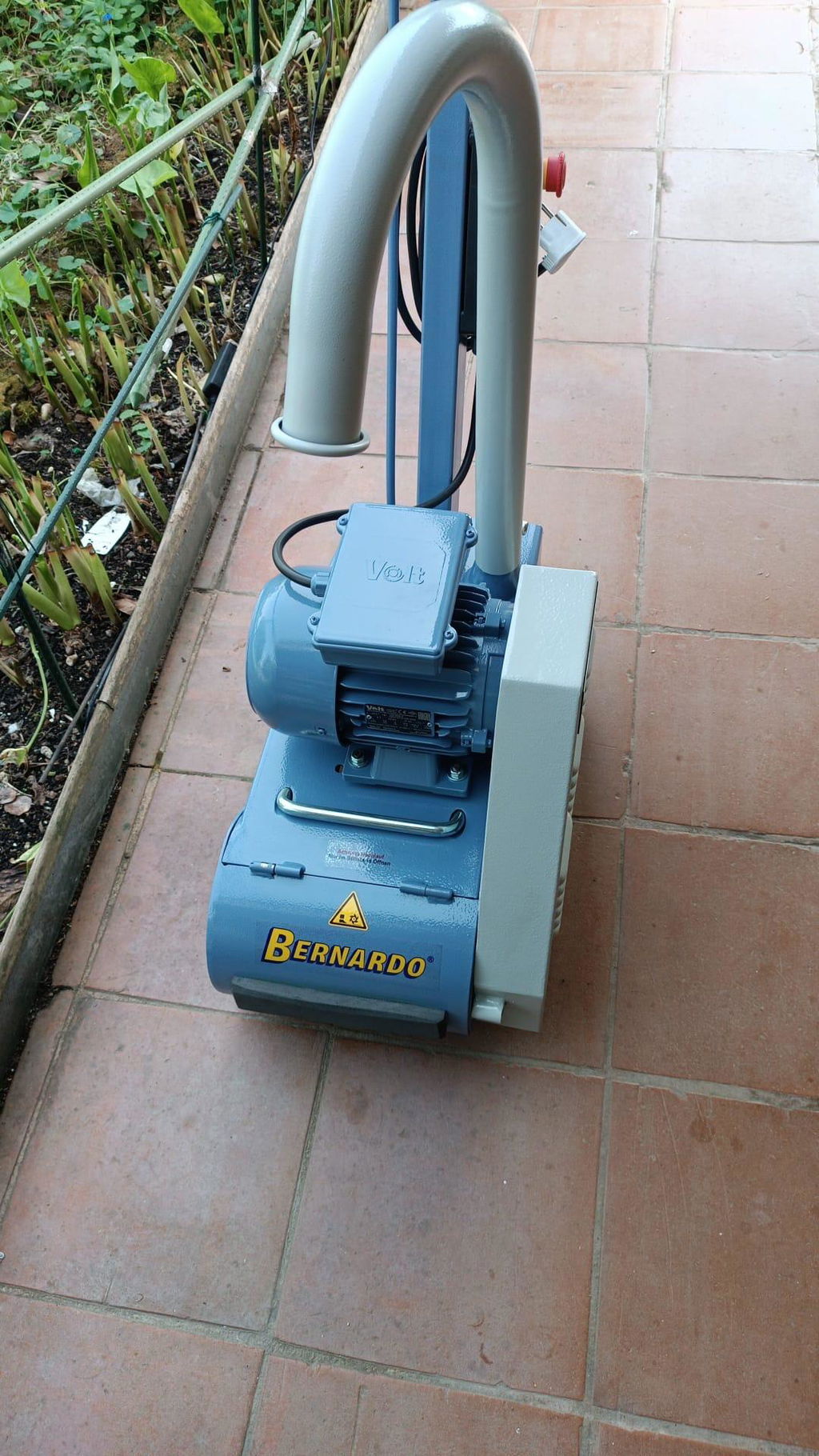


Woodworking machines are divided into 5 categories: cutting (circular saws from €800, band saws from €600), planing (jointer-planers from €1,200), shaping (routers from €2,500, lathes from €800), multi-function combination machines (from €1,105), and dust extraction (from €234). The choice depends on three factors: available budget (€2,000-€50,000+), workshop space (15-200 m²), and production volume. This guide analyzes each type with technical specifications and selection criteria.
The 5 Categories of Woodworking Machines
Before choosing, it's helpful to understand how machines are classified. Each category addresses a specific need in the wood processing workflow.
Classification by Function
Cutting machines are used for dimensioning, cross-cutting, and trimming rough timber or panels. They include table saws, band saws, and miter saws. They are the starting point of any woodworking: without cutting, there is no project.
Surface preparation machines prepare wood surfaces, making them flat, parallel, and smooth. Jointer-planers, wide belt sanders, and sanders fall into this category. Without properly prepared surfaces, joints won't fit, and finishes will be poor.
Shaping machines create forms, profiles, and cavities. Vertical routers, lathes, drilling machines, and mortisers allow for creating moldings, turned legs, precise holes, and traditional joints.
Combination machines integrate 4-6 functions into a single structure. They occupy 3-5 m² instead of the 15-20 m² required for equivalent individual machines. The solution for those with limited space.
Dust extraction systems are not processing machines, but they are mandatory. Wood dust is classified as carcinogenic: every machine must be connected to a dust extractor.
Summary Table
Category
Main Machines
Price Range
When Needed
| Cutting | Circular saw, band saw, miter saw | €600 - €8,000 | Always (first machine) |
| Surfaces | Jointer-planer, wide belt sander, sander | €500 - €15,000 | Solid wood |
| Shaping | Router, lathe, drilling machine, mortiser | €600 - €12,000 | Profiles, legs, joints |
| Combination | Multi-function 4-6 operations | €1,105 - €9,284 | Space <20 m² |
| Dust Extraction | Mobile, centralized, cyclone | €234 - €2,850 | Always (mandatory) |
Classification by Usage Level
Hobbyist machines have a light structure, single-phase 230V motors from 1-2 kW, and reduced working capacity. Prices: €500-€3,000. For those who work occasionally on personal projects.
Semi-professional machines offer a robust cast iron structure, 2-4 kW motors (230V or 400V), and greater precision. Prices: €2,000-€8,000. For artisans and small woodworking shops.
Industrial machines are designed for continuous use 8+ hours/day: three-phase 400V motors, heavy cast iron structures, advanced safety systems. Prices: €8,000-€50,000+. For mass production.
Cutting Machines
Cutting is the first operation in woodworking. The choice of machine depends on the type of cut you perform most frequently: straight or curved, panels or solid wood, occasional or repetitive.
Table Saws

The table saw is the most widely used machine in any workshop. It allows for rip cuts (resawing boards), cross-cuts (trimming to length), and angled cuts up to 45°.
Main components:
The worktable must be perfectly flat. Professional models use rectified cast iron (flatness ±0.1mm), while hobbyist models use die-cast aluminum or stamped steel. Side and rear extensions increase capacity for large panels.
The rip fence is used for rip cuts. It must slide smoothly, lock securely, and remain parallel to the blade. An imprecise fence produces crooked cuts and burning on the wood.
The sliding table (on advanced models) handles cross-cuts with superior safety and precision compared to a simple miter gauge.
Technical specifications to consider:
The blade diameter determines the maximum cutting height:
- Ø250mm blade → max cut 75mm
- Ø315mm blade → max cut 100mm
- Ø400mm blade → max cut 130mm
Motor power influences continuous cutting capacity:
- Hobbyist use: 1.5-2.2 kW (230V single-phase)
- Professional use: 3-5 kW (400V three-phase)
Price range: €800-€6,500
If you want to delve deeper into the selection criteria, read the guide dedicated to circular saws. For a comparison between specific models, consult the ranking of the best table saws 2026.
Wood Band Saws
The band saw is complementary to the circular saw. It excels at curved cuts, resawing thick boards, and sectioning logs. It does not replace it, but complements it.
Differences from the circular saw:
The band saw uses a continuous blade (0.5-0.8mm thick) that runs on two flywheels. It produces less waste compared to the 3-4mm kerf of a circular blade: with precious woods, every millimeter counts.
The cutting height capacity is much greater: a woodworking band saw cuts 200-400mm thick, allowing for "opening" thick boards into thin sheets (resawing).
Curved cuts are impossible with a circular saw but natural with a band saw. The radius of curvature depends on the blade width: 6mm blades for tight curves, 20-25mm blades for straight cuts.
Technical specifications:
- Ø350mm flywheels: hobbyist machines
- Ø500-600mm flywheels: semi-professional
- Ø700mm+ flywheels: industrial
Price range: €600-€5,500
Band saw blades require periodic maintenance. If you want to learn how to manage them independently, read the guide on how to sharpen and weld blades.
Miter Saws and Scroll Saws
Miter saws specialize in rapid, accurate cross-cutting to length. The tilting head descends onto the workpiece clamped against the fence: square, repeatable cuts in seconds. Widely used for battens, frames, baseboards.
Scroll saws have very thin, vertically tensioned blades. They allow for intricate cuts with curvature radii of a few millimeters: inlays, model making, artistic works.
Planing and Sanding Machines
After cutting, wood surfaces must be made flat and smooth. This phase is crucial: without parallel and square faces, furniture won't assemble correctly.
Jointer-Planers
The planer transforms rough boards with irregular surfaces into elements with perfectly flat and parallel faces. It's the machine that distinguishes hobbyist from professional work.
Difference between jointer and planer:
Jointing creates the first flat reference surface. The wood rests on an adjustable table and passes under the cutterhead. The operator controls pressure and feed manually. To learn more about the correct technique, read the guide on how to plane wood.
Planing makes the second face parallel to the first. The wood passes between a fixed bed and a cutterhead with automatic feed rollers. The final thickness is adjusted to a tenth of a millimeter.
Available widths:
- 260mm: hobbyists, small projects (€1,200-€2,800)
- 310mm: artisans, small woodworking shops (€2,800-€5,500)
- 410mm: professionals, medium production (€5,500-€9,000)
- 530mm+: industrial (€9,000-€15,000)
Traditional vs. helical cutterhead:
The traditional cutterhead uses 2-3 straight HSS steel knives. Economical but noisy (85-90 dB) and requires frequent sharpening.
The helical cutterhead uses 24-48 tungsten carbide (TCT) inserts arranged helically. Advantages: reduced noise by 8-10 dB, superior finish on difficult woods, 3x longer lifespan, replacement of individual inserts instead of the entire knife. Costs €500-€1,500 more. Planers with helical cutterheads are particularly suitable for those who work many hours a day.
For a detailed comparison of models, consult the ranking of the best planers 2026.
Wood Wide Belt Sanders
The wide belt sander is different from the planer: it uses abrasive belts instead of knives. It works on pre-glued panels, doors, and kitchen tops without the risk of tearing at the joints.
When to use it:
- Plywood or laminated panels already assembled
- Glued doors and frames
- Surfaces requiring fine finishing (120-180 grit)
Price range: €2,200-€8,500
Wood Sanders
Benchtop sanders complete surface preparation before varnishing. Main types: belt (for chamfers and flat surfaces), disc (for small pieces and rounding), combined belt+disc.
Price range: €350-€2,500
Shaping Machines
Shaping machines transform squared pieces into elements with shapes, profiles, and cavities. This is where the creativity of the woodworker is expressed.
Wood Routers (Spindle Moulders)
The vertical router (also called "spindle moulder") is the machine for profiling edges, creating grooves, and making joints and decorative moldings.
Types:
- Pure vertical router: vertical spindle, table with fence, guards. The most common.
- Combined router with planer: two machines in one, saving space. See combined routers.
Technical specifications:
- Spindle diameter: Ø30mm (standard) or Ø50mm (industrial)
- Useful spindle height: 100-180mm
- Power: 2-5 kW
- Speed: 3,000-10,000 rpm (variable)
Price range: €2,500-€8,000
Wood Lathes
The lathe creates cylindrical and shaped pieces by rotation: table and chair legs, columns, knobs, bowls, decorative objects. A machine that combines technique and art.
Specifications to consider:
- Distance between centers: 500mm (small objects) → 1500mm (long table legs)
- Center height: determines the maximum workable diameter
- Variable speed: essential (500-3000 rpm)
- Power: 0.5-2 kW
Price range: €800-€4,500
To choose the right model, consult the ranking of the best wood lathes.
Drilling and Mortising Machines
Drilling machines perform serial holes for doweling, hinges, hardware. Multi-spindle models speed up production.
Mortising machines create rectangular cavities (mortises) for traditional mortise and tenon joints, still the strongest joint in woodworking.
Price range: €600-€3,500
Combination Machines and Panel Saws
Multi-function Combination Machines

The combination machine integrates 4-6 functions into a single machine: circular saw, jointer, thickness planer, vertical router, drilling machine (and sometimes mortiser). It occupies 3-5 m² instead of the 15-20 m² required for separate equivalent machines.
Typical configurations:
- 4 functions: saw + jointer + planer + router
- 5 functions: + drilling machine
- 6 functions: + mortiser
Pros:
- Space saving (3-5 m² vs 15-20 m²)
- 30-40% lower cost compared to equivalent single machines
- Single investment, single maintenance
Cons:
- Function change time: 5-15 minutes for reconfiguration
- No simultaneous operations
- Compromises on maximum capacities
Krollit price range: €1,105 (CWM 150 entry-level) → €9,284 (CF 410 F-2600 professional)
For a detailed comparison of all available models, with technical specifications and use cases, read the ranking of the best combination machines 2026.
Panel Saws
The panel saw is an advanced circular saw with a precision sliding carriage and scoring unit. Designed for cutting panels (chipboard, MDF, plywood) with perfectly square cuts and no chipping on the visible side.
Difference from basic circular saw:
- Sliding carriage on rectified guides (stroke 1500-3200mm)
- Adjustable scoring blade that pre-cuts the panel, preventing chipping
- Cutting precision ±0.1mm over the entire stroke
When needed: mass furniture production, panel cutting, woodworking shops that primarily work with melamine and laminated panels.
Price range: €3,500-€18,000
Dust Extraction Systems
Extraction is not an option: it's a necessity for health, safety, and work quality. Wood dust is classified as carcinogenic by IARC (Group 1).
Why Extraction is Mandatory
Health: Prolonged exposure to wood dust causes nasal adenocarcinoma and chronic respiratory problems. The occupational exposure limit is 2 mg/m³ (in Italy), achievable only with effective extraction.
Machine operation: Accumulating sawdust compromises guides, sensors, and mechanisms. Extraction keeps everything efficient.
Work quality: Chips in the cutting area cause imperfections. Source extraction ensures clean surfaces.
Types of Extractors
Single mobile extractors (€234-€650): Mobile units to connect to one machine at a time. 50-200 liter chip bag + dust filter. For hobbyists and small workshops with 1-2 machines.
Double bag extractors (€480-€850): Higher flow rate (2500-3900 m³/h), possibility to connect 2-3 machines with a Y-adapter. For artisans.
Extractors with fine dust filter CF (€775-€850): Filter cartridge that captures particles up to 1-2 microns (the most dangerous for the lungs). For those who work many hours a day.
Industrial extractors (€2,850+): Flow rate 7000+ m³/h, Class M certification, for centralized systems with 4+ machines.
Sizing
Each machine requires a minimum extraction flow rate:
Machine
Minimum Flow Rate
Recommended Extractor
| Circular saw | 800-1000 m³/h | DC 200 E (€289) |
| Planer up to 260mm | 1000-1500 m³/h | DC 300 (€481) |
| Planer 310mm+ | 1500-2000 m³/h | DC 500 E (€645) |
| Entry-level combination machine | 1500-2000 m³/h | DC 400 (€500) |
| Professional combination machine | 2500-3500 m³/h | DC 500 E (€645) |
| 4+ machines | 5000+ m³/h | FT 502 SF (€2,850) |
For a complete comparison of all models with technical specifications and updated prices, consult the 2026 dust collector guide. If you are interested in systems with separators, also see cyclone extractors.
Buyer's Guide by User Profile
The choice of machines depends on your profile. Here are three typical scenarios with budgets, priorities, and recommended machines.
Hobbyist and DIYer
Situation: You work in your free time, personal projects, garage or basement as a workshop (15-25 m²).
Indicative budget: €2,000-€8,000
Priorities: Versatility, small footprint, ease of use, 230V power supply.
Recommended machines:
- 5-function combination machine (€1,105-€3,500) OR compact circular saw (€800-€1,800) + 260mm planer (€1,200-€2,000)
- Mobile extractor (€234-€500)
- Over time: small band saw, sander, drill press
Artisan and Small Woodworking Shop
Situation: You produce for clients, professional quality required, work regularly (40-80 m²).
Indicative budget: €10,000-€30,000
Priorities: Precision, reliability, production efficiency, 400V possibility.
Recommended machines:
- Panel saw with sliding carriage (€4,000-€10,000)
- Jointer-planer 310-410mm, preferably spiral cutterhead (€3,500-€7,000)
- Vertical router with Ø30mm spindle (€3,000-€5,000)
- Band saw for curved cuts (€1,500-€3,500)
- Powerful extractor or centralized system (€650-€2,000)
Industrial Woodworking Shop
Situation: Serial production, specialized processing, continuous use 8+ hours/day (100+ m²).
Indicative budget: €50,000+
Priorities: Productivity, automation, durability, 400V three-phase power supply.
Recommended machines:
- Vertical or horizontal panel saw
- Wide belt sander
- Automatic edge bander
- Router with automatic feeder
- CNC machining center (optional)
- Centralized extraction system sized for all machines
Summary Table
Profile
Budget
Space
First Machine
Extraction
| Hobbyist | €2,000-€8,000 | 15-25 m² | 5-function combination machine | Mobile €234-€500 |
| Artisan | €10,000-€30,000 | 40-80 m² | Panel saw + planer | Double bag €500-€850 |
| Industrial | €50,000+ | 100+ m² | Panel saw + wide belt sander | Centralized €2,850+ |
Recommended Purchase Order for Those Starting from Scratch
- Month 1: Combination machine OR circular saw (nothing can be done without cutting)
- Month 1: Extractor (mandatory from day one)
- Month 3-6: Separate planer (when work volume increases)
- Month 6-12: Band saw (for curved cuts and resawing)
- Year 2: Vertical router (for profiles and joinery)
Frequently Asked Questions
What is the first machine to buy for a woodworking shop?
A table saw (€800-€2,000) is generally the first machine because it allows for the fundamental cuts for any project. Alternatively, a multi-function combination machine (€1,105-€3,500) offers more versatility for those with limited space under 20 m².
How much does it cost to equip a hobby woodworking shop?
The minimum budget is €2,000-€4,000 for a basic setup: 5-function combination machine (€1,105-€2,500) + extractor (€234-€400) + hand tools and accessories (€500-€1,000). For a complete hobby workshop, €6,000-€8,000 is needed.
Is a combination jointer-planer better or two separate machines?
For hobbyists and small productions (<20 boards/day), the jointer-planer combination is more practical and convenient. For professional productions with significant volumes, two separate machines avoid the 5-10 minutes of setup for each change and allow for simultaneous operations.
What power should a table saw have?
For hobby use with softwoods and thicknesses up to 50mm: 1.5-2.2 kW (230V). For professional use with hardwoods (oak, ash) and thicknesses up to 100mm: 3-4 kW (preferably 400V). Power affects continuous cutting capacity without overheating.
What is a spiral cutterhead in planers and is it worth it?
A spiral cutterhead uses 24-48 helical carbide inserts instead of the traditional 2-3 straight knives. Advantages: 8-10 dB reduced noise, superior finish on difficult woods (with knots, tear-out), 3x longer life, replacement of individual inserts (€5-€8 each) instead of the entire knife. It costs €500-€1,500 more: it's worth it for those who work many hours.
Is dust extraction really necessary for woodworking machines?
Yes, it is legally mandatory in workplaces and strongly recommended even for hobbyists. Wood dust is classified as carcinogenic (IARC Group 1). In addition to health: extraction keeps machines efficient, improves work quality, and keeps the workshop clean. Minimum budget: €234 for an entry-level extractor.
Build Your Workshop
Choosing the right machinery is an investment that pays off over time with productivity, precision, and satisfaction. Whether you are a beginner hobbyist or a professional upgrading your equipment, build quality and after-sales support make all the difference.
Krollit distributes leading brands in Italy such as Bernardo, Laguna, Güde, and FLOTT, offering technical assistance, original spare parts, and personalized advice.